
1. Introduction
Some futurist interpretations identify the final seven years of Daniel’s Seventy Weeks prophecy as a future tribulation period, during which the Antichrist makes a Covenant with Israel and stops sacrifices midway through it. This lesson argues that the covenant-confirming figure is Jesus the Messiah and that the seventieth week concerns His ministry, His sacrificial death, and the subsequent ministry of His apostles.
We therefore distinguish Daniel’s seventieth week from the Great Tribulation. In our related lessons, we propose a secondary application of Daniel’s 2,300 days to the Great Tribulation. Here, we examine why assigning Daniel 9:27 to the Antichrist attributes to him the covenant-confirming work that this lesson understands to belong to Christ.
2. The Seventy-Weeks Prophecy
The passage used to support the teaching of a future seven-year peace treaty is Daniel 9:24–27. Daniel speaks of confirming a Covenant with many for one week, but does not explicitly describe a peace treaty or name the Antichrist. To identify the Covenant and the one who confirms it, we must examine the prophecy as a whole.
“Seventy weeks are determined
Daniel 9:24-27
For your people and for your holy city,
To finish the transgression,
To make an end of sins,
To make reconciliation for iniquity,
To bring in everlasting righteousness,
To seal up vision and prophecy,
And to anoint the Most Holy.
“Know therefore and understand,
That from the going forth of the command
To restore and build Jerusalem
Until Messiah the Prince,
There shall be seven weeks and sixty-two weeks;
The street shall be built again, and the wall,
Even in troublesome times.
“And after the sixty-two weeks
Messiah shall be cut off, but not for Himself;
And the people of the prince who is to come
Shall destroy the city and the sanctuary.
The end of it shall be with a flood,
And until the end of the war, desolation is determined.
Then he shall confirm a covenant with many for one week.
But in the middle of the week
He shall bring an end to sacrifice and offering.
And on the wing of abominations shall be one who makes desolate,
Even until the consummation, which is determined,
Is poured out on the desolate.”
Now let us go through this logically and chronologically.
3. One Week for Seven Years
Seventy weeks are determined
Daniel 9:24
For your people and for your holy city,
A. One Day for Each Year
In this interpretation, Daniel’s seventy weeks are understood as seventy seven-year periods. Scripture parallels this in Leviticus 25:8, where seven sabbaths of years amount to forty-nine years.
‘And you shall count seven sabbaths of years for yourself, seven times seven years; and the time of the seven sabbaths of years shall be to you forty-nine years.
Leviticus 25:8
Ezekiel 4:6 also illustrates the prophetic use of a day to represent a year.
And when you have completed them, lie again on your right side; then you shall bear the iniquity of the house of Judah forty days. I have laid on you a day for each year.
Ezekiel 4:6
Accordingly, Daniel’s seventy weeks amount to 490 years.
B. Sixty-Nine Weeks Until the Start of Jesus’ Ministry
The next verse says that there are seven weeks plus sixty-two weeks.
Until Messiah the Prince,
Daniel 9:25
There shall be seven weeks and sixty-two weeks;
Seven weeks amount to forty-nine years, and sixty-two weeks amount to 434 years. Together, these total 483 years until Messiah the Prince, which this lesson identifies with the beginning of Jesus’ public ministry.
Taking 458 BCE as the starting year, this lesson identifies Artaxerxes’ commission to Ezra as the decree associated with the restoration of Jerusalem. The commission authorised the return of Jewish exiles, provided resources for Temple worship, and empowered Ezra to appoint magistrates and judges who would administer God’s law.
Ezra 7:9 records that Ezra began his journey in the first month and arrived in Jerusalem in the fifth month. These details do not establish an exact autumn date for the decree.
And Ezra came to Jerusalem in the fifth month, which was in the seventh year of the king. On the first day of the first month he began his journey from Babylon, and on the first day of the fifth month he came to Jerusalem, according to the good hand of his God upon him.
Ezra 7:8-9
Ezra arrived in Jerusalem in the fifth month, shortly before the beginning of the civil Hebrew year on 1 Tishri, which fell on 12 September 458 BCE. The text does not provide the precise date on which Artaxerxes issued his commission.
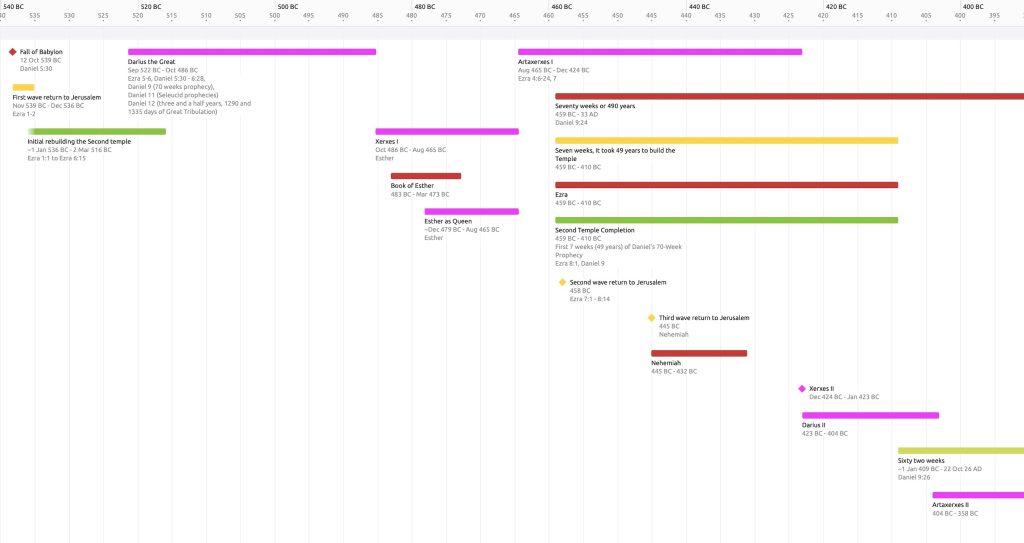
Counting forty-nine years from 458 BCE brings us to 409 BCE. Under this interpretation, the first seven weeks concern Jerusalem’s restoration, not the construction of the Temple, which was already complete. A specific event marking the end of these forty-nine years requires further historical support.
Counting the full 483 years from 458 BCE brings us to 26 CE, allowing for the absence of a year zero. This provides the proposed year for the beginning of Jesus’ ministry; it does not independently establish the month or day.
We are now at the sixty-ninth week in 26 CE, as shown in this spreadsheet.
Before we consider the seventieth week, we need to establish Jesus’ birth date.
4. Jesus’ Birth Year
A. Approximately 30 Years Old
Luke says Jesus was about thirty years old when He began His ministry.
Now Jesus Himself began His ministry at about thirty years of age,
Luke 3:23
The Greek word translated “about” is ὡσεί (hōsei), which here indicates approximation. Luke therefore gives Jesus’ approximate age without identifying His birthday or the exact date His ministry began.
Within the chronology proposed in this lesson, a birth in the autumn of 4 BCE would place Jesus at approximately twenty-nine when His ministry began in the autumn of 26 CE. This is consistent with Luke’s description of Him as “about thirty.”
B. Herod the Great’s Demise
Herod’s death provides a boundary for dating Jesus’ birth, since Matthew places Jesus’ birth, the visit of the wise men, and the flight into Egypt before Herod died.
Josephus records a lunar eclipse before Herod’s death (Antiquities 17.6.4). NASA’s eclipse catalogue records a total lunar eclipse on 10 January 1 BCE. This lesson adopts the reasonable proposal that this was the eclipse Josephus described, placing Herod’s death after that eclipse and before the following Passover (19 March 1 BCE).
Herod determined from the wise men when the star had appeared and used this information to order the killing of boys two years old and under (Matthew 2:7, 16). If the star’s appearance coincided with Jesus’ birth, Herod could have estimated His age. The decree therefore provides a reasonable basis for suggesting that Jesus may have been approaching two years old, although it does not establish His exact age.
Then Herod, when he saw that the wise men deceived him, was exceedingly angry; and he sent forth and put to death all the male children who were in Bethlehem and in all its districts, from two years old and under, according to the time which he had determined from the wise men.
Matthew 2:16
For the chronology developed in this lesson, I propose that Jesus was born in the autumn of 4 BCE. This would place Him at approximately twenty-nine when His ministry began in the autumn of 26 CE, consistent with Luke’s description of Him as “about thirty.” The proposed birth date fits this chronology, but Herod’s decree alone does not establish it.
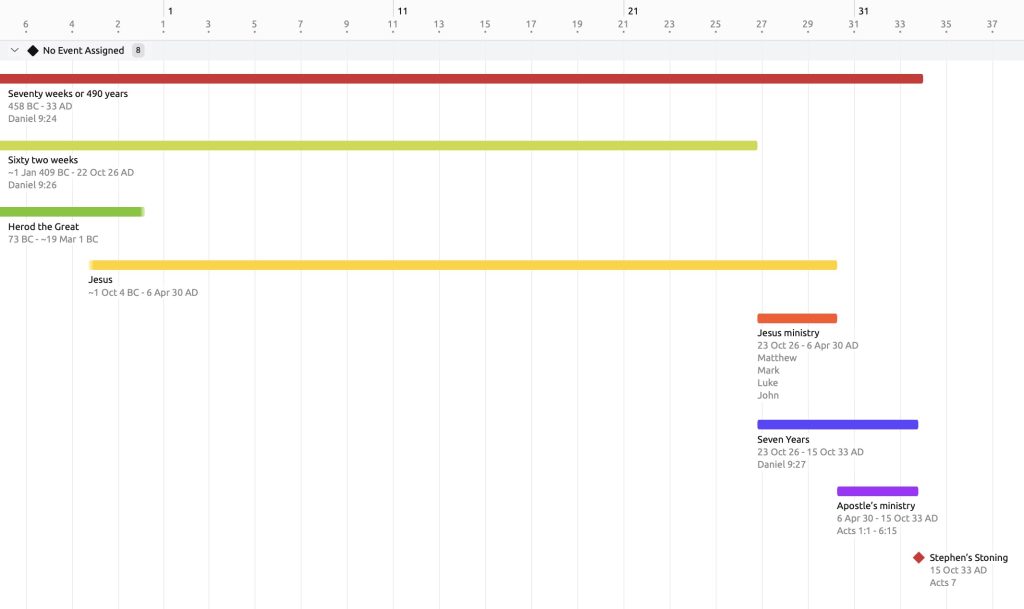
Here’s the spreadsheet showing the years and major events from 458 BCE to 33 CE, covering 490 years. There’s also another spreadsheet for the last seven years.
5. Jesus’ Death
A. Cut Off
Daniel places the Messiah’s death after the sixty-two weeks that follow the initial seven weeks—that is, after the sixty-ninth week.
“And after the sixty-two weeks
Daniel 9:26
Messiah shall be cut off, but not for Himself;
The prophecy says “after,” rather than “during,” these weeks. Jesus’ death within the seventieth week is therefore consistent with this sequence. His death in the middle of that week follows from the interpretation of verse 27 developed below.
Here, “cut off” refers to His death. The NKJV wording, “but not for Himself,” accords with Jesus’ sacrificial work on behalf of others. He laid down His life for our sins and, through His death and resurrection, opened the way for us to become sons and daughters of God.
B. Middle of the Week
This lesson understands the Messiah’s death as occurring in the middle of the seventieth week.
Then he shall confirm a covenant with many for one week;
Daniel 9:27 NKJV
But in the middle of the week
He shall bring an end to sacrifice and offering.
Jesus’ death fulfilled the sacrifices the Old Covenant pointed to. Although animal sacrifices continued in the Temple, His was the definitive, once-for-all offering for sin (Hebrews 10:10–18). Through His blood, Jesus established the New Covenant, confirming the Covenant of Daniel 9:27. On this understanding, the covenant-confirming work of Daniel 9:27 belongs to Jesus the Messiah.
6. Destroying Jerusalem
A. Judgment upon Earthly Jerusalem
Jesus warned that Jerusalem and its Temple would be destroyed within that generation. Revelation later describes earthly Jerusalem spiritually as Sodom and Egypt:
And their dead bodies will lie in the street of the great city which spiritually is called Sodom and Egypt, where also our Lord was crucified.
Revelation 11:8 NKJV
As God had previously used Nebuchadnezzar to judge Jerusalem, He now used the Roman armies to bring the judgment Jesus foretold.
B. People of the Prince
Daniel first identifies the coming Messiah as “Messiah the Prince”:
Until Messiah the Prince, there shall be seven weeks and sixty-two weeks;
Daniel 9:25 NKJV
Daniel then foretells the destruction of Jerusalem and the sanctuary:
“And after the sixty-two weeks
Daniel 9:26 NKJV
Messiah shall be cut off, but not for Himself;
And the people of the prince who is to come
Shall destroy the city and the sanctuary.
The end of it shall be with a flood,
And till the end of the war desolations are determined.
Many interpreters identify “the people of the Prince” as the Romans because Roman forces physically destroyed Jerusalem and the Temple. This lesson proposes an additional dimension: since Jesus is the Prince and He came from the Jewish people, the phrase also points to the Jewish population’s responsibility for the city’s destruction.
Jesus described Jerusalem’s approaching desolation in terms of surrounding armies:
“But when you see Jerusalem surrounded by armies, then know that its desolation is near.
Luke 21:20 NKJV
The Romans completed the physical destruction, but Jerusalem had already been devastated from within. Rival Jewish factions fought one another, killed their opponents, burned food supplies, and weakened the city during the siege. Jewish defenders also burned some Temple porticoes to hinder the Roman advance.
Josephus states that the fire which consumed the sanctuary itself began when a Roman soldier threw a burning object into one of its chambers. Roman troops then continued the destruction despite Titus’ reported attempts to stop it (Jewish War 6.4.5–7). After the Temple fell, the Romans attacked the Upper City and completed Jerusalem’s destruction.
Daniel’s prophecy was therefore fulfilled through both the Jewish factions and the Roman army. The Jewish factions helped destroy Jerusalem from within, while the Romans burned the sanctuary and completed the city’s physical destruction.
7. The New Jerusalem
Another purpose of the Messiah’s death and resurrection was the restoration of Jerusalem:
To restore and build Jerusalem
Daniel 9:25 NKJV
The prophecy begins with the restoration following the Babylonian exile, but its fulfilment does not end with the natural Jerusalem. The wider context concerns the Messiah, reconciliation for iniquity, everlasting righteousness, the New Covenant, and the ending of sacrifice. Jesus’ death and resurrection accomplished these realities and point to a greater Jerusalem.
A. The Jerusalem Above
Daniel describes Jerusalem as having a wall and a street:
The street shall be built again, and the wall,
Daniel 9:25 NKJV
Even in troublesome times
Revelation uses the same features when describing the holy Jerusalem. John sees a great and high wall surrounding the city and later describes its street:
In the middle of its street, and on either side of the river, was the tree of life, which bore twelve fruits, each tree yielding its fruit every month. The leaves of the tree were for the healing of the nations.
Revelation 22:2 NKJV
Within this interpretation, Daniel’s restored Jerusalem ultimately points beyond the natural city to the New Jerusalem created through the New Covenant.
B. Jerusalem in Bondage
Paul distinguishes natural Jerusalem from the Jerusalem above:
For these are the two covenants: the one from Mount Sinai, which gives birth to bondage, which is Hagar. For this Hagar is Mount Sinai in Arabia, and corresponds to Jerusalem, which now is, and is in bondage with her children. But the Jerusalem above is free, which is the mother of us all.
Galatians 4:24-26 NKJV
Paul wrote Galatians before Jerusalem’s destruction in 70 CE. Therefore, its bondage was not caused by the Roman destruction but by the Old Covenant represented by Mount Sinai.
C. The Bride of Christ
The Jerusalem above is associated with the New Covenant and God’s redeemed people. Revelation identifies her as the Bride of Christ:
“Come, I will show you the bride, the Lamb’s wife.” And he carried me away in the Spirit to a great and high mountain, and showed me the great city, the holy Jerusalem, descending out of heaven from God, having the glory of God. Her light was like a most precious stone, like a jasper stone, clear as crystal. Also, she had a great and high wall with twelve gates, and twelve angels at the gates, and names written on them, which are the names of the twelve tribes of the children of Israel: three gates on the east, three gates on the north, three gates on the south, and three gates on the west.
Revelation 21:9-12 NKJV
Daniel foretold the restoration of Jerusalem, the coming and death of Messiah the Prince, reconciliation for iniquity, everlasting righteousness, and the confirming of the Covenant. Paul and John reveal the result: the Jerusalem above, the Bride of Christ, established through Jesus’ death and resurrection.
Daniel, Paul and John therefore connect the restored Jerusalem, its wall and street, the change of covenants, and the redeemed people of God.
8. Seal up the Vision And Anoint the Most Holy
Daniel states that two purposes of the seventy weeks were to seal up vision and prophecy and to anoint the Most Holy:
To seal up vision and prophecy, and to anoint the Most Holy
Daniel 9:24 NKJV
A. Seal Up the Vision
At some point during the seven-year period, Jesus will seal the scroll. In our lesson on the seven seals, we learned that Jesus opens the scrolls as He stands at Stephen’s martyrdom in 33 CE. Therefore, sealing the vision and prophecy must have happened before this. If He is sealing the prophecy, He is closing it. Which prophecy is He closing? Daniel’s prophecy and His own about the next forty-year and one-hundred-year generation that He made just before His death in April of 30 CE.
To “seal up” vision and prophecy can mean to confirm it, bring it to completion, and establish its fulfilment. The events surrounding Jesus’ ministry, death, resurrection and the establishment of the New Covenant confirmed the prophetic purpose revealed to Daniel.
B. The Sealed Scroll
But one of the elders said to me, “Do not weep. Behold, the Lion of the tribe of Judah, the Root of David, has prevailed to open the scroll and to loose its seven seals.”
Revelation 5:5 NKJV
In our lesson on the seven seals, we propose that the sealed scroll of Revelation is connected with the judgments foretold by Daniel and Jesus. Following Jesus’ death, resurrection and ascension to the throne, He alone was worthy to receive and open the scroll.
This lesson links the opening of the seals to Stephen’s martyrdom in 33 CE. Stephen saw Jesus standing at the right hand of God, and the persecution that followed his death scattered the believers beyond Jerusalem.
This connection is an interpretation drawn from Daniel, Revelation, and Acts; Revelation does not explicitly identify Stephen’s death as the moment the first seal was opened, but it does say Jesus is standing at that time, whereas before and after this event, He is seated.
C. Anoint the Most Holy
Daniel also states that one purpose of the seventy weeks was:
To anoint the Most Holy
Daniel 9:24 NKJV
The Hebrew expression translated “the Most Holy” is qōḏeš qodāšîm, literally “holy of holies” or “most holy.” It is commonly used of sacred places and objects associated with the presence of God.
Under the New Covenant, God no longer dwells in a Temple made with hands, but within His people through the Holy Spirit. Paul writes:
Do you not know that you are the temple of God and that the Spirit of God dwells in you?
1 Corinthians 3:16 NKJV
The Holy Spirit was poured out at Pentecost, anointing the first believers and forming them into God’s New Covenant dwelling place. Everyone who enters into covenant with Jesus receives the Holy Spirit and becomes a Temple of God.
Daniel’s prophecy therefore reaches its fulfilment not merely in an earthly sanctuary, but in the anointed people within whom God now dwells.
9. Seven Years of Confirming the Covenant
Daniel now describes the final week of the seventy-week prophecy:
Then he shall confirm a covenant with many for one week;
Daniel 9:27 NKJV
But in the middle of the week
He shall bring an end to sacrifice and offering.
The seventieth week therefore consists of two periods of approximately three and a half years. The first encompasses Jesus’ public ministry, culminating in His death in the middle of the week. The second covers the apostles’ continuing ministry to Israel.
A. Jesus’ 3½-year ministry
John records three Passovers during Jesus’ ministry (John 2:13; 6:4; 11:55), showing that His ministry spanned several years. Daniel 9:27 provides the chronological framework for this lesson: Jesus’ death occurs “in the middle of the week,” placing the beginning of His ministry about three and a half years earlier.
First Passover:
Now the Passover of the Jews was at hand, and Jesus went up to Jerusalem.
John 2:13 NKJV
Second Passover:
Now the Passover, a feast of the Jews, was near.
John 6:4
The Passover at which Jesus was crucified:
And the Passover of the Jews was near, and many went from the country up to Jerusalem before the Passover, to purify themselves.
John 11:55
These Passovers confirm that Jesus’ ministry extended over several years. In the chronology proposed in this lesson, Daniel 9:27 provides the framework for identifying this period as the first three and a half years of the final week, culminating in Jesus’ death and the establishment of the New Covenant.
B. The Second 3½ years
Daniel divides the final seven-year period around the event that occurs in the middle of the week:
Then he shall confirm a covenant with many for one week;
Daniel 9:27 NKJV
But in the middle of the week
He shall bring an end to sacrifice and offering.
In this interpretation, Jesus’ death marks the middle of the week. Revelation 12 describes another three-and-a-half-year period associated with Israel and the events surrounding Jesus’ coming, ascension, and the subsequent persecution of His followers.
John first identifies the historical setting by describing the dragon waiting to destroy the Child:
His tail drew a third of the stars of heaven and threw them to the earth. And the dragon stood before the woman who was ready to give birth, to devour her Child as soon as it was born.
Revelation 12:4 NKJV
This corresponds to the attempt to destroy Jesus following His birth. Revelation then moves forward to His exaltation to the throne:
She bore a male Child who was to rule all nations with a rod of iron. And her Child was caught up to God and His throne.
Revelation 12:5 NKJV
The vision therefore spans events from Jesus’ birth through His ascension. The next chronological element is especially important to our interpretation: God sustains the woman for 1,260 days.
C. The Woman is Israel
In our lesson on Revelation 12, we learned that the woman represents the Jewish people of Israel.
After Jesus’ ascension, the woman (Israel) was sustained for three and a half years.
Then the woman fled into the wilderness, where she had a place prepared by God, that they should feed her there one thousand two hundred and sixty days.
Revelation 12:6 NKJV
This is reiterated a few verses later:
But the woman was given two wings of a great eagle, that she might fly into the wilderness to her place, where she is nourished for a time and times and half a time, from the presence of the serpent.
Revelation 12:14 NKJV
This seven-year period of confirming the Covenant appears in both Daniel and Revelation as two periods of three and a half years (1260 days), separated by a Covenant.
D. Apostles Feed the Jews
We find that during those three and a half years, it was the apostles who fed the Jews, until the death of Stephen in 33 CE.
And they continued steadfastly in the apostles’ doctrine and fellowship, in the breaking of bread, and in prayers. Then fear came upon every soul, and many wonders and signs were done through the apostles.
Acts 2:42-43 NKJV
E. Royal Priesthood Anointing
We have seen that the apostles fed the Jews by established doctrine during those three and a half years, but we also see them moving in the power of the Lord with signs and wonders.
Then fear came upon every soul, and many wonders and signs were done through the apostles.
Acts 2:43 NKJV
In our lesson on Revelation 11 and the two witnesses, we learned that the two witnesses represented the two anointings the Apostles carried. The kingly and priestly anointings taught the early church to be a royal priesthood.
And I will give power to my two witnesses, and they will prophesy one thousand two hundred and sixty days, clothed in sackcloth.”
Revelation 11:3 NKJV
The apostles taught the early church while “clothed in sackcloth,” carrying the cross of Jesus Christ in their ministry, not ashamed of their testimony.
And with great power, the apostles gave witness to the resurrection of the Lord Jesus. And great grace was upon them all.
Acts 4:33 NKJV
They were mainly limited to Jerusalem for those three and a half years so they could “nourish the woman. With the death of Stephen, many Christians fled Jerusalem and spread through the known world.
10. Dating the Seven Years of Peace
Previously, we have established that the Seventy Weeks Prophecy concluded sometime in 33 CE, three and a half years after Jesus’ death. We can work out more accurate dates for the beginning and end of these Seven Years of peace.
A. Jesus Death
We now have a confirmed date for Jesus’ death, which occurred when He was about 33 years old in 30 CE. He was born in 4 BCE. We know this because Herod died shortly after the full lunar eclipse on January 10, 1 BCE, and before that year’s Passover on March 20, 1 BCE. Herod attempted to kill Jesus when He was older than two, indicating that Jesus’ birth was before 3 April BCE.
Then he shall confirm a covenant with many for one week;
Daniel 9:27 NKJV
But in the middle of the week
He shall bring an end to sacrifice and offering.
Jesus died on the Passover of 30 CE, which fell on Nisan 15. This was the day that the Old Covenant ended, and the new Covenant began. Therefore, it falls in the middle of the seven years referred to in Daniel’s seventy-week prophecy.
B. Hebrew Calendar
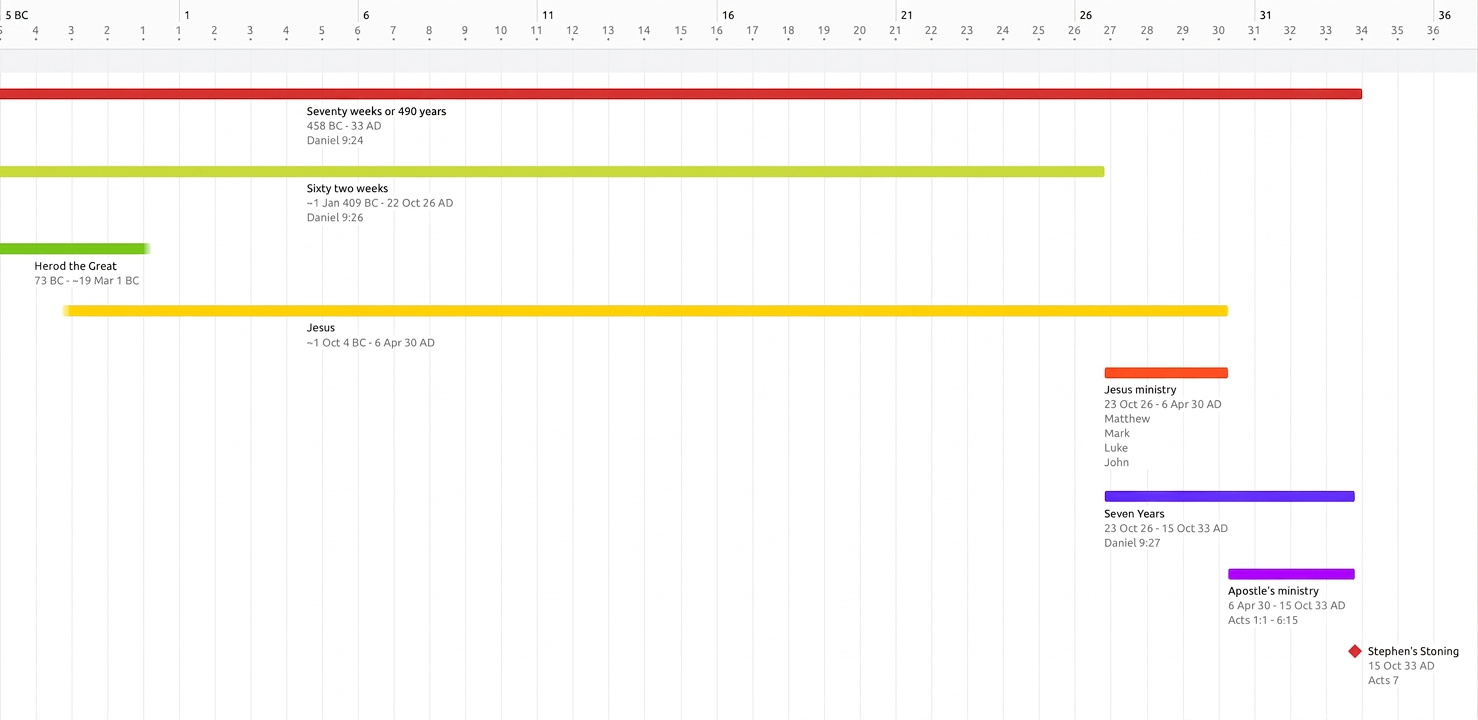
In our lesson on Calendar Insights into Biblical Prophecy, we examined the Hebrew Calendar. Using the Hebrew Calendar calculator, we know Jesus’ death occurred on Thursday, 6 April 30 CE. From there, using the same calculator, it is easy to determine the day Jesus began His ministry and the day Stephen died. We can do this by counting 1260 days backwards to the start of His ministry. Then, counting 1260 days forward to the end of the seven years of peace and Stephen’s martyrdom.
C. Start of Ministry
The start of Jesus’ ministry was on
- Hebrew Calendar 22 Cheshvan, 26 CE, or
- With the Julian Calendar, 23 October, 26 CE
- Our Gregorian calendar, 21 October, 26 CE.
Here is the spreadsheet for the calculation.
11. Stephen’s Death
Stephen’s death is important for several reasons:
- It is the first martyrdom after Christ.
- It marks the beginning of the seven seals.
- His death signals the conclusion of the 1260-day period described in Revelation 12.
- This is how Paul’s salvation comes about.
- It signals the beginning of the persecution of Christians referred to in Revelation 12:16
But the earth helped the woman, and the earth opened its mouth and swallowed up the flood which the dragon had spewed out of his mouth. And the dragon was enraged with the woman, and he went to make war with the rest of her offspring, who keep the commandments of God and have the testimony of Jesus Christ.
Revelation 12:16-17 NKJV
Once the devil could not attack the Jews anymore, he then turned his attention to the Christians. This resulted in the death of Stephen and others.
A. When Did Stephen die?
Here is the calculation of Stephen’s death and the conclusion of the seven-year and seventy-week prophecies.
- Hebrew Calendar: 2 Cheshvan, 33 CE, or
- With the Julian Calendar, 15 October, 33 CE
- Our Gregorian calendar, 13 October, 33 CE.
If you look into Stephen’s death, you’ll find most sources say he died at the end of December. However, this is just a tradition of sainthood, with no proof. The tradition started four hundred years after his death (!), when the Catholic Church wanted to set a date to celebrate him as a saint.
B. Jesus’ Death or His Ascension
A fair question is whether we should begin calculating the second half of the seven years from Jesus’ death or from His ascension forty days later. Some could argue that Revelation says that it is after He ascends to the throne, which occurred forty days after His death.
The reason I use Jesus’ death over His ascension is:
- It breaks the seven-year period.
- Daniel’s seventy-week prophecy centres on the change in Covenant, not on the ascension referred to earlier in the Book of Daniel.
If, however, someone wants to use His ascension date, then it would be:
- Hebrew Calendar: 13 Kislev, 33 CE
- Julian Calendar: 24 November 33 CE
- Proleptic Gregorian Calendar: 22 November 33 CE.
C. Persecution Starts
Stephen was the first martyr, and the church spread throughout Judea and Samaria.
Now Saul was consenting to his death.
Acts 8:1 NKJV
At that time a great persecution arose against the church which was at Jerusalem; and they were all scattered throughout the regions of Judea and Samaria, except the apostles.
12. Summary of the Seventy Weeks
- Jesus is the Messiah, and the Prince mentioned in Daniel 9:24-27.
- Claiming that the Antichrist will make a peace treaty with Israel is essentially branding Jesus as the Antichrist!
- Jesus fulfilled all the requirements and established a New Covenant for the forgiveness of sins and the arrival of everlasting righteousness through His death.
- The seventy-week prophecy is 490 years.
- The seventy-week prophecy of Daniel started in 458 BCE, just before 1 Tishri.
- The seven weeks, or 49 years, mark the end of the Temple’s construction in 409 BCE.
- The sixty-two weeks bring us to 26 CE
- Herod died between 10 January 1 BCE and 20 March 1 BCE
- Because Jesus was more than 2 years old before Herod died, Jesus must have been born before 19 March 3 BCE.
- Jesus was born in the autumn of 4 BCE.
- Jesus was about 30 years old when He started His ministry
- Jesus died on 15 Nisan (Thursday, 6 April 30 CE on the Julian Calendar).
- 1260 days before that date brings us to the start of His ministry
- Jesus started His ministry on 22 Cheshvan (October 23, 30 CE on the Julian Calendar).
- Stephen died on 2 Cheshvan (15 October, 33 CE, according to the Julian Calendar).
- The seventy weeks finished on 2 Cheshvan (15 October, 33 CE, according to the Julian Calendar).
© Use by Permission Awakening Impact Ministries / Dr Neville Westerbeek van Eerten D.Miss, 2027