

1. Introduction
This lesson proposes that the Great Tribulation lasted for 2,300 days, from 27 December 66 CE to 14 April 73 CE. It examines a secondary application of Daniel’s 2,300 evenings and mornings to the first-century judgement of Jerusalem and Judea, following their initial application to the events surrounding Antiochus IV and the cleansing of the Temple. This period is distinct from the final seven years of Daniel’s seventy-week prophecy, which some futurist interpretations place in the future.
In our Introduction to the Great Tribulation, we answered these questions:
- When was the Great Tribulation?
- Why will it never happen in our lifetime?
- What was the Abomination of Desolation?
- Had the gospel been preached to all nations before the Great Tribulation?
- Why does Revelation equate Jerusalem to Sodom and Egypt?
- Who was Josephus, and is he a credible historian?
A. Seven Seals
We then examined the Seven Seals of Revelation and their relationship to the Great Tribulation of 66 CE to 73 CE. We answered these questions:
- What are the Seven Seals?
- How do the seals connect to the Great Tribulation?
- Was a quarter of the population killed, as Revelation states?
B. 144,000
In our third lesson, we studied the 144,000 and determined that they were Jews of the first century before and during the Great Tribulation.
C. Calendars
We examined the calendars used during this period to interpret historical dates and develop the proposed chronology.
D. Seventy-Weeks Prophecy
Our lessons on Daniel’s Seventy-Weeks Prophecy presented the chronological case for identifying the beginning of Jesus’ ministry and the completion of the seventy weeks. By comparing the relevant calendars and scriptural evidence, we proposed dates for the inauguration of the New Covenant and Stephen’s martyrdom, alongside a date of 4 BCE for Jesus’ birth.
E. Euphrates Army
In our lesson on the Euphrates Army, we examined Revelation 9 and 16 within the first-century setting of the Jewish War. We interpreted the immense number of horsemen symbolically and proposed a correspondence between the four angels and the four Roman legionary forces involved in Jerusalem’s destruction. We also examined the historical connections between the Tenth and Twelfth Legions and the Euphrates, along with the reinforcements drawn from its guards.
2. Refreshing the Calendar of the 2300 Day Great Tribulation
Our Calendar Insights lesson explained the calendars relevant to dating the Great Tribulation: the Roman Julian calendar, the Hebrew calendar, and the Macedonian and Tyrian systems encountered in historical sources. Comparing these requires care, since similar month names don’t always correspond to the same dates.
A. Hebrew Calendar
The Hebrew calendar is lunisolar, combining lunar months with adjustments that keep the festivals within their seasons. In the fixed nineteen-year cycle, leap years fall in years 3, 6, 8, 11, 14, 17 and 19. Ordinary years contain twelve months and 353–355 days; leap years contain thirteen months and 383–385 days.
The table below provides the calendar framework used in this lesson. Hebrew dates calculated for the first century using the later fixed calendar serve as a working reconstruction; they do not independently establish when each month or festival was observed then.
| Year CE | Hebrew Year (AM) | Year # in 19-year cycle | Year Type | Number of Days | Number of months |
| 65-66 | 3826 | 7th | Common | 354 | 12 |
| 66-67 | 3827 | 8th | Leap | 385 | 13 |
| 67-68 | 3828 | 9th | Common | 353 | 12 |
| 68-69 | 3829 | 10th | Common | 355 | 12 |
| 69-70 | 3830 | 11th | Lunar | 384 | 13 |
| 70-71 | 3831 | 12th | Common | 355 | 12 |
| 71-72 | 3832 | 13th | Common | 353 | 12 |
| 72-73 | 3833 | 14th | Lunar | 384 | 13 |
B. Reading the Chronological Tables
The chronological tables in this lesson place Josephus’ accounts alongside their proposed calendar equivalents. Each entry identifies the source, the date recorded where available, the corresponding Julian and Hebrew dates, and the historical event.
Josephus frequently uses Macedonian month names. Their relationship to Julian and Hebrew dates depends on the calendar used in each passage; a Macedonian date should not automatically be treated as the same day of a Julian month.
We distinguish dates explicitly recorded by a historical source from calendar conversions and proposed reconstructions. Where the year or conversion remains uncertain, we present the date as a proposal for examination.
3. The Great Two-Thousand-Three-Hundred-Day Tribulation
Our study of Daniel’s seventy weeks placed their completion within Jesus’ ministry and the subsequent apostolic witness. We now turn to the separate period of 2,300 days and its proposed application to the Great Tribulation.
In our discussion on the Seleucids, the Northern Kingdom of Daniel, we learned that the period from the death of Onias III in 170 CE to the sanctuary’s cleansing lasted 2300 days. This is the correct exegetical interpretation of the 2300 evenings and mornings in Daniel 8:14. However, I believe this shares striking similarities, prophetically, with the Great Tribulation in Matthew and Revelation.
A. Daniel’s 2300 Days
Daniel prophesied a six-year and four-month period during which the earthly Temple would be cleansed. The Temple is now within us, not a physical building but the church and the individuals who make it up.
“For two thousand three hundred days; then the sanctuary shall be cleansed.”
Daniel 8:14
In Calendar Insights, we proposed that this period began with the death of Onias III and ended with the cleansing and rededication of the Temple under Judas Maccabeus. This provides a historical foundation for further application.
Jesus subsequently warned His disciples about the “abomination of desolation” spoken of by Daniel. His warning places a fulfilment of Daniel’s desolation prophecy beyond the events of the Maccabean period and within the experience of His hearers.
On this basis, this lesson proposes a secondary application of the 2,300 days to the Great Tribulation, extending from 27 December 66 CE to 14 April 73 CE. Jesus does not explicitly repeat the figure of 2,300 days; its application here rests on the connection proposed between Daniel’s vision, Jesus’ warning and the historical chronology.
B. Jesus’ Prophetic Warning
Jesus connected Daniel’s prophecy of the abomination of desolation with an urgent warning to flee Judea. This provides the basis for examining Daniel’s desolation imagery in relation to the first-century Great Tribulation.
“Therefore when you see the ‘abomination of desolation,’ spoken of by Daniel the prophet, standing in the holy place” (whoever reads, let him understand), “then let those who are in Judea flee to the mountains. Let him who is on the housetop not go down to take anything out of his house. And let him who is in the field not go back to get his clothes. But woe to those who are pregnant and to those who are nursing babies in those days! And pray that your flight may not be in winter or on the Sabbath. For then there will be great tribulation, such as has not been since the beginning of the world until this time, no, nor ever shall be.
Matthew 24:15-21
Luke’s parallel account identifies the approaching danger: Jerusalem would be surrounded by armies, signalling that its desolation was near (Luke 21:20–21). Read together, these passages support identifying the Roman armies with the abomination bringing desolation.
Within this interpretation, Cestius Gallus’s advance against Jerusalem in 66 CE supplied the warning, and his subsequent withdrawal provided an opportunity to escape. The withdrawal is the historical circumstance that made flight possible; Jesus’ explicit instruction was to flee when the warning appeared.
We therefore distinguish the warning and opportunity for escape from the calculated beginning of the days. This lesson proposes that the Great Tribulation began on 27 December 66 CE, after Cestius’s withdrawal and before Vespasian’s campaign in 67 CE.
Cestius Gallus’ advance warned of Jerusalem’s approaching desolation. His withdrawal opened an opportunity to flee before the proposed beginning of the Great Tribulation on 27 December 66 CE.
4. Prelude to the Great Tribulation
A. Sign of Jesus’ Coming
The most frequently cited reference about the coming of the Son of Man is in Matthew:
Then the sign of the Son of Man will appear in heaven, and then all the tribes of the earth will mourn, and they will see the Son of Man coming on the clouds of heaven with power and great glory.
Matthew 24:30
Jesus placed these events within the lifetime of the generation He addressed (Matthew 24:34). In the interpretation developed throughout these lessons, this passage describes His coming in judgement upon Jerusalem, distinct from His final, future return.
Matthew speaks both of the sign of the Son of Man in heaven and of people seeing Him coming on the clouds with power and great glory. Our lesson on Jesus’ comings examines how such language can describe manifestations of His authority and judgement.
Josephus records extraordinary signs preceding Jerusalem’s destruction. We will examine these accounts alongside Jesus’ prophecy, distinguishing what Josephus reports from our interpretation of their significance. We will consider separately whether particular signs occurred in 66 or 67 CE.
B. Chronology of Events and Signs
In the following tables, blue highlighting indicates the closest and most probable date. If it is in red, then it has been explicitly dated in the cited source. This table is partly based on Barbara Levick’s (D.Phil.) work, “Vespasian,” which many regard as the definitive account of Vespasian’s life. I have added the signs associated with the years.
| Josephus’ Reference | Date Recorded | Roman Calendar | Hebrew Calendar | Historic Event |
|---|---|---|---|---|
| 62-63CE | ||||
| 6.300-303 | Feast of Tabernacles c. 62 CE | 7-13 October | 15-21 Tishri | Jesus, son of Ananus, began proclaiming Jerusalem’s destruction. |
| 6.303-309 | Proposed interval, 62-63 CE | October 62 CE to April 63 CE | Cheshvan 62 CE – Nisan 63 CE | When brought before Albinus, “Woe, woe to Jerusalem” continued for seven years and five months, until he was killed during the siege in 70 CE. |
| 66 CE | ||||
| 6.289 | Comet | 22 January to 28 April | 18 Shevat to 25 Nisan | Halley’s Comet |
| 6.289 | Full year | A sword-shaped star over Jerusalem for a year | ||
| 6.424 | 3 -5 pm, 29 March | Passover 14 Nisan, Meal 15 Nisan | Passover: Josephus records 256,500 sacrifices, with at least ten participants per sacrifice, and reports a total of 2,700,200 ritually pure participants, excluding foreign worshippers | |
| 21 April to 15 May | Cestius arrives in Corinth after a 3-6 week transit | |||
| 2.284 | Artemisius | 15 May – 18 June | 3 Sivan – 1 Tammuz | Unrest in Caesarea starts |
| 2.315 | 16 Artemesius | 16 May | 4 Sivan | Unrest in Jerusalem |
| 18-19 May | 6-7 Sivan | Pentecost | ||
| 6.298 | 21 Artemesius | 21 May | 9 Sivan | Heavenly armies reported, identified here as the sign of the Son of Man. |
C. Seven Years and Five Months of Warning
Jesus, son of Ananus, began proclaiming Jerusalem’s destruction at Tabernacles, approximately 62 CE. After mistreatment by leading citizens, he was brought before Albinus, repeatedly crying, “Woe, woe to Jerusalem!“
Josephus records seven years and five months of lament, ending when a Roman siege stone killed him in 70 CE. He distinguishes the initial proclamation from the interrogation but gives neither the interval between them nor an explicit starting point for the count.
Jesus, the son of Ananus, … who, four years before the war began, and at a time when the city was in very great peace and prosperity, came to that feast whereon it is our custom for everyone to make tabernacles to God in the temple, began on a sudden to cry aloud, “A voice from the east, a voice from the west, a voice from the four winds, a voice against Jerusalem and the holy house, a voice against the bridegrooms and the brides, and a voice against this whole people!” This was his cry, as he went about by day and by night, in all the lanes of the city.
… brought him to the Roman procurator; where he was whipped till his bones were laid bare
…at every stroke of the whip his answer was, “Woe, woe to Jerusalem!”
…This cry of his was the loudest at the festivals; and he continued this ditty for seven years and five months, without growing hoarse, or being tired therewith, until the very time that he saw his presage in earnest fulfilled in our siege, when it ceased; … for as he was going round upon the wall, he cried out with his utmost force, “Woe, woe, to the city again, and to the people, and to the holy house!” And just as he added at the last,–“Woe, woe, to myself also!” there came a stone out of one of the engines, and smote him, and killed him immediately; and as he was uttering the very same presages, he gave up the ghost.
Josephus, Jewish War 6.5.3, §§6.300–309
D. Sword Over Jerusalem and a Comet.
Halley’s Comet appeared in 66 CE, reaching perihelion on 25 January and its closest approach to Earth on 20 March. Penn Museum identifies this appearance with Josephus’ account.
Josephus describes a sword-like star over Jerusalem and a comet that lasted a year (Jewish War 6.288–289). The astronomical dates support retaining 66 CE for Halley’s appearance, while Josephus’ statement about its duration should remain attributed to his account.
Thus were the miserable people persuaded by these deceivers, and such as belied God himself; while they did not attend, nor give credit, to the signs that were so evident and did so plainly foretell their future desolation; but, like men infatuated, without either eyes to see, or minds to consider, did not regard the denunciations that God made to them. Thus, there was a star resembling a sword, which stood over the city, and a comet that continued for a whole year.
Josephus, Jewish War 6.5.3, 288-289
5. Sign of the Son of Man

For as the lightning comes from the east and flashes to the west, so also will the coming of the Son of Man be.
Matthew 24:27-30 §§
… Immediately after the tribulation of those days, the sun will be darkened, and the moon will not give its light; the stars will fall from heaven, and the powers of the heavens will be shaken. Then the sign of the Son of Man will appear in heaven, and then all the tribes of the earth will mourn, and they will see the Son of Man coming on the clouds of heaven with power and great glory.
I understand “the tribulation of those days” here as the distress associated with Cestius Gallus’s advance against Jerusalem and subsequent withdrawal in late 66 CE. Within this reading, the heavenly signs followed that initial distress, rather than the completion of the entire 2,300-day Great Tribulation. We will examine their proposed occurrence in 67 CE in our discussion of Josephus’ chronology.
The word translated “then” in Matthew 24:30 is τότε (tote), which can mean “at that time.” It connects the sign of the Son of Man with the heavenly disturbances just described, without requiring a further interval. These events follow “the tribulation of those days”, understood here as the distress associated with Cestius Gallus’s campaign in late 66 CE. Sections 6 and following develop the historical and chronological basis for this interpretation.
A. Historians
Josephus records that, on 21 Artemisius, chariots and armed troops were seen among the clouds before sunset, surrounding cities. He appeals to eyewitness reports and interprets the phenomenon as a portent of the destruction that followed.
In this lesson, I identify this reported appearance with the sign of the Son of Man Jesus described. Our separate lesson examines the historical accounts and the case for dating the event to 67 CE.
On the twenty-first day of the month of Artemisius [Jyar], a certain prodigious and incredible phenomenon appeared; I suppose the account of it would seem to be a fable, were it not related by those that saw it, and were not the events that followed it of so considerable a nature as to deserve such signals; for, before sunsetting, chariots and troops of soldiers in their armor were seen running about among the clouds, and surrounding of cities.
Josephus The Wars of the Jews 6.5.3
B. Cestius Gallus and the Passover Census
Cestius Gallus wanted Nero to recognise Jerusalem’s strength and importance. To demonstrate that it was no ordinary city, he asked the chief priests to estimate the multitude gathered for Passover.
Josephus records 256,500 sacrifices, with at least ten participants per sacrifice and often twenty. He reports a total of 2,700,200 ritually eligible participants, excluding those prevented from sharing the meal by ritual impurity and ineligible foreign worshippers.
These are Josephus’ reported figures. His stated total does not match the calculation of ten participants per sacrifice, but his account portrays an exceptionally large gathering, swollen by pilgrims from outside Jerusalem.
Such gatherings provided opportunities for extraordinary events to be widely witnessed and reports to circulate among visitors from distant regions. The census nevertheless supplies neither a count of those who saw the heavenly signs nor an explicit year for the Passover gathering.
And that this city could contain so many people in it is manifest by that number of them which was taken under Cestius, who being desirous of informing Nero of the power of the city, who otherwise was disposed to contemn that nation, entreated the high priests, if the thing were possible, to take the number of their whole multitude. So these high priests, upon the coming of their feast which is called the Passover, when they slay their sacrifices, from the ninth hour till the eleventh, but so that a company not less than ten belong to every sacrifice (for it is not lawful for them to feast singly by themselves), and many of us are twenty in a company, found the number of sacrifices was two hundred and fifty-six thousand five hundred; which, upon the allowance of no more than ten that feast together, amounts to two million seven hundred thousand and two hundred persons that were pure and holy;
Josephus, The Wars of the Jews, 6.9.3 §§422-425
C. Caiaphas Would See This Sign
At His trial before Caiaphas and the council, Jesus declared that they would see the Son of Man seated at the right hand of Power and coming on the clouds of heaven.
Jesus said to him, “It is as you said. Nevertheless, I say to you, hereafter you will see the Son of Man sitting at the right hand of the Power, and coming on the clouds of heaven.”
Matthew 26:64 (NKJV)
His words addressed those judging Him, placing His coming vindication within their own historical setting.
In the interpretation developed in our lesson on Jesus’ comings, the heavenly sign recorded by Josephus forms part of the fulfilment of this declaration. On that understanding, Caiaphas would witness the vindication of the One he had condemned. This conclusion rests on our reading of Jesus’ words; Josephus does not name Caiaphas among the witnesses.
6. Start of the Great Tribulation
A. Arrival of the XII Fulminata Legion
In autumn 66 CE, Cestius Gallus advanced against Jerusalem with an army that included the entire Twelfth Legion, Legio XII Fulminata, together with detachments from other legions, auxiliary infantry, cavalry and allied troops.
Josephus traces the campaign from Antioch through the coastal region and inland towards Jerusalem. Cestius eventually established his camp at Scopus, northeast of Jerusalem, approximately seven stadia—about 1.3 km—from the ancient city.
After waiting three days in the hope of a surrender, Cestius advanced into the city on the fourth day, which Josephus dates to 30 Hyperberetaios.
The Twelfth Legion’s title, Fulminata, associated it with the thunderbolt. The following subsection considers its proposed connection with Jesus’ lightning imagery.

B. Jesus’ Lightning Warning
Jesus gave many signs that the Jews would need to flee Jerusalem. One warning of His coming was that it would come like lightning, flashing across the sky from east to west.

For as the lightning comes from the east and flashes to the west, so also will the coming of the Son of Man be. For wherever the carcass is, there the eagles will be gathered together.
Matthew 24:27-28
Jesus’ imagery of lightning and gathering eagles strikingly corresponds to the Roman army that approached Jerusalem in 66 CE. Cestius Gallus’ forces included Legio XII Fulminata, the Twelfth Legion, whose name and thunderbolt emblem associated it with lightning. The emblem also appears on its shields. (Legio XII Fulminata, Wikipedia, citing H. M. D. Parker, The Roman Legions (1957), p. 269.) Alongside this imagery, the eagle was the standard of a Roman legion.
Cestius established his camp at Mount Scopus, northeast of Jerusalem.

His army subsequently advanced against the city before withdrawing towards Beth-horon, to the northwest. In this interpretation, the legion’s thunderbolt imagery, eagle standard, and movement from Jerusalem’s eastern side toward the west correspond historically with Jesus’ warning.
I propose that these visible features reinforced the warning for believers who recognised the approaching judgement. Luke records the explicit sign and instruction: when armies surrounded Jerusalem, those in Judea were to flee to the mountains (Luke 21:20–21). The Roman withdrawal then provided an opportunity to escape.
C. Lightning Goes From East to West
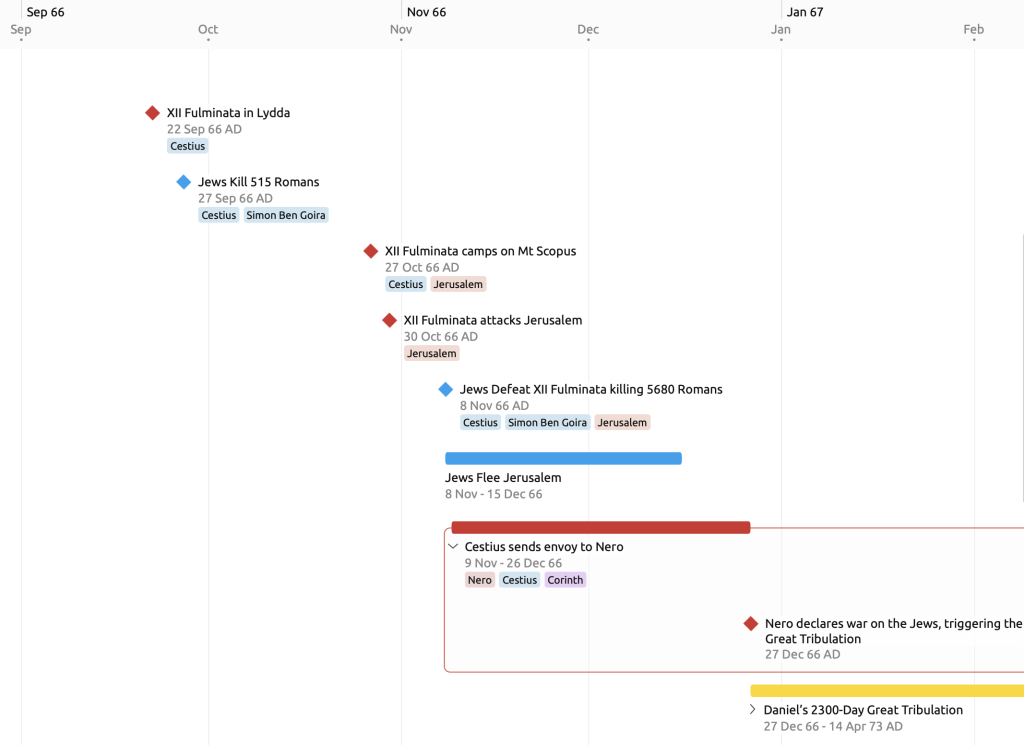
The Roman advance met fierce resistance. Josephus records that 515 Romans were killed in an earlier engagement (Jewish War 2.519). Cestius then withdrew from Jerusalem, and his retreat became disastrous as he moved toward Beth-horon, northwest of the city. Jewish forces pursued the Romans through the narrow passes. Josephus records a further 5,300 infantry and 380 cavalry killed during the retreat—a total of 5,680 (Jewish War 2.555). Together, these reported losses amount to 6,195 Roman troops.
The Twelfth Legion, associated with the thunderbolt, approached Jerusalem from its camp at Mount Scopus to the northeast, then retreated west toward Beth-horon. I propose that this movement provides a striking historical correspondence with Jesus’ description of lightning coming from the east and flashing towards the west (Matthew 24:27).
For believers in Jerusalem, the withdrawal also allowed them to act on Jesus’ instruction to flee. The army that had surrounded the city had departed, opening a window of escape before the renewed Roman campaign.
| Josephus’ Reference | Macedonian Date | Hebrew Calendar | Roman Calendar | Historic Event |
| 66 CE | ||||
| 2.515 | 15 – 23 Tishrei | 22 – 30 September | XII Fulminata legion in Lydda | |
| 2.519 | 20 Tishrei | 27 September | Cestius loses 515 men to the Jews in battle | |
| 2.528 | 27 Hyperberetaeus | 20 Cheshvan | 27 October | XII Fulminata legion camps to the northeast of Jerusalem on Mt Scopus |
| 2.535 | 30 Hyperberetaeus | 23 Cheshvan | 30 October | XII Fulminata legion attacks Jerusalem from the east and departs to the west. |
| 2.555 | 8 Dius | 2 Kislev | 8 November | XII Fulminata legion defeated, with 5300 infantry and 380 cavalry killed. Cestius’ envoy departed to Nero to blame Florus for starting the war. |
7. Start and End Dates of the Great Tribulation
A. Jesus’ Prediction of the Start of the Great Tribulation
The unrest in Jerusalem in May 66 CE marked an early stage of the conflict. However, Jesus gave His followers a specific warning by which they would recognise that Jerusalem’s desolation was approaching:
“But when you see Jerusalem surrounded by armies, then know that its desolation is near. Then let those who are in Judea flee to the mountains, let those who are in the midst of her depart, and let not those who are in the country enter her. For these are the days of vengeance, that all things which are written may be fulfilled.
Luke 21:20-22
Cestius Gallus’ advance against Jerusalem in the autumn of 66 CE corresponds to this warning. His subsequent withdrawal allowed believers to obey Jesus’ instruction and escape before the renewed Roman campaign.
The surrounding of Jerusalem therefore supplied the recognisable warning; it did not itself specify the calendar date on which the Great Tribulation began. In the chronology proposed here, that beginning is calculated as 27 December 66 CE, by counting back 2,300 elapsed days from the proposed endpoint at Masada on 14 April 73 CE. The following sections explain this calculation and how it applies to Daniel’s prophecy.
B. All Things Fulfilled
Jesus described the approaching judgement as” “” the days of vengeance, that all things which are written may be fulfilled””” (Luke 21:22). His words connect Jerusalem’s coming desolation with the fulfilment of prophetic Scripture.
“How long will the vision be, concerning the daily sacrifices and the transgression of desolation, the giving of both the sanctuary and the host to be trampled underfoot?”
Daniel 8:13-14
And he said to me, “For two thousand three hundred days; then the sanctuary shall be cleansed.”
As discussed earlier, this prophecy has an initial application to the events surrounding Onias III and the restoration of the Temple under Judas Maccabeus. I propose a further application to the Great Tribulation, drawing on Jesus’ reference to Daniel’s abomination of desolation as still future in His day (Matthew 24:15). Within this interpretation, the following elements correspond to events during the Jewish–Roman War:
- The transgression of desolation: Roman armies carry out the judgement against Jerusalem and Judea, culminating in the proposed endpoint at Masada.
- The daily sacrifices: The Temple sacrifices cease during the siege of Jerusalem in 70 CE.
- The sanctuary trampled underfoot: The Romans invade the Temple precincts and destroy the Temple in 70 CE.
- The host trampled underfoot: The people suffer warfare, death, and captivity as the Roman campaign continues, concluding within this chronology with Masada’s fall in 73 CE.
The proposed 2,300-day period extends from 27 December 66 CE to 14 April 73 CE. The Temple’s destruction falls within that period; Masada supplies its proposed endpoint. Next, we consider what it means for the sanctuary to be” “” cleansed””” or” “” made right.”””
C. Sanctuary is Made Right
Daniel 8:14 concludes, “then the sanctuary shall be cleansed.” The Hebrew verb here, וְנִצְדַּק (weniṣdaq), comes from צָדַק (tsadaq), meaning to be right or righteous. In this context, it can convey the sanctuary being restored to its rightful state or vindicated.
The prophecy’s initial historical application corresponds to the restoration of the Temple after its desecration under Antiochus IV. In the further application proposed here, its significance concerns the vindication of God’s New Covenant sanctuary.
D. Trampled Underfoot
The language of being “trampled underfoot” strengthens the connection between Daniel’s vision and Jesus’ warning. Daniel describes both the sanctuary and the host being trampled underfoot (Daniel 8:13). At the same time, Jesus declares that
Jerusalem will be trampled by Gentiles until the times of the Gentiles are fulfilled
Luke 21:24
I understand this shared imagery as a further link between Daniel’s prophecy and the Roman judgement upon Jerusalem.
Through Jesus’ death and resurrection, God established a people in whom He dwells by His Spirit:
- Jesus is the true Temple: He identified His body as the Temple that would be raised after three days (John 2:19–21).
- Believers are God’s Temple: The Spirit of God dwells in His people (1 Corinthians 3:16).
- Together, they form His dwelling place: Believers are built upon the foundation of the apostles and prophets, with Jesus Christ as the chief cornerstone (Ephesians 2:19–22).
This spiritual sanctuary already existed before Jerusalem’s destruction. I understand the trampling of the earthly sanctuary and the judgement upon its Temple as publicly vindicating the New Covenant order established through Christ.
Within this interpretation, the sanctuary being “made right” points to God’s dwelling among His redeemed people, whose access to Him rests upon Christ’s completed sacrifice.
Josephus also describes literal trampling during the destruction of the Temple:
many of them were trampled on by one another, while a great number fell
History of the Destruction of Jerusalem, Josephus 6.257
His account gives a terrible physical expression to the prophetic imagery: amid the destruction of the sanctuary, people themselves were being trampled underfoot. In this interpretation, this reinforces the connection between Daniel’s vision, Jesus’ warning, and Jerusalem’s destruction.
E. Calculating the End Date of the Great Tribulation
Within the chronology developed here, the Great Tribulation must begin after 8 November 66 CE, the proposed date of Cestius Gallus’ defeat. His army’s withdrawal allowed believers to flee before the ensuing judgement.
To calculate the beginning more precisely, we must first identify the endpoint of the proposed 2,300-day period. In this interpretation, the fall of Masada marks the conclusion of the judgement described in the preceding sections.
Identifying Masada as the endpoint of Daniel’s 2,300 days is an interpretive conclusion. Josephus supplies the historical account and the month and day; he does not connect Masada with Daniel’s prophecy.
Counting backwards 2,300 elapsed days from 14 April 73 CE gives 27 December 66 CE, consistent with the requirement that the Great Tribulation begin after Cestius’ defeat and withdrawal.
F. Calculating the Start of the Great Tribulation
Using 14 April 73 CE as the proposed endpoint, we count backwards 2,300 elapsed days:
14 April 73 CE − 2,300 days = 27 December 66 CE
This calculation uses the same calendar for both dates and counts actual elapsed days, without assuming that every Hebrew month contains thirty days. Inclusive counting, which labels the starting date as day one, would produce a different result.
The calculated beginning, 27 December 66 CE, falls after Cestius Gallus’ defeat on the proposed date of 8 November 66 CE. It therefore allows an interval for believers to escape following the Roman withdrawal.
I propose 27 December 66 CE to 14 April 73 CE as the period corresponding to Daniel’s 2,300 days in this further application of the prophecy. The arithmetic establishes the interval; its identification with the Great Tribulation rests upon the scriptural and historical argument developed in this lesson.
| Year CE | Year in 19-year cycle | Year Type | Full Year Length | Days within Period | Running Total | Julian Calendar |
| 66-67 | 8th | Leap | 385 | 275 | 275 | 27 December, 66 CE |
| 67-68 | 9th | Common | 353 | 353 | 628 | |
| 68-69 | 10th | Common | 355 | 355 | 983 | |
| 69-70 | 11th | Leap | 384 | 384 | 1367 | |
| 70-71 | 12th | Common | 355 | 355 | 1722 | |
| 71-72 | 13th | Common | 353 | 353 | 2075 | |
| 72-73 | 14th | Leap | 384 | 225 | 2300 | Proposed endpoint: 14 April 73 CE. |
Next, we will examine the events surrounding this proposed beginning.
8. The Flight from Jerusalem in 66 CE
A. Believers Respond to Jesus’ Warning
Cestius Gallus’ withdrawal provided an opportunity to leave Jerusalem before the renewed Roman campaign. Josephus describes prominent Jews departing after the Roman defeat:
After this calamity had befallen Cestius, many of the most eminent of the Jews swam away from the city, as from a ship when it was going to sink;
Josephus War of the Jews 2.556
Although Josephus does not identify these people as believers in Jesus, his account establishes that departures followed Cestius’ defeat. For believers who remembered Jesus’ warning, the surrounding of Jerusalem and the subsequent Roman withdrawal provided both a reason to flee and an opportunity to do so.
“then let those who are in Judea flee to the mountains. Let him who is on the housetop not go down to take anything out of his house, and let him who is in the field not go back to get his clothes.”
Matthew 24:16-18
Jesus emphasised urgency. Within the interpretation developed here, His followers would have recognised the approaching danger and acted upon His instruction. Their departure belongs to the interval between Cestius’ withdrawal and the proposed beginning of the Great Tribulation on 27 December 66 CE.
B. Flee to the Mountains
Jesus instructed those in Judea to flee to the mountains rather than seek protection within Jerusalem (Matthew 24:16; Luke 21:21).
Writing in the fourth century, Eusebius records that the Jerusalem church received a revelation directing its members to leave the city and settle at Pella, across the Jordan. His account preserves a Christian tradition that believers escaped before Jerusalem’s destruction. (Eusebius, Ecclesiastical History 3.5.3.)
Eusebius does not explicitly place their departure immediately after Cestius Gallus’ withdrawal. Nevertheless, that withdrawal provides a plausible opportunity within the chronology proposed here.
The central point is their response to Jesus’ warning: safety lay in leaving the threatened city. Their flight illustrates the practical importance of recognising His warning and acting upon it.
C. Summary of Prelude to Great Tribulation
| Josephus’ Reference | Hebrew Calendar | Julian Calendar | Historic Event |
| 66 CE | |||
| 2.555-256 | 2 Kislev | 8 November | Cestius army defeated. Departures from Jerusalem follow. |
| 2.558 | 3 Kislev | 9 November | Cestius’ envoy departs for Nero to blame Florus for starting a war. Christians and wise Jews start fleeing Jerusalem |
| 23 Kislev | 29 November | Sabbath rest | |
| 25 Kislev to 2 Tevet | 1st December to 8th December | Hanukkah Feast Days (8 days | |
| 2.556 | 3 Tevet | 9 December | Proposed departure of further refugees after the harvest and Hanukkah. |
| 7 Tevet | 13 December | Sabbath rest | |
| 10 Tevet | 16 December | Fast of Tevet | |
| 15 Tevet | 21 December | Estimated date of Cestius Gallus’ envoy’s arrival | |
| 3.1-4 Section 7 above | 21 Tevet | 27 December | Nero the Antichrist resolves to destroy Judea. Calculated start date of the Great Tribulation. |
Red indicates that it has been explicitly dated in the cited source; blue indicates proposed historical dates. Hebrew equivalents follow the calculated calendar.
C. Defeat of the Romans on 8 November.
Cestius Gallus’ defeat, placed in this chronology on 8 November 66 CE, opened an opportunity for believers to leave Jerusalem. The army that had surrounded the city withdrew, allowing them to act upon Jesus’ instruction to flee to the mountains.
As discussed earlier, the westward retreat of the thunderbolt-associated Twelfth Legion provides a proposed correspondence with Jesus’ lightning imagery. The withdrawal also had a practical consequence: the attacking army no longer enclosed Jerusalem.
Josephus records departures after Cestius’ defeat, although he does not establish when individual groups left (Jewish War 2.556). Some may have departed immediately; others may have left later in the interval before the renewed Roman campaign.
The following sections consider whether the olive harvest and religious observances influenced those later departures. These possibilities form part of the proposed reconstruction; Jesus’ warning itself emphasised the urgency of escape.
D. Gathering the Olive Harvest
Following the Roman defeat, some refugees may have needed to gather provisions for their journey and support themselves away from home. For those with access to olive groves, completing the autumn harvest could have supplied food, oil, and produce to sell.
I propose that these practical considerations may have influenced the timing of some departures. Those who remained briefly could have gathered supplies or sold produce to people intending to stay before leaving Jerusalem and its surrounding region.
Josephus does not connect the departures with the olive harvest, so this remains a possible explanation for later departures within the available interval. It does not imply that all believers delayed or that completing the harvest was a condition of obeying Jesus’ urgent warning.
E. Hanukkah and the Timing of Departure
Hanukkah commemorates the Temple’s rededication in 164 BCE after AntiochuIV’s desecrationIV. In the calculated calendar used here, its eight days correspond to 1–8 December 66 CE, from 25 Kislev to 2 Tevet.
The recent Roman defeat may have given that year’s celebration particular significance. A festival recalling deliverance from foreign oppression could have strengthened hopes that the Jews would again preserve their freedom and their Temple.
I propose that some who intended to leave may have remained until the festival ended, placing their departure from 9 December onwards. This is a possible reconstruction, not a departure date supplied by Josephus. Hanukkah’s restrictions on mourning did not themselves prohibit travel or escape from danger.
For believers, Jesus’ warning remained decisive: the Roman withdrawal provided an opportunity to leave before the approaching judgement.
F. Not on the Sabbath
And pray that your flight may not be in winter or on the Sabbath.
Matthew 24:20
Jesus recognised the practical difficulties of escaping on the Sabbath, when customary restrictions on travel and activity could complicate a hurried departure.
In the Julian calendar for 66 CE, the Sabbaths following Cestius’ proposed defeat date fell on 15, 22, and 29 November, and 6, 13, 20, and 27 December. Within the proposed period after Hanukkah and before 27 December, 13 and 20 December would therefore have been less favourable departure dates.
Jesus’ instruction expresses a prayer that these difficulties might be avoided. It does not establish the actual day of departure or rule out escape on a Sabbath if danger required it.
G. Not During the Fast of Tevet
The Fast of the Tenth of Tevet commemorates the beginning of Nebuchadnezzar’s siege of Jerusalem (2 Kings 25:1; Zechariah 8:19). In the calculated calendar used here, 10 Tevet corresponds to Tuesday, 16 December 66 CE.
For those observing the fast, its solemn character and the practical difficulty of travelling while fasting may have made another day preferable. I therefore suggest that it could have influenced the timing of some departures.
However, this was a fast day, not a weekly Sabbath, and it did not, by itself, prohibit escape. Josephus does not say refugees delayed their departure because of this observance, so its influence remains possible within the proposed chronology.
H. Not in Winter
Travelling with children and food to survive winter would have been very unlikely.
And pray that your flight may not be in winter or on the Sabbath.
Matthew 24:20
By November, autumn rains could already make escape more difficult. Wet paths, swollen watercourses, and cold nights would particularly burden families travelling with children and provisions. Refuge in the mountains also required adequate shelter.
Acts 27 illustrates the dangers of travel at this time of year. Luke notes that sailing had become dangerous because “the Fast was already over” (Acts 27:9), referring to the Day of Atonement.
The voyage subsequently encountered the violent tempest called Euroclydon (Acts 27:14).
Although this was a Mediterranean sea storm, it illustrates the seasonal hazards facing travellers.
Cestius’ withdrawal in November therefore opened an opportunity to escape when deteriorating weather already made delay undesirable. Those leaving after Hanukkah in early December would have faced increasing difficulty.
Jesus’ warning gives practical force to the urgency of departure. It supports leaving before winter conditions worsen, but offers no exact departure date.
I. Cestius Informs Nero
Following his defeat, Cestius Gallus sent Saul and his companions to Nero in Achaia to report the situation and blame Gessius Florus for provoking the war. Josephus explains that Cestius hoped to divert Nero’s anger towards Florus and reduce the danger to himself (Jewish War 2.558).
The envoys’ journey took place as travelling conditions deteriorated. November rains could slow overland travel, while adverse winds and storms could delay sea crossings or force ships to remain in harbour. Acts 27 illustrates these seasonal dangers: sailing had become hazardous after the Fast, and Paul’s ship encountered the violent storm called Euroclydon (Acts 27:9, 14).
These conditions provide a practical reason to allow approximately six weeks for the journey, although Josephus supplies neither its duration nor the precise route. A proposed departure on 9 November 66 CE would place their arrival around 21 December, leaving several days for their report to be heard and for an imperial response to be prepared.
Josephus records Nero’s alarm at the Roman defeat and his selection of Vespasian to conduct the war (Jewish War 3.1–8). He does not date that decision to a particular day.
I propose that Nero’s response in late December corresponds to the calculated beginning of the Great Tribulation on 27 December 66 CE. The six-week journey provides a plausible sequence leading to that date; the date itself derives from counting backwards 2,300 elapsed days from the proposed endpoint at Masada on 14 April 73 CE.
Within this interpretation, the Great Tribulation began under Nero and concluded under Vespasian.
Proposed Dates of the Great Tribulation:
Nero’s response to Cestius’ defeat is proposed as the historical setting for the beginning of the Great Tribulation on 27 December 66 CE.
Counting forward 2,300 elapsed days reaches 14 April 73 CE, the proposed date of Masada’s fall.
27 December 66 CE → 2,300 days → 14 April 73 CE
9. Summary
- Daniel’s 2,300 days: This lesson proposes a further application of Daniel 8:13–14 to the Great Tribulation, following its initial fulfilment associated with Onias III and the Temple’s restoration under Judas Maccabeus. This period is distinct from the final seven years of Daniel’s seventy-week prophecy.
- Jesus’ warning: Cestius Gallus’ surrounding of Jerusalem in 66 CE provided the warning to flee. His subsequent withdrawal allowed believers to escape before the renewed Roman campaign.
- The interval before judgement: Josephus records departures following Cestius’ defeat. The suggested influence of harvests, festivals, Sabbaths, and winter weather forms part of the reconstruction offered here.
- Nero’s response: Cestius sent envoys to Nero, who subsequently appointed Vespasian to conduct the war. Seasonal travelling difficulties support allowing approximately six weeks for the journey, placing the report and imperial response plausibly in late December.
- The proposed dates: Counting backwards 2,300 elapsed days from the proposed fall of Masada on 14 April 73 CE gives 27 December 66 CE. This beginning falls after Cestius’ withdrawal and allows time for escape.
- The sanctuary and the people: The cessation of sacrifices, the destruction of the Temple, and the people’s suffering correspond, within this interpretation, to Daniel’s imagery of trampling. The destruction of the earthly Temple publicly vindicated the New Covenant sanctuary already established in Christ and His people.
The interval is mathematically exact; its identification with the Great Tribulation rests upon the scriptural interpretation and historical chronology presented in this lesson.
© Use by Permission Awakening Impact Ministries/Dr Neville Westerbeek van Eerten D.Miss. 2027