


1. Understanding Revelation’s Five-Month Prophecy
Revelation’s five-month prophecy describes a period of torment associated with the fifth trumpet in Revelation 9. In this lesson, we examine its fulfilment in the siege of Jerusalem in 70 CE, considering the locust imagery, the Roman armies and the suffering recorded by Josephus.
Within AIM’s interpretation, these five months form an intense period of judgment within the wider Great Tribulation. We compare the biblical passages with the historical sequence while distinguishing Jerusalem’s destruction from Jesus’ future bodily return.
A. Previously
This is our tenth lesson examining the Great Tribulation and the events surrounding the Jewish-Roman War.
In our Introduction to the Great Tribulation, we established that:
- Jesus taught that the Great Tribulation would never occur again.
- The Roman armies were the Abomination of Desolation.
- The gospel had been preached throughout the nations before the Great Tribulation.
- Josephus provides an important historical witness to these events.
We then examined the Seven Seals of Revelation and their relationship to the Great Tribulation, including the judgment of the fourth seal in which authority was given over a fourth of the earth.
In our third lesson, we examined the 144,000 and identified them as first-century Jews sealed by God before and during the Great Tribulation.
We then studied the first-century calendars needed to reconstruct the chronology of the Great Tribulation. Understanding the relationship between the Hebrew, Macedonian and Julian calendars enables us to compare the prophetic periods directly with the historical events recorded by Josephus.
Our study of Daniel’s Seventy-Weeks Prophecy showed how the seventy weeks culminated in Jesus’ ministry and the establishment of the New Covenant. The calendar evidence also enabled us to date the beginning of Jesus’ ministry, Stephen’s martyrdom and, working backwards, Jesus’ birth in 4 BCE.
We then examined the Euphrates Army of Revelation. Four Roman military forces associated with the eastern provinces advanced against Jerusalem. Among them was Legio X Fretensis, which played a prominent role in the siege of Jerusalem. Together with their cavalry and auxiliary forces, these armies provide the historical setting for John’s vision of the great army released at the Euphrates.
In our seventh lesson, we identified Daniel’s 2300 days as the Great Tribulation.
In 67 CE: A Year of Signs, we examined four extraordinary signs associated with the Temple that linked Daniel and Revelation with the events of the following three and a half years.
Then, in the Forty-Two-Month Prophecy of Revelation, we examined the period during which the Gentiles, including the Idumeans, trampled Jerusalem and the Temple courts until the city fell.
We now turn to Revelation’s Five-Month Prophecy and its remarkable fulfilment during the final siege of Jerusalem in 70 CE.
2. The Summit of the Great Tribulation: 70 CE
A. The Factions in Jerusalem
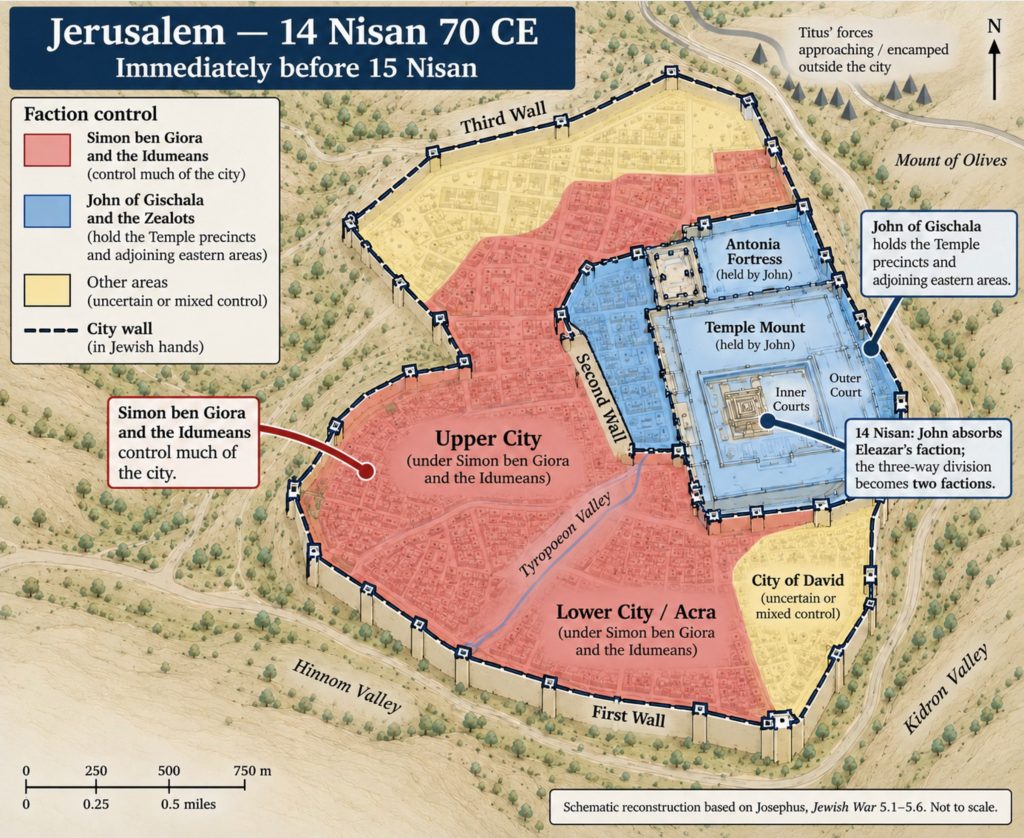
As Titus approached Jerusalem in 70 CE, the city remained divided by bitter factional conflict. Simon son of Giora controlled much of the Upper and Lower City with 10,000 men, supported by approximately 5,000 Idumeans. John of Gischala commanded 6,000 men and controlled the Temple area, while Eleazar son of Simon commanded a further 2,400 Zealots within the inner Temple.
At Passover, Eleazar’s faction joined John’s forces, leaving two main military blocs in Jerusalem as Titus began the siege: Simon with about 15,000 men and John with about 8,400.1
B. The Seditious and the Innocent
The ordinary people suffered between the rival factions and the Roman siege. Josephus repeatedly describes those who refused to join the rebels as being robbed, beaten or killed. Food became increasingly scarce, and those suspected of hiding provisions or attempting to escape to the Romans faced brutal treatment.2
As the siege tightened, famine, violence and disease combined to turn Jerusalem into a place of extraordinary suffering. Those who hoped the Romans might end the civil conflict often found themselves treated as traitors by the factions controlling the city.3
C. Sacrifices Continue
When Titus arrived at Jerusalem near Passover, worship at the Temple had not yet ceased. Pilgrims had continued to gather for the feast, increasing the population trapped inside the city.
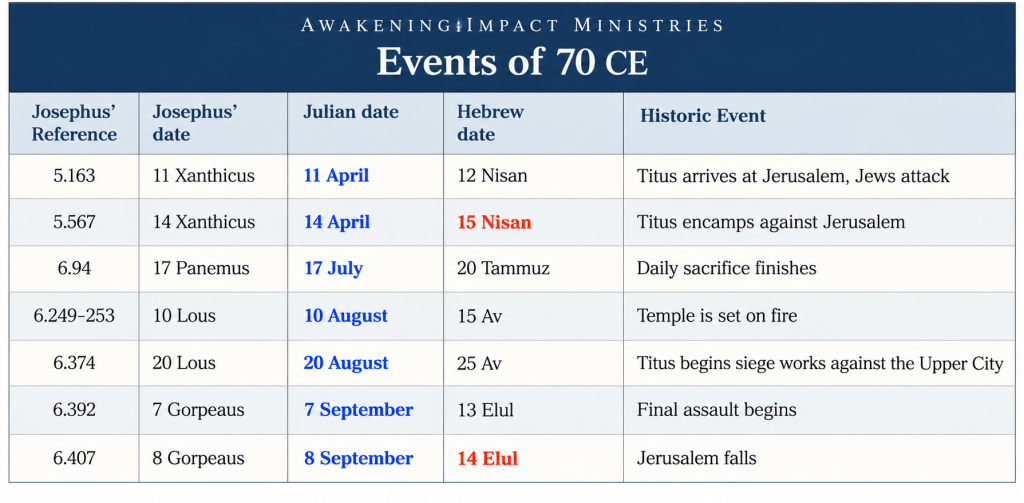
The daily sacrifice continued until 20 Tammuz, 70 CE. Its cessation marked another major stage in the collapse of the Temple order before the sanctuary itself was destroyed.4
D. Famine
As the Roman siege closed around Jerusalem, famine became catastrophic.5 Josephus describes people searching desperately for food, houses being searched, the dead filling the streets, and eventually the horrific case of a mother eating her own child.6
The famine became one of the defining horrors of the final months of the Great Tribulation. The Romans did not cause the suffering alone; the destruction of food supplies during the internal fighting had already weakened the city before the siege reached its climax.
E. The Fate of the Idumeans
The Idumeans formed a substantial part of Simon’s force. As Jerusalem’s position became hopeless, some attempted to negotiate their surrender to Titus.7 Titus agreed to spare them, but Simon discovered the plan. He killed the five men who had approached Titus and imprisoned the Idumean commanders, including Jacob son of Sosas. Simon placed the remaining Idumeans under guard and strengthened the watch on the walls to prevent their departure. Nevertheless, Josephus records that many still deserted despite these restrictions.
F. Judgment on Edom
The Idumeans were descendants of Edom and had been incorporated into the Jewish nation generations earlier. Their presence in Jerusalem during its final judgment provides an important prophetic connection with the Old Testament judgments pronounced against Edom. Isaiah describes the Lord coming from Edom with garments stained by judgment:
The LORD in Judgment and Salvation
Isaiah 63:1-4 (NKJV)
Who is this who comes from Edom,
With dyed garments from Bozrah,
This One who is glorious in His apparel,
Traveling in the greatness of His strength?—
“I who speak in righteousness, mighty to save.”
Why is Your apparel red,
And Your garments like one who treads in the winepress?
“I have trodden the winepress alone,
And from the peoples no one was with Me.
For I have trodden them in My anger,
And trampled them in My fury;
Their blood is sprinkled upon My garments,
And I have stained all My robes.
For the day of vengeance is in My heart,
And the year of My redeemed has come.
In this lesson, I understand the destruction that overtook the Idumeans alongside Jerusalem as part of the wider prophetic judgment associated with Edom.
G. September in Jerusalem
After Jerusalem fell, Titus spent the next three days honouring his officers and soldiers and distributing rewards from the spoils. He left Legio X Fretensis to guard Jerusalem, sent XII Fulminata back toward the Euphrates frontier, and retained two legions with him.8
Titus then marched approximately 120 km to Caesarea Maritima with his army. There he stored the spoils and ordered the captives to be held. Josephus records that 97,000 people were taken captive during the war, although this number represents the total captured throughout the conflict rather than a single group marched from Jerusalem.9
The fall of Jerusalem brought the forty-two-month trampling of the city to its conclusion. The Temple had been destroyed, Gentile forces controlled Jerusalem, and the final five months of Revelation’s prophecy had ended.
Before examining the events following Jerusalem’s destruction and Daniel’s 1290- and 1335-day prophecies, we will examine Revelation 9 and its five-month period in detail.
3. Hell on Earth
A. The Bottomless Pit is Opened
Revelation describes the opening of the bottomless pit as the fifth trumpet sounds. Smoke rises from the abyss like the smoke of a great furnace, darkening the sun and the air.
Then the fifth angel sounded: And I saw a star fallen from heaven to the earth. To him was given the key to the bottomless pit. And he opened the bottomless pit, and smoke arose out of the pit like the smoke of a great furnace. So the sun and the air were darkened because of the smoke of the pit..
Revelation 9:1-2 (NKJV)
The imagery introduces a period of extraordinary judgment. The abyss is opened, and from it emerges the destructive force that will torment those under judgment.
B. Abaddon and Apollyon
Revelation identifies the king over this destructive host as the angel of the bottomless pit. His Hebrew name is Abaddon, and his Greek name is Apollyon; both convey destruction or a destroyer.
And they had as king over them the angel of the bottomless pit, whose name in Hebrew is Abaddon, but in Greek he has the name Apollyon.
Revelation 9:11 (NKJV)
The name fits the judgment that was about to overwhelm Jerusalem. In this interpretation, Apollyon represents the spiritual power of destruction operating through the events of the siege. In our lesson on Hell, we saw that many of Jesus’ warnings concerning judgment were directed toward the generation that would experience Jerusalem’s destruction.
C. Torment Jerusalem for Five Months
And they were not given authority to kill them, but to torment them for five months. Their torment was like the torment of a scorpion when it strikes a man.
Revelation 9:5 (NKJV)
I understand these five months as the final siege of Jerusalem, beginning on 15 Nisan 70 CE and ending on 14 Elul when the city fell. During this period, the population was trapped between the Roman armies outside the walls and the violent factions within the city.
People had already fled before the advancing Roman armies and before the violence of Simon son of Giora, the Zealots and the Idumeans across Judea. Many entered Jerusalem believing the city and Temple would remain secure. Once Titus encamped against Jerusalem, escape became increasingly difficult, food and water became scarce, and the inhabitants endured famine, violence and constant fear.10
When Titus arrived near Jerusalem on 11 April, Jewish forces immediately attacked the Romans. Josephus describes the extraordinary violence within the city and the many people who had already died or attempted to escape. Titus repeatedly called on Jerusalem to surrender, seeking to preserve the city and Temple, but the factions refused.11
D. Locusts
John’s vision describes locusts emerging from the smoke of the bottomless pit.
Then out of the smoke locusts came upon the earth. And to them was given power, as the scorpions of the earth have power.
Revelation 9:3 (NKJV)
Locust imagery was already associated with divine judgment in the Old Testament. Joel uses locusts to describe devastating judgment upon the land and later identifies them collectively as God’s army.
What the chewing locust left, the swarming locust has eaten; what the swarming locust left, the crawling locust has eaten; and what the crawling locust left, the consuming locust has eaten.
Joel 1:4 (NKJV)
”So I will restore to you the years that the swarming locust has eaten, the crawling locust, the consuming locust, and the chewing locust, my great army, which I sent among you.
Joel 2:25 (NKJV)
In Joel, the locusts are not merely insects; they become the imagery of an invading army sent by God in judgment. Revelation 9 draws on the same prophetic language.
I understand Joel’s four forms of locust as corresponding prophetically to the four Roman military forces involved in the campaign against Jerusalem. This interpretation does not mean that Joel explicitly names four Roman legions. Rather, the fourfold locust imagery provides a prophetic pattern that corresponds to the four major Roman forces we identified in the Euphrates Army lesson.
E. Like Horses
Revelation describes the locusts as resembling horses prepared for battle.
The locusts resembled horses prepared for battle. On their heads were crowns of something like gold, and their faces were like the faces of men.
Revelation 9:7 (NKJV)
Joel uses the same imagery when describing the invading army:
Their appearance is like the appearance of horses; and like swift steeds, so they run.
Joel 2:4 (NKJV)
The parallel is significant. Both Joel and Revelation portray the locust army as horses advancing into battle. The Roman forces campaigning against Jerusalem included cavalry and mounted auxiliaries alongside their infantry legions.
I understand this imagery as corresponding to the Roman military forces advancing against Jerusalem. The comparison concerns the army as a whole and does not require identifying any particular infantry legion as a cavalry formation.
F. Do Not Harm the Trees and Grass
John specifically states that the locust army was commanded not to harm the vegetation:
They were commanded not to harm the grass of the earth, or any green thing, or any tree, but only those men who do not have the seal of God on their foreheads.
Revelation 9:4 (NKJV)
This command is striking because natural locusts normally destroy vegetation. They consume grasses, leaves, crops and other green plants, but they do not normally attack people. Revelation reverses that natural behaviour: these locusts are commanded not to harm the grass, green plants or trees, but instead to torment people who do not have the seal of God.
The Greek text confirms the prohibition. The phrase ἵνα μὴ ἀδικήσωσιν means “that they should not harm.” The word ἵνα means “that” or “so that,” while μή supplies the negative, “not.” The NKJV therefore correctly translates the command as a prohibition against harming the vegetation.
This shows that John’s locusts are not literal insects. Their behaviour is the opposite of natural locusts: they spare the vegetation and direct their power against people. This supports the interpretation that the locusts represent a military force carrying out God’s judgment.
During the siege, the Roman army physically cut down trees and cleared the land around Jerusalem for military purposes.12 Revelation 9:4 therefore does not describe every literal action of the Roman soldiers. It emphasises the true object of the prophetic judgment: “those men who do not have the seal of God on their foreheads.”
Titus was authorised to damage trees and grass but not to kill those marked by God on their foreheads. Using this authority, Titus ordered the felling of all trees within 16 kilometres in each direction.
G. Gold Helmets and Like Lions
Revelation describes the locust army as having human faces, something like golden crowns on their heads, hair like women’s hair, teeth like lions’ teeth and breastplates like iron.
The locusts resembled horses prepared for battle. On their heads were crowns of something like gold, and their faces were like the faces of men. They had hair like women’s hair, and their teeth were like lions’ teeth. And they had breastplates like iron breastplates.
Revelation 9:7-9a
These features closely resemble the appearance of Roman legionaries prepared for battle. The illustration of Legio XII Fulminata shows the legion’s lightning-bolt emblem on the shield, together with a gold-coloured helmet, flowing neck protection and body armour.
The overall appearance strikingly matches John’s description of human faces: “hair like women’s hair” and “breastplates like breastplates of iron.” Joel uses similar imagery when describing the invading nation:

For a nation has come up against My land, strong, and without number; his teeth are the teeth of a lion, and he has the fangs of a fierce lion.
Joel 1:6 (NKJV)
H. Scorpions
Revelation describes the locust army as having scorpion-like tails, with the power to hurt men for five months. It also compares the sound of their wings to chariots and many horses rushing into battle.
And they had breastplates like breastplates of iron, and the sound of their wings was like the sound of chariots with many horses running into battle. They had tails like scorpions, and there were stings in their tails. Their power was to hurt men five months.
Revelation 9:9-10 (NKJV)
The scorpion imagery has a striking parallel in Roman military history. The Romans used torsion artillery, including bolt-throwers commonly known as scorpiones, which could fire heavy darts and bolts with great force against defenders and fortifications.

Roman Scorpion firing over the walls of Jerusalem
Josephus shows the immense scale of Roman artillery in this war. At Jotapata in 67 CE, Vespasian positioned 160 artillery engines around the city. Josephus describes them firing “stones and darts,” along with other missiles, against the defenders. The barrage was so intense that it overwhelmed the walls and those standing upon them.13
By the siege of Jerusalem in 70 CE, every Roman legion possessed its own artillery train. Josephus specifically notes that the engines of Legio X Fretensis were especially powerful. He describes Roman engines hurling darts and enormous stones into Jerusalem, showing this was not an occasional weapon but a major part of the siege.14
Although Josephus does not state how many individual scorpiones were deployed at Jerusalem, the evidence demonstrates the scale of Roman artillery. At Jotapata alone he records 160 artillery engines, while at Jerusalem each legion brought its own siege equipment and the engines of Legio X Fretensis were particularly powerful.
John’s image of scorpion-like power therefore corresponds strikingly to the Roman army that tormented Jerusalem for five months: an army equipped with numerous missile engines capable of striking men from beyond the walls.
I. Do Not Harm the Christians
John next identifies the people exempt from the locusts’ power: those with God’s seal on their foreheads.
They were commanded not to harm the grass of the earth, or any green thing, or any tree, but only those men who do not have the seal of God on their foreheads. And they were not given authority to kill them, but to torment them for five months. Their torment was like the torment of a scorpion when it strikes a man.
Revelation 9:4-5 (NKJV)
In our lesson on the 144,000, we identified the seal of God with first-century believers who belonged to Christ. Revelation 9 therefore distinguishes between those under judgment and those protected by God.
The passage does not say that nobody would die during these five months. It says that the locust army was not given authority to harm those who bore God’s seal. In this interpretation, the restriction applies to the Roman force represented by the locusts, not to every act of violence occurring inside Jerusalem.
In this interpretation, any Christians who remained in and around Jerusalem would have been non-combatants. The greater danger to civilians came from internal factions, robbers, and those who suspected them of favouring Rome.
Josephus repeatedly describes the killing, intimidation and robbery of people suspected of desertion or disloyalty.15
J. The Limits of the Locusts’ Authority
Revelation 9 presents a spiritual judgment operating through earthly events. I understand the smoke rising from the abyss as portraying the emergence and obscuring influence of spiritual forces, with the locusts representing the Roman armies advancing under their influence.
Two restrictions govern their activity. Revelation 9:4 excludes those bearing God’s seal from the harm they inflict. In our study of the 144,000, we identified these sealed people as first-century believers. Verse 5 then limits the locusts’ authority over the unsealed: they may torment them for five months, but are not given authority to kill them.
The siege brought prolonged torment through deprivation, bombardment, confinement and fear. Hunger, thirst, missiles from siege engines and the continuing threat of destruction made life increasingly unbearable. The sight of people crucified outside the walls compounded this suffering, while the danger of being disembowelled after escaping to the Roman forces made flight itself a terrifying prospect.16
The spiritual commission must nevertheless be distinguished from individual human actions. Roman soldiers and the factions within Jerusalem remained responsible for their choices. The occurrence of killings during the siege does not, by itself, establish that the spiritual powers represented in the vision had received authority to cause those killings. The restriction concerns what they may commission; it does not remove human responsibility or require attributing every violent act to spiritual influence.
Within AIM’s adopted chronology, the five months extend from 15 Nisan to 14 Elul 70 CE. Jerusalem’s final overthrow brought this period of siege torment to its conclusion. Josephus describes widespread slaughter as Roman soldiers entered the Upper City.
When the Roman soldiers entered the city with drawn swords, they killed those they encountered and set fire to houses where people had taken refuge. As they entered homes to plunder them, they discovered entire families dead from famine and upper rooms filled with corpses. Horrified by these discoveries, they withdrew without taking anything.
Josephus, The Jewish War 6.8.5 (6.404-406), paraphrased
Yet their pity for those who had died did not extend to the living. They continued killing those they met, filling the lanes with bodies. Josephus portrays the bloodshed as so extensive that blood extinguished the fires in some houses.
I understand this transition from prolonged torment to final destruction as marking the end of the five months. The correspondence does not require attributing every death during the siege to the locusts’ spiritual commission, nor does Revelation explicitly describe a new grant of authority after that period.
4. Summary of the Five-Month Prophecy
The Five-Month Prophecy of Revelation 9:1-11 closely corresponds with the final siege of Jerusalem, beginning on 15 Nisan 70 CE and ending on 14 Elul when the city fell.
- The five-month period corresponds with Titus’ siege of Jerusalem, during which the population endured warfare, famine, internal violence and Roman bombardment.
- Revelation’s locusts behave unlike natural locusts. Instead of destroying vegetation, they direct their power against people without God’s seal, suggesting the imagery represents a human military force rather than literal insects.
- Joel identifies the locust host as God’s army. I understand Joel’s four forms of locust as corresponding prophetically to the four major Roman military forces involved in the campaign against Jerusalem.
- Both Joel and Revelation describe the locust army as resembling horses prepared for battle. This imagery matches the Roman forces advancing on Jerusalem, which included cavalry and mounted auxiliaries.
- Revelation describes the locusts as having scorpion-like power. Roman armies employed large numbers of artillery engines, including bolt-throwers known as scorpiones, while Josephus records the immense scale of Roman artillery used during the Jewish-Roman War.
- John’s description of human faces, something like golden crowns, flowing hair and iron breastplates, provides a striking visual correspondence with Roman legionaries in their helmets, neck protection and body armour.
- Revelation distinguishes those who bear God’s seal from those under judgment. In this interpretation, the Roman force represented by the locusts was restricted in its authority for five months.
- After five months, Jerusalem fell. Josephus describes widespread slaughter as Roman soldiers entered the Upper City. This final destruction marks the end of the siege’s prolonged torment. The correspondence does not imply that Roman killing began only then, nor does Revelation explicitly describe a new grant of authority after the five months.
- The Idumeans shared in Jerusalem’s final destruction. I understand their fate within the wider prophetic judgment associated with Edom in Isaiah 63:1-4.
Now that the city has been destroyed, we can examine the rest of 70 CE and the fulfilment of Daniel’s 1290-day and 1335-day prophecy.
Historic References
- Josephus, The Jewish War 5.6.1 (5.248-250) ↩︎
- Josephus, The Jewish War 5.10.1-2 (5.419-425) ↩︎
- Josephus, The Jewish War 5.9.4 (5.403-406); 5.10.3-4 (5.426-438) ↩︎
- Josephus, The Jewish War 6.2.1 (6.94) ↩︎
- Josephus, The Jewish War 5.10.2-5 (5.424-445) ↩︎
- Josephus, The Jewish War 6.3.4 (6.201-213) ↩︎
- Josephus, The Jewish War 6.8.2 (6.378-386) ↩︎
- Josephus, The Jewish War 7.1.3 (7.13-20) ↩︎
- Josephus, The Jewish War 7.1.3 (7.13-20); 6.9.3 (6.420) ↩︎
- Josephus, The Jewish War 4.9.3-8 (4.503-537); 5.10.1-5 (5.419-445) ↩︎
- Josephus, The Jewish War 5.2.1-3 (5.47-66); 5.8.2 (5.331-347); 5.9.3-4 (5.361-419) ↩︎
- Josephus, The Jewish War 5.3.2 (5.106-108); 6.1.1 (6.5-8) ↩︎
- Josephus, The Jewish War 3.7.9 (3.166-168) ↩︎
- Josephus, The Jewish War 5.6.3 (5.267-273) ↩︎
- Josephus, The Jewish War 5.9.4 (5.403-406); 5.10.1-5 (5.419-445) ↩︎
- Josephus, The Jewish War 5.11.1-2 (5.449-454); 5.13.4-5 (5.550-561) ↩︎
AI Assistance Disclosure
Most of the research and writing for this lesson was prayerfully undertaken by Dr Neville Westerbeek van Eerten. AI tools assisted with editorial review and checks of consistency, references and chronology. Some wording and illustrations were developed with AI assistance. The author reviewed the final material and retains responsibility for its interpretations, accuracy and conclusions.
© Use by Permission Awakening Impact Ministries / Dr Neville Westerbeek van Eerten D.Miss, BVSc 2027