

1. Introduction
This lesson examines the extraordinary signs Josephus recorded before Jerusalem’s destruction and their significance in relation to biblical prophecy. The chronology proposed here places these signs at Passover and Pentecost in 67 CE. Dating them precisely requires considering Josephus’s narrative and the different calendars used in the first century.
Within this proposed chronology, the first day of Passover in 67 CE marks the beginning of the following prophetic periods:
• The time, times, and half a time of Daniel 7:25 and 12:7.
• The 1,290 days of Daniel 12:11.
• The 1,335 days of Daniel 12:12.
• The forty-two months of Revelation 11:2 and 13:5.
Unless otherwise stated, Western calendar dates in this lesson follow the Julian calendar.
A. Previously
Our earlier lessons examined the Great Tribulation, the Abomination of Desolation, the spread of the gospel throughout the known world, and Revelation’s description of Jerusalem as Sodom and Egypt. We also considered Josephus’s value as a historical witness.
We then explored the Seven Seals and identified the 144,000 as first-century Jews. Our calendar lesson explained the importance of distinguishing Hebrew, Macedonian, Julian, and Gregorian dates when examining these events.
Our study of Daniel’s Seventy Weeks considered its relationship to Jesus’ ministry and the establishment of the New Covenant. We also examined the Euphrates army of Revelation and its proposed connection with Roman forces.
Daniel’s 2,300 evenings and mornings have their primary historical setting in the events surrounding Antiochus IV and the cleansing of the Temple. Our proposed secondary application relates this period to the Great Tribulation, drawing on Jesus’ reference to Daniel’s Abomination of Desolation as still future in His day.
Within this proposed chronology, the 2,300-day period extends from 27 December 66 CE to 14 April 73 CE, the date adopted in these lessons for the fall of Masada. The starting date is calculated backwards from that endpoint; it is not an independently recorded date for Nero’s command.
2. Dating the Signs: 66 or 67 CE?
Our lesson Dating the Great Tribulation presents the historical reasoning and calendar calculations for placing the beginning of the war proper in December 66 CE, distinguishing it from the rebellion that began in May. It also explains the proposed 2,300-day period from 27 December 66 CE to 14 April 73 CE.
Building on that discussion, this chapter examines whether the Temple signs recorded by Josephus should be placed in 66 or 67 CE, and explains why this study proposes Passover 67 CE.
A. The Chronological Framework
As explained in Dating the Great Tribulation, this interpretation distinguishes the initial rebellion, Cestius Gallus’s campaign and defeat, Nero’s subsequent appointment of Vespasian, and the larger Roman campaign that followed. Readers should consult that lesson for the supporting evidence and the distinction between recorded events and calculated dates.
The question here is more specific: when Josephus looks backwards from Jerusalem’s destruction and describes signs preceding rebellion and war, which stage of the conflict does he mean? Answering that question requires examining the surrounding narrative, his calendar terminology, and the proposed relationship between the signs and the prophetic periods.
B. Josephus’ Retrospective Account
Josephus introduces these signs while describing the Temple’s destruction during the siege of Jerusalem in 70 CE. Immediately beforehand, he recounts the deaths of approximately 6,000 people who had gathered in a Temple portico after a false prophet promised divine deliverance. Roman soldiers set the portico on fire.
Josephus then contrasts the false promises people believed with the earlier warnings they ignored. He recalls the sword-shaped star and the comet, then describes the light that shone around the altar and sanctuary for half an hour (Jewish War 6.283–291).
The narrative therefore moves backwards from the destruction to earlier events. Its placement in Book 6 does not mean that the signs occurred in 70 CE, nor does that placement alone establish whether they occurred in 66 or 67 CE.
The chronological question rests particularly on Josephus’s description of the signs as occurring before the rebellion and the disturbances preceding the war. This study considers whether those words refer to the initial uprising or to the later internal conflict and military assault on Jerusalem.
C. Which Rebellion and Which War?
In this study, I understand Josephus’ reference to “rebellion” in Jewish War 6.290 as the later internal struggle involving John of Gischala and the Zealots against Jerusalem’s leadership, particularly Ananus, followed by the Idumean intervention. Josephus describes these events in Book 4, chapters 3–5.
I do not identify this reference with the earlier uprising of 66 CE that prompted Cestius Gallus’s campaign. As explained in Dating the Great Tribulation, I distinguish that rebellion and Roman intervention from the commencement of the war proper, which this study places in December 66 CE.
In Josephus’ account of the signs, I understand “the war” more specifically as Vespasian’s military campaign, particularly his advance against Jotapata, which this study dates to 22 May 67 CE. The proposed Passover signs in April 67 CE would therefore precede both that attack and the later internal struggle in Jerusalem.
The sign of the Son of Man also has chronological significance within this framework. As discussed in Dating the Great Tribulation, I understand that sign as preceding the commencement of the war proper in December 66 CE, with Vespasian’s campaign following in 67 CE.
Josephus looks back at Jerusalem’s destruction in 70 CE. However, he does not explicitly identify the rebellion and war in 6.290 with the particular events proposed here. This reading allows the suggested sequence; it does not, by itself, establish 67 CE as the year of the signs.
3. 67 CE: A Year of Signs
A. The Jewish Day
The Jewish day runs from sunset to sunset, while the Julian calendar day is counted from midnight to midnight. An event occurring after midnight therefore retains the same Jewish date as the preceding evening.
Using the Utrecht Hebrew Calendar Calculator, Nisan 15 in 67 CE corresponds to 18 April in the Julian calendar. The festival therefore begins at sunset on 17 April and continues until sunset on 18 April. Within our proposed chronology, events placed at midnight and approximately 3 am during that opening night would both fall on 18 April.
These dates are calculated using the current Hebrew calendar rules projected backwards. They provide a basis for our proposed chronology, while the precise calendar dates observed in the first century remain subject to historical uncertainty.
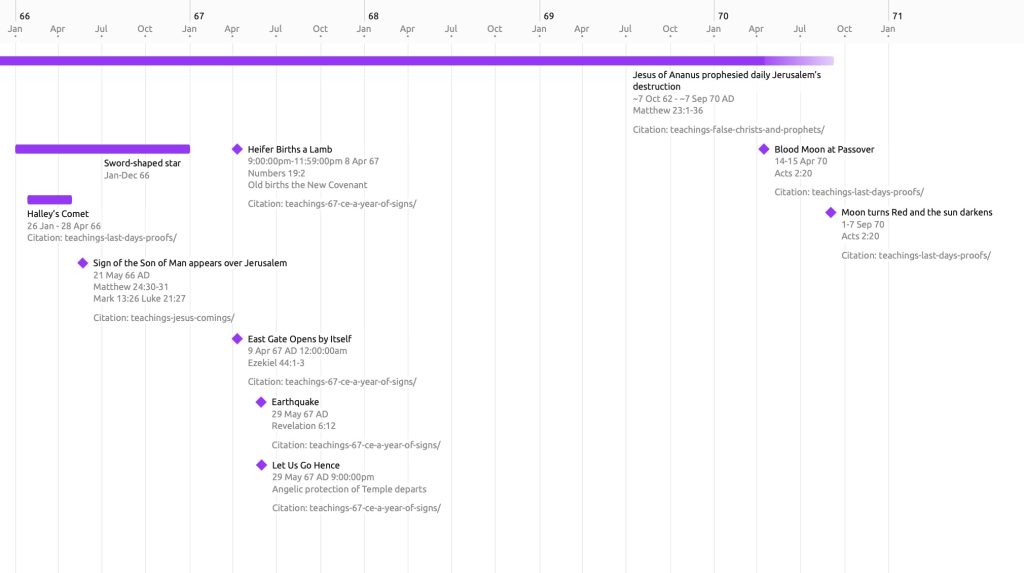
B. Table of Signs: Proposed Dating in 67 CE
| Josephus Reference | Timing Recorded by Josephus | Proposed Julian date | Proposed Hebrew date | Sign |
| 67CE | ||||
| Jewish War 6.292 | At the same festival | 17 April sunset – 18 April sunset | 15 Nisan | A heifer being led for sacrifice gives birth to a lamb in the Temple. |
| Jewish War 6.293-295 | About the sixth hour of the night | 18 April – about midnight | 15 Nisan | The eastern gate of the inner Temple court opens of its own accord. |
| Jewish War 6.290-291 | Xanthicus 8, ninth hour of the night | 18 April 3 am | 3 am 15 Nisan | A bright light shines around the altar and sanctuary for half an hour. |
| Jewish War 6.299-300 | At Pentecost, during the night | 6 June sunset – 7 June sunset | 6 Sivan | Priests report a quaking, a great noise, and a sound like a multitude saying, ‘Let us remove hence.’ |
The Hebrew and Julian dates present the chronology proposed in this lesson, using Utrecht’s retrospective Hebrew calendar calculation. Each Jewish day begins at sunset on the preceding Julian date.
Josephus explicitly places the heifer sign “at the same festival” (Jewish War 6.292), referring back to the Feast of Unleavened Bread mentioned in 6.290. I therefore read these accounts together as signs associated with the same festival gathering. Within the chronology proposed here, I place the light, the opening gate, and the heifer sign at Passover in 67 CE, retaining Nisan 15 as their proposed Hebrew date. Josephus’ wording supports their festival connection, while their placement on that particular day, and the identification of Xanthicus 8 with Nisan 15, remain elements of the calendar interpretation adopted in this lesson.
4. The Glory Departs
A. Glory of the Latter
The prophet Haggai states that the new temple will be more glorious than the previous one.
“For thus says the LORD of hosts: ‘Once more (it is a little while) I will shake heaven and earth, the sea and dry land; and I will shake all nations, and they shall come to the Desire of All Nations, and I will fill this temple with glory,’ says the LORD of hosts. ‘The silver is Mine, and the gold is Mine,’ says the LORD of hosts. The glory of this latter temple shall be greater than the former,’ says the LORD of hosts. ‘And in this place I will give peace,’ says the LORD of hosts.”
Haggai 2:6-9
Haggai originally addressed those rebuilding the Temple after the Babylonian exile. Although its appearance seemed insignificant beside Solomon’s Temple, God promised that its latter glory would exceed its former glory. This promise cannot be measured simply by the quantity of silver and gold adorning the building.
In the interpretation developed in our lesson on the Feast of Tabernacles, this promise finds its fullest expression in Christ and His people. Through the Holy Spirit, God dwells in believers individually and in the Church collectively. Paul describes believers as being built together into a holy temple, a dwelling place for God in the Spirit (Ephesians 2:19–22).
B. East Gate Opens
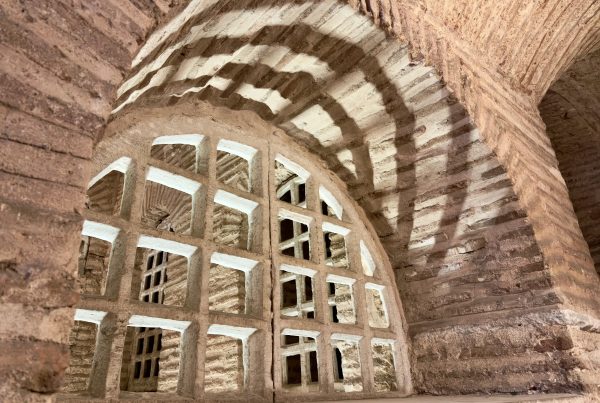
Josephus records that the eastern gate of the inner Temple court opened of its own accord around the sixth hour of the night—about midnight. In the chronology proposed here, this occurred during the opening night of Passover, on 18 April 67 CE in the Julian calendar.
Moreover, the eastern gate of the inner [COURT OF THE] temple, which was of brass, and vastly heavy, and had been with difficulty shut by twenty men, and rested upon a basis armed with iron, and had bolts fastened very deep into the firm floor, which was there made of one entire stone, was seen to be opened of its own accord about the sixth hour of the night. Now, those that kept watch in the temple came hereupon running to the captain of the temple, and told him of it: who then came up thither, and not without great difficulty, was able to shut the gate again. This also appeared to the vulgar to be a very happy prodigy, as if God did thereby open them the gate of happiness. But the men of learning understood it, that the security of their holy house was dissolved of its own accord, and that the gate was opened for the advantage of their enemies.
Flavius Josephus 6.293-295
C. Joy Turned to Mourning
Some interpreted the gate’s opening as a favourable sign. Josephus, however, explains that the learned understood it as a warning that the Temple’s protection had been removed and its entrance opened to their enemies. The eastern gate also has significance in Ezekiel’s vision of the Temple.
And the LORD said to me, “This gate shall be shut; it shall not be opened, and no man shall enter by it, because the LORD God of Israel has entered by it; therefore it shall be shut.
Ezekiel 44:2
In Ezekiel’s vision, the eastern gate remains shut because the Lord God of Israel has entered through it. Although this verse does not predict the opening that Josephus reports, it connects the eastern gate to God’s presence.
Earlier, Ezekiel saw God’s glory departing from the Temple and standing at its eastern gate:
Then the glory of the LORD departed from the threshold of the temple and stood over the cherubim. And the cherubim lifted their wings and mounted up from the earth in my sight. When they went out, the wheels were beside them; and they stood at the door of the east gate of the LORD’s house, and the glory of the God of Israel was above them.
Ezekiel 10:18-19
Read alongside that vision, the opening recorded by Josephus can be understood as a sign of divine protection being withdrawn before Jerusalem’s destruction. In this lesson, we interpret it as the first sign considered here that portrays the departure of God’s glory.
D. Bright Light
Josephus records a glow surrounding the altar and sanctuary. Read alongside Ezekiel’s vision, its emergence and fading suggest, in this view, the retreat of divine protection before the Temple’s ruin. The old covenant order was fading, while believers were already becoming God’s dwelling place in the Spirit.
…before those commotions which preceded the war, when the people were come in great crowds to the feast of unleavened bread, on the eighth day of the month Xanthicus [NISAN], and at the ninth hour of the night, so great a light shone round the altar and the holy house, that it appeared to be bright day time; which light lasted for half an hour. This light seemed to be a good sign to the unskillful, but was so interpreted by the sacred scribes as to portend those events that followed immediately upon it.
Flavius Josephus War of the Jews 6.290-291
E. The Glory Departs
Josephus describes light around the altar and sanctuary. Read alongside Ezekiel’s vision, its appearance and disappearance signify, in this interpretation, the withdrawal of God’s protection before the Temple’s destruction. The Old Covenant order was passing away, while believers were already becoming God’s dwelling place in the Spirit.
In that He says, “A new covenant,” He has made the first obsolete. Now what is becoming obsolete and growing old is ready to vanish away.
Hebrews 8:13
Ezekiel saw the Lord’s glory leave the Temple’s threshold and stand above the cherubim at the eastern gate (Ezekiel 10:18–19 above). His vision of an earlier judgement provides the prophetic pattern through which we interpret these signs.
5. Thirty Minutes of Silence in Heaven
A. Light Fades in the Temple
Josephus records a light around the altar and sanctuary lasting half an hour. Revelation describes silence in heaven for about half an hour when the seventh seal opens. In this lesson, we interpret these similar durations as corresponding to the earthly sign and the heavenly vision.
B. Revelation’s Thirty-Minute Silence
When He opened the seventh seal, there was silence in heaven for about half an hour. And I saw the seven angels who stand before God, and to them were given seven trumpets. Then another angel, having a golden censer, came and stood at the altar. He was given much incense, that he should offer it with the prayers of all the saints upon the golden altar which was before the throne. And the smoke of the incense, with the prayers of the saints, ascended before God from the angel’s hand.
Revelation 8:1-5
C. The Saints of the Most High
Revelation was addressed to seven first-century churches, and its language draws extensively on the Old Testament, including Daniel. We should therefore understand the saints within that biblical and historical setting. In this interpretation, they include God’s faithful people from among both Jews and Gentiles. Daniel anticipates the Most High giving the kingdom to the saints.
Then the kingdom and dominion,
Daniel 7:27
And the greatness of the kingdoms under the whole heaven,
Shall be given to the people, the saints of the Most High.
His kingdom is an everlasting kingdom,
And all dominions shall serve and obey Him.’
D. Kingdom Theology
Within our proposed chronology, the light of 18 April 67 CE and Revelation’s half-hour silence point towards the approaching judgement on Jerusalem. Revelation places the saints’ prayers before God immediately before the angel casts fire upon the earth (Revelation 8:3–5).
Christ had already inaugurated the New Covenant and received His kingdom. The Temple’s subsequent destruction marked the decisive end of its sacrificial ministry. In the interpretation developed in our lesson on the Millennium, the millennial reign follows the Great Tribulation.
We therefore understand the fading light as another sign of God’s glory’s departure, while recognising that neither Josephus nor Revelation explicitly links these two half-hour events.
6. Sign of the New Covenant
Another sign Josephus records at the festival concerns a heifer giving birth to a lamb in the Temple.
A. The Heifer and Purification
Numbers 19 describes the red heifer used in the Old Covenant purification rites. This suggests a possible symbolic connection to the heifer Josephus describes, although he does not identify its colour or explicitly link it to that rite.
“This is the ordinance of the law which the LORD has commanded, saying: ‘Speak to the children of Israel, that they bring you a red heifer without blemish, in which there is no defect and on which a yoke has never come.
Numbers 19:2
For Christians, purification finds its fulfilment in Christ. Hebrews 9:13–14 contrasts the cleansing associated with the ashes of a heifer with the greater cleansing accomplished through Christ’s blood.
B. Heifer Gives Birth to a Lamb
At the same festival, a heifer, as she was led by the high priest to be sacrificed, brought forth a lamb in the midst of the temple.
Flavius Josephus War of the Jews 6.292
In this lesson, the heifer represents the Old Covenant sacrificial order, while the lamb points to Jesus, the Lamb of God. The extraordinary birth thus becomes a prophetic picture of new life through Christ, as the Temple’s sacrificial ministry draws to a close.
This is our interpretation of the sign; Josephus records the event without assigning it this Christian meaning.
C. The Sacrificial Order Passes Away
Josephus says the heifer was being led for sacrifice, but does not describe what happened to it after the birth. The significance proposed here, therefore, rests on the contrast between the sacrificial animal and the living lamb.
The New Covenant had already been established through Jesus’ death and resurrection. We understand this sign as a witness to that existing reality and to the approaching judgement upon the earthly Temple. The next sign considered occurred at Pentecost, the feast associated with the outpouring of the Holy Spirit upon the Church.
7. The Angels Depart the Temple
A. Let Us Go Hence
At Pentecost, approximately seven weeks after Passover, Josephus records another extraordinary sign. Priests entering the inner Temple court at night reported a quaking, a great noise, and a sound like a multitude declaring their departure. Within our proposed chronology, this occurred at Pentecost in 67 CE.
Moreover at that feast which we call Pentecost, as the priests were going by night into the inner [COURT OF THE] temple, as their custom was, to perform their sacred ministrations, they said that, in the first place, they felt a quaking, and heard a great noise, and after that they heard a sound as of a great multitude, saying, “Let us remove hence.”
Flavius Josephus War of the Jews 6.299-300
We interpret this great multitude as angels declaring their exit from the Temple. Josephus leaves the speakers unnamed, yet their statement supports this reading. Viewed with the opening gate, the dimming light, and Ezekiel’s vision, it serves as another sign that divine protection is receding before the Temple’s ruin.
B. Book of Revelation Account
Revelation contains a parallel scene of judgement involving the heavenly altar, an angel, sounds, and an earthquake:
Then the angel took the censer, filled it with fire from the altar, and threw it to the earth. And there were noises, thunderings, lightning, and an earthquake.
Revelation 8:5
The Greek word translated as “noises” is phōnai, the plural of phōnē, which can mean a voice or sound. Here it accompanies thunderings, lightning, and an earthquake.
C. The Church As God’s Temple
Through Christ, Jewish and Gentile believers are united as God’s household and dwelling place in the Spirit (Ephesians 2:19–22). This reality was already established before Jerusalem’s destruction; the Church did not first become God’s Temple when the earthly sanctuary fell.
Within this interpretation, the departing voices announce judgement upon the earthly Temple, while God continues to dwell among His people through the Holy Spirit.
7. Summary
Josephus records extraordinary signs warning of Jerusalem’s impending destruction: a heifer giving birth to a lamb, the eastern Temple gate opening, a brilliant light lasting half an hour, and the Pentecost declaration, “Let us remove hence.”
This lesson proposes that these signs occurred at Passover and Pentecost in 67 CE. Sections 2- 3 explain the reasoning behind this dating and the historical and calendar questions that remain.
Within this chronology, Passover 67 CE begins the forty-two-month period associated with Jerusalem’s fall, together with the related periods examined in our lessons on Daniel 12. The wider proposed 2,300-day Great Tribulation, from 27 December 66 CE to 14 April 73 CE, is discussed separately in Dating the Great Tribulation.
We interpret the opening gate, fading light, and departing voices as signs of God’s glory and protection being withdrawn from the earthly Temple. The heifer and lamb portray the passing sacrificial order and the new life already established through Christ.
The New Covenant and the Church as God’s dwelling place preceded the Temple’s destruction. These signs are therefore understood as witnesses to an existing spiritual reality and warnings of approaching judgement. Their connection with Revelation forms the theological interpretation developed in this lesson.
© Use by Permission Awakening Impact Ministries / Dr Neville Westerbeek van Eerten D.Miss, 2027