
1. Introduction
Jesus refers to “the fig tree becoming tender” in His eschatological teaching on the coming of the Son of Man.
Now learn this parable from the fig tree: When its branch has already become tender and puts forth leaves, you know that summer is near.
Matthew 24:32
A popular false teaching is that this refers to the return to Israel; the blossoming and Jesus’ final coming are the meaning of summer is near. Contrary to Christian Zionism teaching, although the return of the Jews to the nation of Israel is important, there is no biblical support that Israel is a fig or fig trees except where there is judgment on them.
When Jesus states that it is near, he does not mean in 2000 years. In each of the gospel accounts, Jesus provides a time limitation of one generation. This is evident in the following verse.
Assuredly, I say to you, this generation will by no means pass away until all these things occur.
Matthew 24:34
We examined the term “generation” in detail in the first of our eschatology series, Jesus’ Last Days Prophecy, showing that it refers to a period of 40 years, not to the Jews as a people. Therefore, the blossoming of the fig tree must also occur within one generation—otherwise Jesus’ prophecy would have failed.
In this lesson, we will learn that the fig tree blossomed less than a week after it was prophesied, thereby commencing the 40-year prophecy.
As we go through this topic, we will find that the fig tree is used as a sign of covenant with individuals, from the first covenant with Adam to the New Covenant with Jews and Gentiles alike. This covenant is based on belief in Jesus as the only begotten Son of God.
2. Israel the Olive Tree
Except where Israel is being spoken of under judgment, both the Old and New Testaments portray the nation and people of Israel as an olive tree rather than a fig tree:
A. Old Testament
Speaking through Jeremiah, God describes Israel as an Olive Tree:
The LORD called your name,
Jeremiah 11:16
Green Olive Tree, Lovely and of Good Fruit.
With the noise of a great tumult,
He has kindled fire upon it,
And its branches are broken.
B. The New Testament
Paul affirms that the nation of Israel and its people are represented by an olive tree.
And they also, if they do not continue in unbelief, will be grafted in, for God is able to graft them in again. For if you were cut out of the olive tree which is wild by nature, and were grafted contrary to nature into a cultivated olive tree, how much more will these, who are natural branches, be grafted into their own olive tree?
Romans 11:23-25
3. Figs in Jeremiah
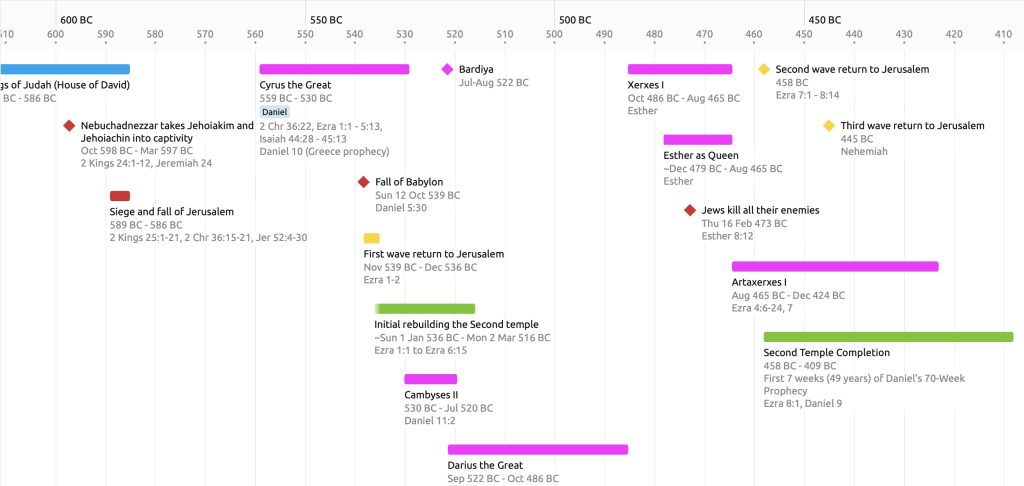
In 597 BCE, God showed Jeremiah two baskets of figs.
The LORD showed me, and there were two baskets of figs after Nebuchadnezzar, king of Babylon, had carried away captive … from Jerusalem, and had brought them to Babylon. One basket had very good figs, like the figs that are first ripe, and the other basket had very bad figs, which could not be eaten; they were so bad.
Jeremiah 24:1-2
These figs relate to the leader’s captivity that had just occurred, followed by the fall of Jerusalem in 586 BCE.
A. Very Good (Blessed) Figs
The basket of very good figs is explained in the following verses:
“Thus says the LORD, the God of Israel: ‘Like these good figs, so will I acknowledge those who are carried away captive from Judah, whom I have sent out of this place for their own good, into the land of the Chaldeans. For I will set My eyes on them for good, and I will bring them back to this land; I will build them and not pull them down, and I will plant them and not pluck them up.
Jeremiah 24:5-6
Regarding the timing of the Babylonian conquest of Jerusalem, those who were taken into captivity by the Babylonians were the very good figs. They would leave Jerusalem, and over the next three generations, their descendants would return to Jerusalem to rebuild the city and the temple.
B. Very Bad (Cursed) Figs
Now let us turn our attention to the other basket of figs. For those who choose to remain in Jerusalem, the story is very different:
‘And as the bad figs which cannot be eaten, they are so bad… so will I give up Zedekiah the king of Judah, his princes, the residue of Jerusalem who remain in this land, and those who dwell in the land of Egypt. I will deliver them to trouble into all the kingdoms of the earth, for their harm, to be a reproach and a byword, a taunt and a curse, in all places where I shall drive them. And I will send the sword, the famine, and the pestilence among them, till they are consumed from the land that I gave to them and their fathers.'”
Jeremiah 24:8-10
Those who remained in Jerusalem during the Babylonian invasion are represented by the very bad figs. The bad figs are those that stayed on the tree too long, while the good figs are those that ripen early in the summer season.
At first, we might assume that this applies only to the Babylonian captivity. However, a more careful study shows that it specifically looks forward to the time of Christ and the coming of the New Covenant.
4. Jesus Curses The Fig Tree.
Now that we have seen that Jesus referred to fig trees bringing forth leaves in a positive sense, and that Jeremiah referred to figs in both a positive and a negative light, we need to see where Jesus refers to figs in a negative sense.
A. Learn the Parable of the Fig Tree
In the verses where Jesus refers to the fig tree bringing forth new leaves, Jesus said:
“Now learn this parable from the fig tree: …”
Matthew 24:32
The Greek word for “learn” is μανθάνω (manthanō), which means “to understand.” He was not just saying, “Look at the fig tree”; He was saying, “Understand what the parable of the fig tree means.” What was He referring to? He is reminding the disciples of what had happened a few days previously:
Now, in the morning, as He returned to the city, He was hungry. And seeing a fig tree by the road, He came to it and found nothing on it but leaves and said to it, “Let no fruit grow on you ever again.” Immediately, the fig tree withered away.
Matthew 21:18-19
This event’s significance is highlighted by Matthew’s description of the disciples’ response:
And when the disciples saw it, they marvelled, saying, “How did the fig tree wither away so soon?”
Matthew 21:20
That they marvelled at this above all else they had seen means that when Jesus referred to understanding the parable of the fig tree, they would immediately remember what had happened a few days earlier.
The context of Matthew 24 is the coming judgment on Israel. Matthew 23 brings the woes upon the religious leaders, and the majority of Matthew 24 refers to the destruction of the Temple and the city of Jerusalem.
And Jesus said to them, “Do you not see all these things? Assuredly, I say to you, not one stone shall be left here upon another, that shall not be thrown down.”
Matthew 24:2
5. Israel the Judged Fig Tree
Jesus’ cursing of the fig tree reminds us of Joel’s use of the fig tree’s withering as a prophecy of God’s judgment on Israel.
A. Joel
To Jesus’ Jewish audience, the withered fig tree was a warning of the coming day of the Lord as prophesied by Joel.
He has laid waste My vine,
Joel 1:7,12,15
And ruined My fig tree;
He has stripped it bare and thrown it away;
Its branches are made white …
The vine has dried up,
And the fig tree has withered…
Alas for the day!
For the day of the LORD is at hand;
It shall come as destruction from the Almighty.
B. Coming Roman Army
The day of the Lord would come in judgment on Israel through the Roman Empire, who in Joel 2:18 is referred to as the Northern Army.
Blow the trumpet in Zion,
Joel 2:1
And sound an alarm in My holy mountain!
Let all the inhabitants of the land tremble;
For the day of the LORD is coming,
For it is at hand:
C. Day of the Lord
Peter’s sermon on the day of Pentecost identified that the day of the Lord would be accompanied by the sun turned into darkness and the moon into blood. And of course, we learned that these occurred on Passover 70 CE, the night Jerusalem was surrounded by the four Roman armies, and then again exactly five months later, on the night Jerusalem was destroyed by those same armies.
The sun shall be turned into darkness,
Acts 2:20
And the moon into blood,
Before the coming of the great and awesome day of the LORD.
Now, let us consider the first fig leaf in scripture and its connection to the first covenant between man and God, the Adamic Covenant. We will observe that the fig tree being cursed and Jesus’ prophecy about it bearing leaves are irrevocably linked to the covenant.
6. Fig Tree in Covenant
A. The Edenic Promise
The first covenant God made granted humankind dominion over His creation.
Then God said, “Let Us make man in Our image, according to Our likeness; let them have dominion over the fish of the sea, over the birds of the air, and over the cattle, over all the earth and over every creeping thing that creeps on the earth.”
Genesis 1:26
B. Adamic Covenant
However, after Adam and Eve sinned, they felt ashamed and tried to cover themselves with fig leaves.
Then the eyes of both of them were opened, and they knew that they were naked; and they sewed fig leaves together and made themselves coverings.
Genesis 3:7
God did not regard this as sufficient; instead, He provided them with garments of animal skin.
Also for Adam and his wife the LORD God made tunics of skin, and clothed them.
Genesis 3:21
God’s provision of animal skins meant that blood had to be shed. The shedding of blood is an essential component of every covenant God makes with humankind. The terms of the Adamic Covenant are found in the preceding verses.
C. Humankind, Not Israel
The fig tree concerns humanity as a whole rather than the Jewish people. It would be more than 2,250 years before the Jews would become a distinct people through Jacob. The fig tree and its leaves are linked to sin and humanity’s attempt to cover shame with fig leaves to hide nakedness. God’s answer, however, is a covenant that requires the shedding of blood, foreshadowing Jesus’ death on the cross, to remove sin through the New Covenant.
Also for Adam and his wife the LORD God made tunics of skin, and clothed them.
Genesis 3:21
Thus, the fig tree is associated with sin and with the covenant God made with humankind as a whole, rather than with the Jewish people specifically.
D. Death Reigns
Romans teaches that death reigned from Adam to Moses.
Nevertheless, death reigned from Adam to Moses,…
Romans 5:14
It was never God’s intention for sin to continue to reign and for this reason the parable of the fig tree was important to Jesus and marvellous in the eys of the disciples
The sting of death is sin, and the strength of sin is the law.
1 Corinthians 15:56
E. Strength of Sin Destroyed
In the following verse we find that sin reigned in death
Moreover the law entered that the offense might abound. But where sin abounded, grace abounded much more, so that as sin reigned in death, even so grace might reign through righteousness to eternal life through Jesus Christ our Lord.
Romans 5:20-21
Now let us return to Jesus cursing the fig tree and see what Jesus said next:
F. Sin Thrown into the Sea
There is an amazing scripture saying that if you speak to this mountain you can throw it into the sea.
So Jesus answered and said to them, “Assuredly, I say to you, if you have faith and do not doubt, you will not only do what was done to the fig tree, but also if you say to this mountain, ‘Be removed and be cast into the sea,’ it will be done.
Matthew 21:21
This is a great faith scripture for preaching. However, we must look at it in context. If throwing a mountain into the sea was a demonstration of faith, why did Jesus not do this?
Jesus was standing on Mount Olivet. This mountain is known for its olive trees; however, it was also a mountain of fig trees, so much so that the village of Bethphage was on its slope. Bethphage in Aramaic means “house of unripened figs”.
G. Sin is Forgotten, Not Just Covered
This is a direct fulfilling of:
He will again have compassion on us,
Micah 7:19
And will subdue our iniquities.
You will cast all our sins
Into the depths of the sea.
So he was saying that the mountain of figs representing the covering of sin can be removed through faith! There is no more covering of sin; now our sins are forgiven and forgotten.
For I will be merciful to their unrighteousness, and their sins and their lawless deeds I will remember no more.”
When Jesus caused the fig tree to wither and die, He was declaring that the law and death are dead, and all confessed sin is thrown into the sea.
7. Summer Is Near
A. The Promise of Blessing
Having established that figs are associated with covenant and the withered fig tree a prophetic sign of judgement, we should return to the original scripture.
“Now learn this parable from the fig tree: When its branch has already become tender and puts forth leaves, you know that summer is near. So you also, when you see all these things, know that it is near—at the doors!
Matthew 24:32-33
Some interpret Jesus’ statements about the near future as referring to events in the next 2,000 years. However, it is important to remember that Jesus was speaking to human beings and that the events He described would occur within five to seven days, as He established a new covenant based on faith through His sacrificial death.
B. Good Figs
If we remember that there were good figs and bad figs in Jeremiah’s prophecy, the good figs would have a heart to know God and would come into a covenant relationship with Him.
Thus says the LORD, the God of Israel: ‘Like these good figs, …Then I will give them a heart to know Me, that I am the LORD; and they shall be My people, and I will be their God, for they shall return to Me with their whole heart.
Jeremiah 24:5, 7
The highlighted words are the most important clauses of the New Covenant God makes with those who believe Jesus Christ is the Son of God.
For this is the covenant that I will make with the house of Israel after those days, says the LORD: I will put My laws in their mind and write them on their hearts; and I will be their God, and they shall be My people. None of them shall teach his neighbor, and none his brother, saying, ‘Know the LORD,’ for all shall know Me, from the least of them to the greatest of them.
Hebrews 8:10-11
The withering fig tree represents the covenants that empower death and sin no longer having power over those who believe Jesus is the Son of God and receive the Great Exchange: confessing their sins to receive God’s righteousness.
Jesus’ reference to the fig tree bearing leaves does not signify the return of Jews to Israel. It is the establishment of the New Covenant when Jesus died a few days later.
© Use by Permission Awakening Impact Ministries/ Dr Neville Westerbeek van Eerten D. Miss. BVSc. 2026