



1. Introduction
Revelation 12 presents the woman, her child, and the dragon in a vision of the conflict surrounding Jesus’ birth, death, resurrection, and enthronement. It also shows Satan expelled from heaven, God protecting the woman, and the dragon persecuting Jesus’ followers.
The chapter does not unfold as a continuous timeline. It gathers events from different points in the historical chronology argued here. The lesson distinguishes the vision’s sequence from the chronology of its fulfilment.
Here, the child is Jesus, the woman represents Israel, and the dragon is Satan. Revelation 12 also informs the claim that Daniel predicted a future seven-year peace treaty with Israel. This lesson reads its seven-year pattern through Jesus’ ministry and the apostles’ witness to Israel. Our separate lesson, Daniel’s Seventy Weeks, covers the detailed chronology.
2. The Child
A. The Child and the Dragon’s Threat
Revelation portrays the dragon waiting to devour the child at birth (Revelation 12:4). The child is Jesus. Herod’s order to kill the male children in Bethlehem and its districts provides the historical counterpart to the dragon’s threat (Matthew 2:16).
B. The Son Who Rules
Revelation identifies the child as the ruler who will govern the nations with a rod of iron (Revelation 12:5). This language echoes the Messianic promise in Psalm 2:7-9. Isaiah also joins the images of a child born and a son given (Isaiah 9:6). These passages identify the Messiah; they do not describe a child changing into a mature or firstborn son. Revelation 12:5 uses both “male Child” and “Her Child” for the same figure.
C. The Enthroned Son
She bore a male Child who was to rule all nations with a rod of iron. And her Child was caught up to God and His throne.
Revelation 12:5 (NKJV)
This verse joins the Messiah’s birth, royal authority and enthronement in one visionary sequence. Paul describes Jesus’ exaltation as God raising Him from the dead and seating Him at His right hand (Ephesians 1:20-21). Acts records Jesus’ ascension into heaven (Acts 1:9).
3. The Woman
A. Israel, The Wife of God
The woman represents Israel, the people from whom Jesus came. The prophets use marriage imagery to describe God’s covenant relationship with Israel. Hosea portrays Israel’s unfaithfulness and records God’s promise to restore His relationship with His people (Hosea 2:19-20).
B. The Twelve Tribes
The woman is clothed with the sun and moon and crowned with twelve stars (Revelation 12:1). This imagery recalls Joseph’s dream, in which the sun, moon, and stars represented members of his family (Genesis 37:9-10). The twelve stars evoke Israel’s twelve-tribe family.
C. The House of Israel
God promised the New Covenant to the house of Israel and the house of Judah (Hebrews 8:8-10). Through Christ, Jewish and Gentile believers share one standing in God’s household (Ephesians 2:12-19). Paul expresses this unity by declaring that Christ is all and in all (Colossians 3:11). In this New Covenant sense, the house of Israel includes the worldwide Church: Jewish and Gentile believers joined to Christ.
D. The Bride for Jesus
The nation of Israel was not pleasing to God, because they were repeatedly unfaithful to Him and committed spiritual adultery by turning to other gods.
This is why God permitted the Romans to destroy Jerusalem. We must recognise that the nation of Israel today is no closer to Him than it was then. The good news is that more and more Jews are turning to Christ, becoming part of the bride of Christ.
4. War in Heaven
A. Satan Loses Access to Heaven
Job describes Satan appearing before the Lord among the sons of God (Job 1:6). Revelation announces a decisive change: the accuser who accused believers before God day and night has been cast down (Revelation 12:10).
Job records Satan appearing before God; it does not say that he could enter heaven at any moment. Revelation describes his repeated accusations and then announces his expulsion.
B. War Breaks Out
Revelation names Michael and his angels as the combatants in the heavenly war. The vision does not portray God or Jesus fighting the dragon; Michael leads the conflict against Satan and his angels.
And war broke out in heaven: Michael and his angels fought with the dragon, and the dragon and his angels fought,
Revelation 12:7 (NKJV)
It is important to understand that God does not need to go to war with the devil. The devil is merely a created being, so God sends Michael and his angels to fight against him. Jesus does not enter heaven to defeat the devil; He comes in after the devil is no longer present.
C. Jesus Visits Hades
Before ascending to heaven, Jesus descended to Hades, the realm of the dead. As explained in our lesson on Hell, Hades is distinct from Gehenna and the final lake of fire. Paul refers to Christ’s descent to the lower parts of the earth (Ephesians 4:9).
Peter says that Christ preached to spirits in prison, whom he associates with those who disobeyed in Noah’s time (1 Peter 3:18-20). Peter also says that the gospel was preached to the dead (1 Peter 4:6). Read together, these passages describe Christ’s proclamation in Hades. Peter does not identify the imprisoned spirits as particular righteous people.
Matthew records that many saints were raised and appeared in Jerusalem after Jesus’ resurrection (Matthew 27:52-53). Their resurrection testified that Christ’s victory reached the dead and brought the faithful into life. The risen Jesus holds the keys of Hades and Death (Revelation 1:18), and His words to the repentant criminal also belong in this account of His descent (Luke 23:43).
The raising of these saints was a distinct event associated with Jesus’ resurrection. It does not replace the future resurrection of those who belong to Christ at His coming, which remains the Church’s blessed hope (1 Thessalonians 4:15-17; 1 Corinthians 15:51-52).
D. Jesus Cleanses the Heavenly Sanctuary
Revelation describes Satan and his angels being expelled from heaven and cast to earth (Revelation 12:8-9). The chronology argued here places this expulsion before Jesus’ ascension. Satan is not bound, however; Revelation says that he continues to act on earth for a limited time (Revelation 12:12). Section 5 follows this event with Jesus’ entrance into heaven as High Priest.
E. Satan Is Under God’s Sovereignty
Isaiah describes heaven as God’s throne and earth as His footstool (Isaiah 66:1). Satan’s expulsion to earth places his activity within God’s domain; it does not make him God’s equal. Psalm 110 presents the Messiah enthroned while God subjects His enemies beneath His feet (Psalm 110:1).
F. Body of Christ
Paul describes Christ as head over all things to the Church, His body (Ephesians 1:22-23). Through union with Him, the Church shares in Christ’s victory and remains under His headship. The dragon’s expulsion does not end his activity on earth; it establishes that Christ reigns over every power and that His people belong to Him.
5. Jesus’ Ascension and Heavenly Ministry
A. Jesus Had Not Yet Ascended
On the resurrection morning, Jesus told Mary that He had not yet ascended to the Father (John 20:17). John records that later that day Jesus breathed on His disciples and told them to receive the Holy Spirit (John 20:22). In this sequence, this marks their new birth. Jesus ascended after appearing to His followers over forty days (Acts 1:3, 9).
B. Captivity Led Captive
Paul connects Christ’s descent and ascent with His victory and the gifts He gives to His people (Ephesians 4:7-8). This language echoes the victory described in Psalm 68:18. Through His death and resurrection, Christ disarmed the powers and cancelled the record that stood against humanity (Colossians 2:14-15).
C. Jesus, the High Priest
Jesus entered heaven as both King and High Priest. He reigns at God’s right hand and serves in the true sanctuary, which the Lord established (Hebrews 8:1-2). His priesthood follows the order of Melchizedek, the king and priest whom Abraham honoured (Hebrews 6:20; 7:1-2).
D. Jesus Cleanses the Heavenly Sanctuary
The earthly high priest carried sacrificial blood into the Most Holy Place. Jesus, the New Covenant High Priest, entered the true heavenly sanctuary in His resurrected body and presented His living blood before God.
Therefore, it was necessary that the copies of the things in the heavens should be purified with these, but the heavenly things themselves with better sacrifices than these.
Hebrews 9:23 (NKJV)
Hebrews distinguishes the earthly copies from the heavenly things, which required a better sacrifice. In the chronology argued here, Jesus’ cleansing work in the heavenly sanctuary follows Satan’s expulsion.
6. Jesus’ Enthronement
A. The Son of Man Comes to the Ancient of Days
Daniel sees one like the Son of Man coming with the clouds to the Ancient of Days. He receives dominion, glory, and a kingdom (Daniel 7:13-14). The movement is toward God’s throne: the vision depicts Jesus ascending to receive His kingdom, not descending to earth.
Acts records Jesus’ ascension in a cloud (Acts 1:9). Read with Daniel’s vision and Revelation’s account of the child being caught up to God’s throne (Revelation 12:5), this scene presents Jesus’ entrance into heaven and His investiture with royal authority.
B. Pentecost: Power and Authority
Jesus promised that His disciples would receive power when the Holy Spirit came upon them, enabling them to witness to Him (Acts 1:8). At Pentecost, the Spirit came upon them, and they began to proclaim the risen Jesus (Acts 2:1-4).
Revelation announces the arrival of God’s kingdom and the authority of His Christ after the dragon is cast down (Revelation 12:10). Pentecost marked the public beginning of the apostles’ Spirit-empowered witness to the risen and enthroned Jesus.
C. Pentecost: New Covenant Deliverance
Revelation’s announcement of God’s salvation and kingdom took visible form at Pentecost. Peter proclaimed the risen Jesus, and about three thousand received his message, were baptised, and joined the believers (Acts 2:41).
Here, salvation concerns deliverance into the life of the New Covenant, not the final resurrection.
7. The Seven-Year Framework
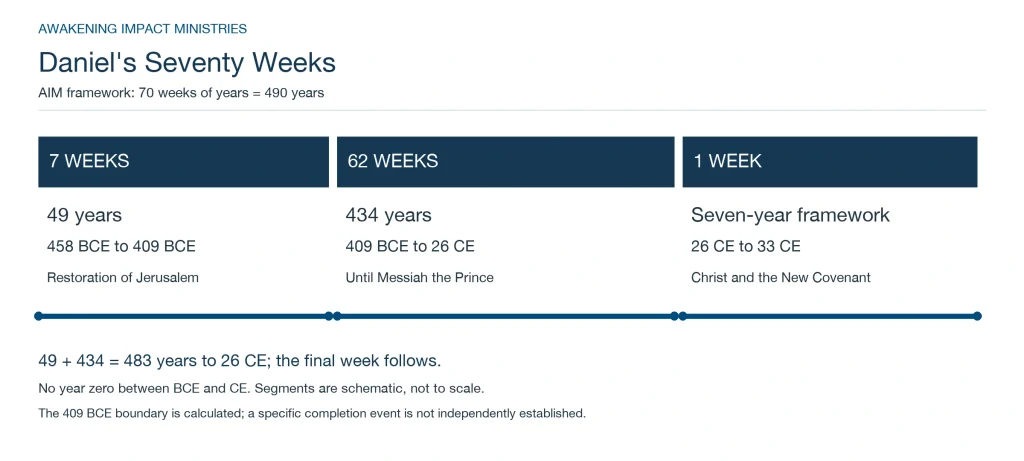
Daniel’s seventy weeks divide into seven weeks, sixty-two weeks, and a final week (Daniel 9:24-27). In the chronology developed in our separate lesson, Daniel’s Seventy Weeks, the first sixty-nine weeks lead to the beginning of Jesus’ ministry in 26 CE.
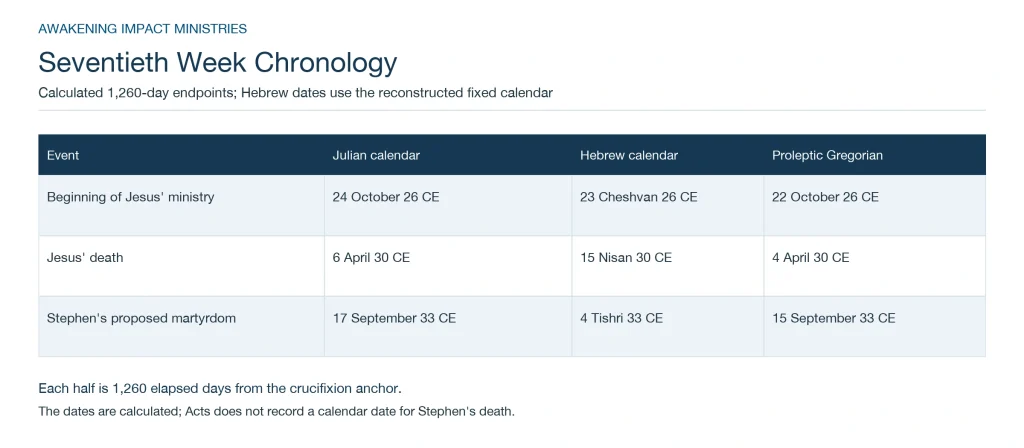
The final week spans seven years and comprises two consecutive periods of 1,260 elapsed days. Jesus’ ministry forms the first half, ending with His death in 30 CE. The apostles’ witness to Israel forms the second half. The tables that follow summarise the framework and its calculated dates.
8. Three and a Half Years
A. Revelation’s Two Expressions
Revelation describes the woman’s protection in the wilderness as lasting 1,260 days and as lasting “a time, times, and half a time” (Revelation 12:6, 14). In this chronology, each expression represents one half of the final week: two consecutive periods of 1,260 elapsed days.
B. The Two Periods
The first period covers Jesus’ ministry to Israel and ends with His death, when He establishes the New Covenant through His blood. The second covers the apostles’ witness to Israel and ends with Stephen’s proposed martyrdom. Revelation’s account of the nourished woman and the dragon’s persecution connects these periods with the chapter’s unfolding vision (Revelation 12:6, 13-14).
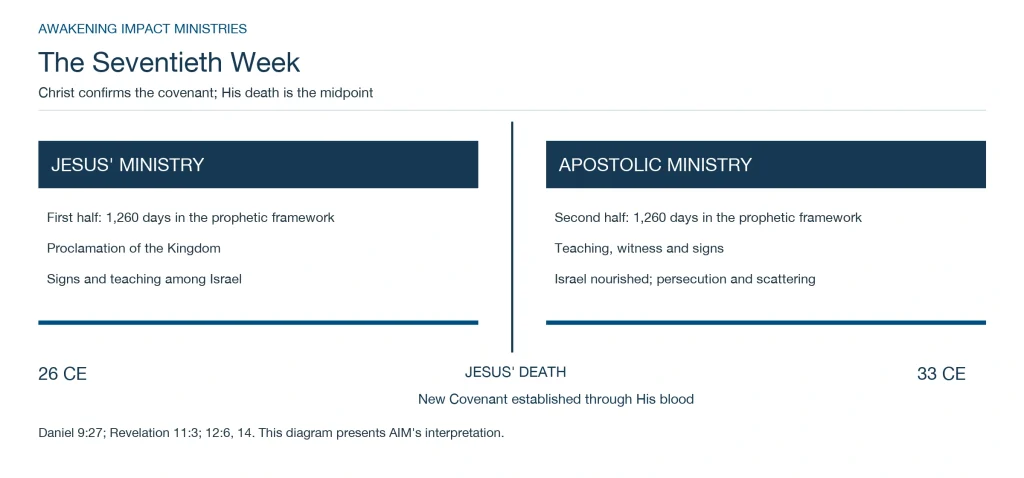
The table places Jesus’ ministry in the first 1,260-day period and the apostolic ministry in the second. Jesus’ death divides the two periods and marks the New Covenant’s establishment.
The next table shows the seventy weeks as seven weeks, sixty-two weeks, and a final week. The first sixty-nine weeks lead to the beginning of Jesus’ ministry in 26 CE; the final week covers His ministry and the apostles’ witness to Israel.
9. The Nourished Woman
A. The Gospel Nourishes Israel
Revelation portrays the woman as nourished in the wilderness while the dragon persecutes her (Revelation 12:6, 13-14). During the second 1,260-day period, the apostles proclaimed the New Covenant to Israel. Peter preached in Jerusalem, and thousands received the message (Acts 2:14, 41). The apostles taught in the Temple and in homes, and many priests became obedient to the faith (Acts 5:42; 6:7).
Through this witness, the apostles nourished Israel with the gospel before persecution scattered the believers. The adopted chronology places Stephen’s proposed martyrdom on 17 September 33 CE, at the close of the period. Acts records his death but gives no calendar date.
10. The Seven Years of Covenant Confirmation
A. The Messiah Confirms the Covenant
Daniel identifies the coming ruler as the Messiah the Prince (Daniel 9:25). The next verse describes His covenant-confirming work:
Then he shall confirm a covenant with many for one week;
Daniel 9:27 (NKJV)
But in the middle of the week
He shall bring an end to sacrifice and offering.
This lesson identifies the covenant-confirming figure as the Messiah whom Daniel calls Messiah the Prince (Daniel 9:25). Jesus’ ministry to Israel begins the week; His death at its midpoint establishes the New Covenant, and the apostles’ witness completes the second half. Daniel describes the Messiah’s covenant work, not a future political peace treaty confirmed by the Antichrist.
B. The Woman in the Wilderness
The wilderness recalls Israel’s formation as God’s covenant people after the Exodus (Exodus 19:4-6). Revelation uses this setting to portray God’s provision for the woman amid the dragon’s persecution (Revelation 12:6, 13-14).
11. The Persecuted Woman
Revelation portrays the dragon pursuing the woman after she is nourished in the wilderness (Revelation 12:13-14). This lesson traces that hostility through events affecting Jewish communities under successive Roman rulers.
During Caligula’s reign (12-41 CE), anti-Jewish violence erupted in Alexandria in 38 CE. Philo (c. 20 BCE-50 CE) describes attacks on Jewish homes and synagogues. Caligula also ordered a statue of himself to be placed in the Jerusalem Temple. The Syrian governor Petronius delayed the order after Jewish resistance; the statue was never installed.1
Under Claudius (10 BCE-54 CE), Jews were expelled from Rome amid disturbances associated with Chrestus. Suetonius records the expulsion, and Acts says Claudius ordered Jews to leave Rome. Suetonius gives no year; the commonly assigned date of around 49 CE is not explicit in his account.2
Under Nero (37-68 CE), the Roman procurator Gessius Florus’s actions in Judea helped turn unrest into open revolt in 66 CE.3 Nero then sent Vespasian (9-79 CE) to suppress the revolt. After Vespasian became emperor, his son Titus (39-81 CE) led the Roman campaign that culminated in Jerusalem’s destruction on 7-8 September 70 CE.4
This sequence presents the dragon’s hostility against the woman through escalating conflict under successive Caesars. The next section returns to the earlier persecution of Jesus’ followers, beginning with Stephen’s death.
12. The Dragon Rages Against the Church
A. The Rest of Her Offspring
The vision now turns from the woman’s persecution under the Caesars to the dragon’s war against her remaining offspring.
And the dragon … and he went to make war with the rest of her offspring, who keep the commandments of God and have the testimony of Jesus Christ.
Revelation 12:17
Acts records this persecution beginning with Stephen’s martyrdom. After Stephen’s death, severe persecution broke out against the Church in Jerusalem, scattering believers; Saul ravaged the congregations (Acts 7:58-60; 8:1-3). The chronology places Stephen’s proposed martyrdom at the close of the second 1,260-day period, as summarised above. Acts records his death but gives no calendar date.
13. The Seven-Year Peace Treaty Claim
Some futurist interpretations assign Daniel’s seventieth week to a future treaty confirmed by the Antichrist. Daniel identifies the coming Prince as “Messiah the Prince” and says that He confirms the covenant (Daniel 9:25, 27). Our separate lesson, Daniel’s Seventy Weeks, presents the detailed case for reading the final week through Jesus’ ministry and the apostles’ witness.
14. Summary
Revelation 12 portrays Israel giving birth to the Messiah and Satan opposing His work. Jesus’ death, resurrection, descent to Hades, and ascension mark His victory. After Satan’s expulsion, Jesus enters heaven as King and High Priest, cleansing the heavenly sanctuary with His living blood.
The chapter’s seven-year pattern is read here as Jesus’ ministry to Israel followed by the apostles’ New Covenant witness. Pentecost publicly displayed the authority of the enthroned Christ. The vision also depicts the dragon’s persecution of the woman and her offspring, reflected in the historical pressures on Jewish communities under successive Caesars and the persecution of Jesus’ followers. Its visionary sequence gathers events from different points in the first-century chronology.
- Philo, In Flaccum 41-96; On the Embassy to Gaius 132-139, 188-203; Josephus, Antiquities 18.8.1-3. ↩︎
- Acts 18:2; Suetonius, Claudius 25.4. Suetonius does not give a year; the expulsion is commonly dated to around 49 CE ↩︎
- Josephus, The Jewish War 2.14.4-9 (2.293-308); Antiquities 20.11.1. ↩︎
- Josephus, The Jewish War 3.1.1-3; 6.10.1 (6.435). ↩︎
AI Assistance Disclosure
Most of the research and writing for this lesson was prayerfully undertaken by Dr Neville Westerbeek van Eerten. AI tools assisted with editorial review and checks of consistency, references and chronology. Some wording and tables were developed with AI assistance. The author reviewed the final material and retains responsibility for its interpretations, accuracy and conclusions.
© Use by Permission Awakening Impact Ministries / Dr Neville Westerbeek van Eerten DMiss BVSc 2027


Sure ask your questions, as long as they are genuine and related to the topic