

1. Introduction
Revelation gives a prophecy concerning a forty-two-month period during which the Gentiles are granted the temple courts and the city.
A. Previously
In our Introduction to the Great Tribulation, we addressed these questions:
- When was the Great Tribulation and why will it never happen in our lifetime?
- What was the Abomination of Desolation?
- Had the gospel been preached to all nations before the Great Tribulation?
- Why does Revelation equate Jerusalem to Sodom and Egypt?
- Who was Josephus, and is he a credible historian?
We then examined the Seven Seals of Revelation and their relationship to the Great Tribulation, which occurred from 66 CE to 73 CE. We answered these questions:
- What are the Seven Seals and how do they connect to the Great Tribulation?
- Was a quarter of the population killed, as Revelation states?
In our third lesson, we studied the 144,000 and determined that they were Jews of the first century prior to and during the Great Tribulation.
Then we examined the key elements of various calendars from the first century to understand the historical view of the Great Tribulation.
Our lessons on Daniel’s Seventy-Weeks Prophecy revealed that the seventy weeks aligned precisely with the start of Jesus’ ministry. By understanding the different calendars, we can determine the beginning of the New Covenant, Stephen’s martyrdom, and subsequently, Jesus’ birth in 4 BCE.
Then we learned that the Euphrates army, comprising a 10,000-man legion of horsemen called the Legio Equestris and a second legion of 10,000 men, came from the Euphrates to attack Jerusalem.
In the eighth lesson, we learned that the Great Tribulation was the 2300-day prophecy of Daniel.
Then, in the last lesson, we learned that 67 CE was accompanied by signs that have links inside Revelation, that heralded most of the remaining timed prophecies of Daniel and Revelation
Then I was given a reed like a measuring rod. And the angel stood, saying, “Rise and measure the temple of God, the altar, and those who worship there. But leave out the court which is outside the temple, and do not measure it, for it has been given to the Gentiles. And they will tread the holy city underfoot for forty-two months
Revelation 11:1-2
2. Forty-Two-Month Prophecy
67 CE is a year of signs from God, warning of Jerusalem’s impending destruction. The first day of Passover marks the start of the following prophecies:
- 42-month prophecy of Revelation.
- three-and-a-half-years prophecy of Daniel 7.
- 1290-day prophecy of Daniel 12.
- 1335-day prophecy of Daniel 12.
A. Tread Down by the Gentiles
67 CE is part of the 2300-day Great Tribulation; John also refers to another time period in Revelation 11 above. John explains that the Gentiles will trample the city of Jerusalem for forty-two months.
The four signs of 67 CE from the last lesson mark the start of a terrifying era for Jerusalem and the cities of Judea, Galilee, and Samaria.
B. Context
When we read the Book of Revelation, the headings we see are not part of the Bible. Your Bible might have a heading like ‘The Two Witnesses’ at the start of the chapter, but that is not in the Bible and is misplaced — it should begin at Revelation 11:3, not verse 1. We have a complete lesson on the Two Witnesses.
The verse about the forty-two months is not related to the Two Witnesses; it is linked to the earlier verse about measuring the Temple, which was written around 63-65 CE. For John to measure the Temple, it was still standing when Revelation was penned.
C. Temple Related
The trampling down by the Gentiles begins when the glory departs from the Temple on 19 April (15 Nisan) 67 CE. It ends forty-two months later, with the city’s final destruction on 8 September (14 Elul). The Romans then remained in the city for several more weeks before withdrawing. Some might object that the period from April to September is only forty-one months, but this calculation must be made using the Jewish lunisolar calendar.
D. Hebrew LuniSolar Calendar
Previously, we learnt that the Hebrew Calendar does not consist of 12 months; instead, it features irregular leap years with an additional month at the end of the year. This extra month, called Adar II or Adar Bet, falls between Shevat and Adar and typically occurs in February or March. Therefore, in 67 CE, it is added before April 18, so that year only has 12 months from April 18, 67 CE, to April 18, 68 CE. However, in 70 CE, Adar Bet is included, bringing the total to 13 months. Here is a table showing the number of months.
| Year CE | Lunar | Number of Months | Total months | Historic Event |
| 66-67 | Lunar | 13 | 0 | Nisan 15 (April 19) Three signs of the Messiah: 1. East gate opens 2. Heifer bears a lamb. 3. Glory Departs In April/May, the first city falls to the Romans |
| 67-68 | Non-Lunar | 12 | 12 | |
| 68-69 | Non-Lunar | 12 | 24 | |
| 69-70 | Lunar | 13 | 37 | |
| April 70 to September 70 | +5 = 42 | Elul 14 (September 8), destruction of the City and Edomites |
It is when we count the months using the Hebrew calendar that we find the forty-two-month prophecy is precisely accurate.
The time from Passover 67 CE (Nisan 15) to the fall of Jerusalem (Elul 14) is forty-two months to the day.
Revelation 11:1-2
3. Gentiles Conquer Throughout the Forty-Two-Month-Prophecy
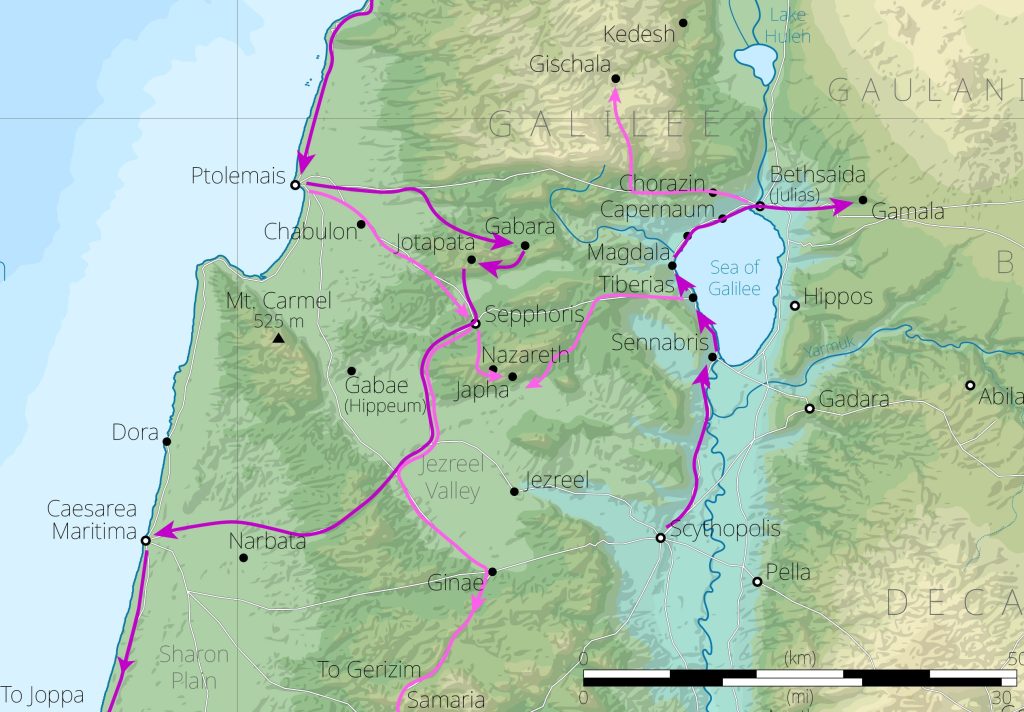
As Christians fled Jerusalem in November and early December 66 CE, the Great Tribulation began when Nero declared war on Judea and Galilee. Much like the early months of World War II, when Britain experienced a relatively quiet “Phoney War,” there was little immediate evidence of Roman conquest for about four and a half months. This lull gave the remaining Jews time to forge weapons and undergo military training. However, once the Romans finally advanced, the Jewish forces were unable to stop them as they swept decisively through Galilee.
Six months after the Jews defeated the Romans, and four months after the Antichrist (Nero) declared war on the Jews, the Jews of Ashkelon (also called Ascalon) rose against the Romans. Their unexpected defeat at the hands of the Romans resulted in 10,000 Jews being killed. The Jews fled to the stronghold city of Jerusalem.
A. Edomites (Idumeans)
The Idumeans were the later historical successors of the Edomites mentioned in the Old Testament, a people against whom the biblical texts record particularly severe oracles of judgment under the Old Covenant.
“For violence against your brother Jacob,
Obadiah 1:9
Shame shall cover you,
And you shall be cut off forever.
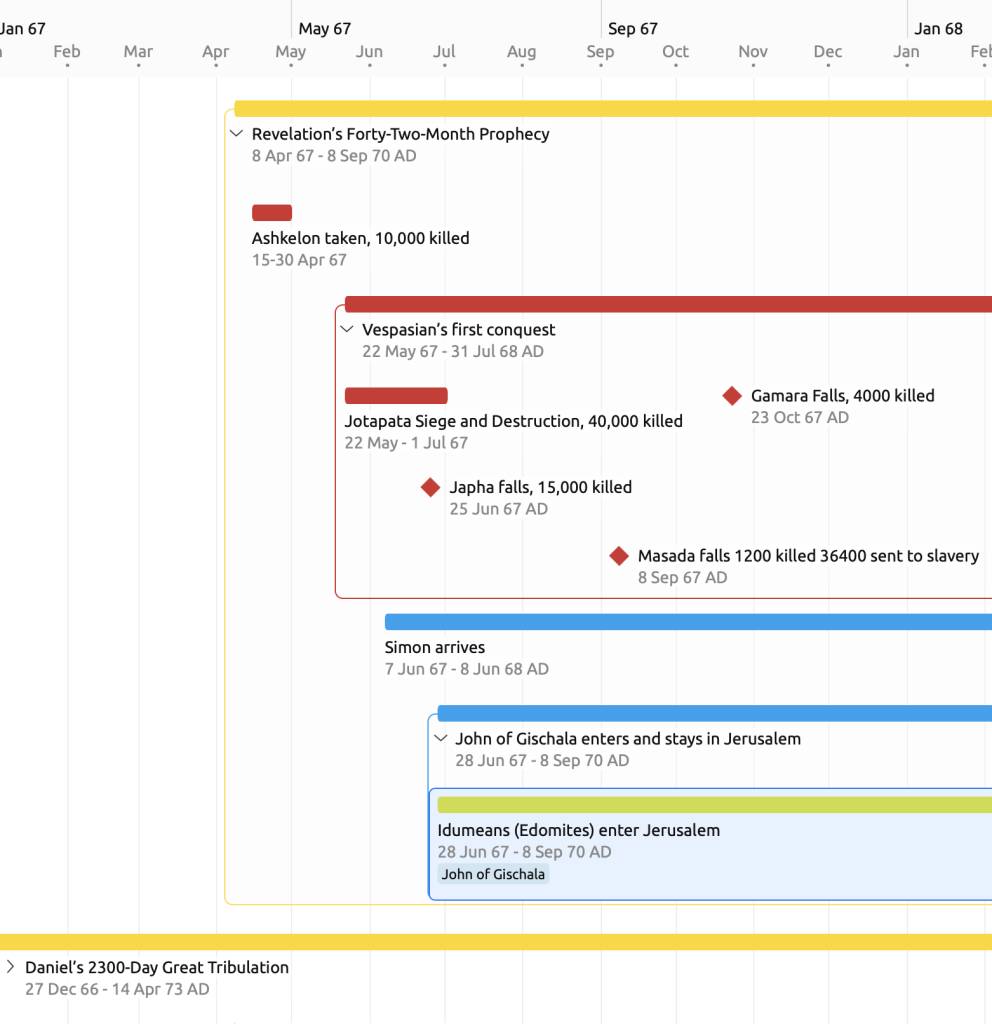
Looking at the chart below, we see that the Edomites were invited to Jerusalem by a Jew named John of Gischala on June 28, 67 CE.
The zealots also joined in the shouts raised by the Idumeans, and the storm itself made the cry even more terrible; nor did the Idumeans spare anyone, for as they are naturally a very barbarous and bloody nation, and had been distressed by the tempest, they used their weapons against those who had shut the gates against them. Now, after these were slain, the zealots and the multitude of the Idumeans fell upon the people as upon a flock of profane animals, and cut their throats;
Flavius Josephus War of the Jews 4.310,316
Within ten days, the Edomites and the Zealots had killed 20,500 Jews. Later, we will see that the death of the Idumeans at the hands of the Romans fulfilled Isaiah 62:1.
B. Samaritans
Although Samaritans were not strictly Gentiles, they were looked down upon by the Jews and considered Gentiles:
Then the woman of Samaria said to Him, “How is it that You, being a Jew, ask a drink from me, a Samaritan woman?” For Jews have no dealings with Samaritans.
John 4:9
C. Jews Acting Like Gentiles to Other Jews
As each city fell to the Romans, increasing numbers of seditious people arrived in Jerusalem. Josephus mentions the seditious Jews looting and openly killing leading figures in the streets of Jerusalem from the beginning of the Great Tribulation.
There were, besides these, other robbers that came out of the country, and came into the city, and joining to them those that were worse than themselves, omitted no kind of barbarity; (139) for they did not measure their courage by their thefts and plunderings only, but proceeded as far as murdering men, and this not in the nighttime or privately, or with regard to ordinary men, but did it openly in the daytime, and began with the most eminent persons in the city;
Josephus 4.138-139
| Josephus Reference | Macedonia Date | Roman Calendar | Hebrew Calendar | Historic Event by Romans | Historic Events by the Jews |
| 67CE | |||||
| 3.1.2, 4.3.4 | April & May | During the harvest (which starts in April), Ascolon falls. 10,000 Jews killed. | The first seditionists arrive in Jerusalem to plunder and murder. | ||
| 3.145 | 22 Artemisius | 22 May | 19 Iyyar | Vespasian arrives at Jotapata | Josephus leads the defence of Jotapata |
| 3.306 | 25 Daesius | 25 June | 24 Sivan | Japha falls, 15,000 Jews killed | More seditious arrive in Jerusalem to plunder and kill. |
| 4.112 | 27 Daesius | 27 June | 26 Sivan | John the Zealot flees Gerizim with his men to take Jerusalem and rule by force over its people. | |
| 3.315 | 28 Daesius | 28 June | 27 Sivan | City of Gerizim falls, 11,600 killed on the Mount of Blessing | More Jews arrive in Jerusalem, fulfillment of fourth bowl and trumpet |
| 3.315 | 28 Daesius | 28 June | 27 Sivan | John the Zealot invites the Idumeans (Edomites) into Jerusalem | |
| 3.316 | 1 Panemus | 1 July | 30 Sivan | City of Jotapata falls, 40,000 Jews killed | Vespasian captures Josephus, who prophesies that he will become Emperor. |
| 4.4.6 – 4.5.3 | 7 Panemus | 7 July | 6 Tammuz | 20,000 Idumeans force into Jerusalem. The zealots join them in killing 20,500 Jews, including the High Priest Anunus. They take over the Temple | |
| 3.414-427 | Panemus | July | Tammuz | Vespasian attacks Joppa. Kills 4200 sailors who try to return to land. Mediterranean Sea turns red | 4200 citizens flee to the sea, but a storm causes all ships to be shipwrecked. Those not killed tried to swim to shore |
| 3.532-542 | 8 Gorpeaus | 8 Sept | 10 Elul | City of Magdala (Taricheae) falls. 1200 killed, 6000 sent to Nero, and 30,400 were sold | |
| 3.522-531 | 9 Gorpeaus | 9 Sept | 11 Elul | Battle for the Sea of Galilee | Sea Turns Red in fulfilment of 2nd bowl and trumpets of Revelation |
| 4.69, 4.83 | 23 Hyperberetaeus | 23 October | 26 Tishri | Fall of Gamala. The Romans killed 4000. | The Jews threw their wives and children down the walls, killing 5000 more. |
D. Massacre in the Temple Courts
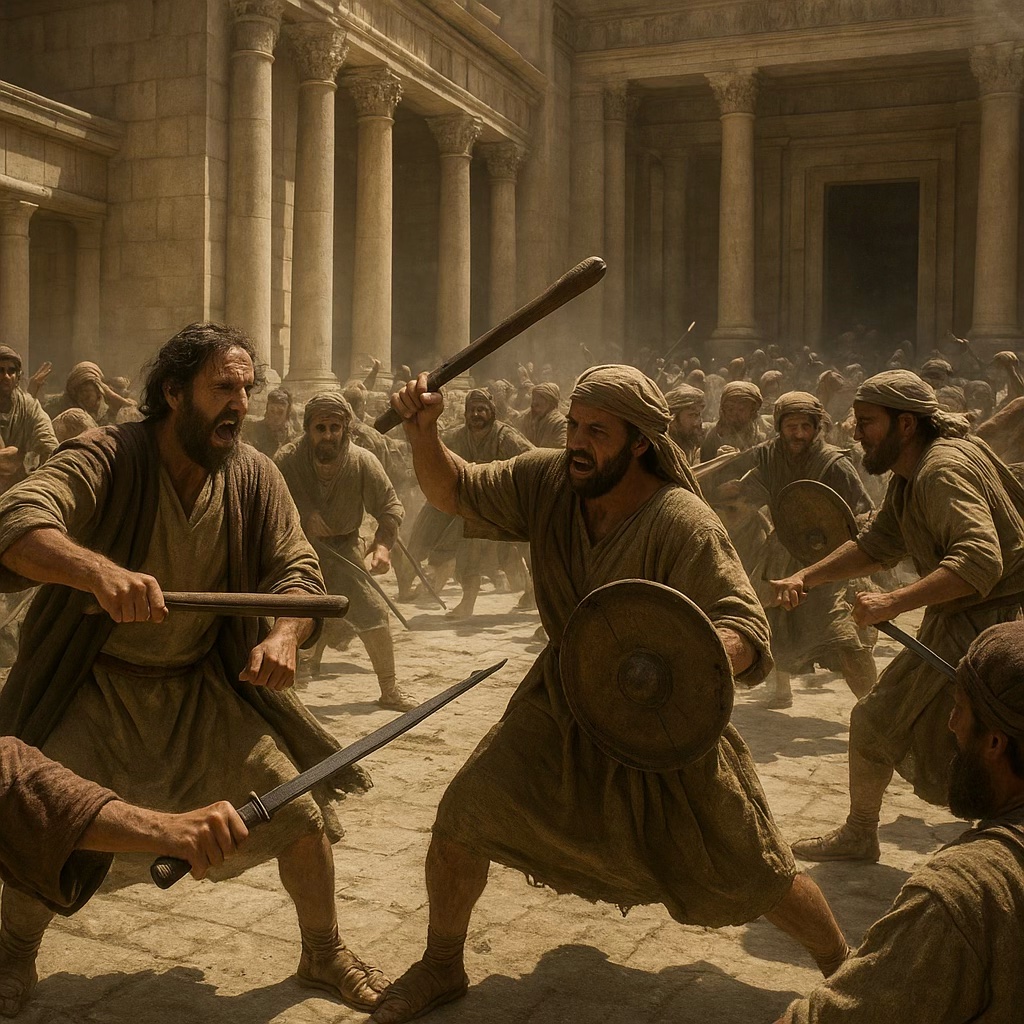
The plundering and murder were not limited to Jerusalem itself but also took place in the Temple Courts, as predicted in Revelation 11; the courts would be trampled by the Gentiles for forty-two months.
But leave out the court which is outside the temple, and do not measure it, for it has been given to the Gentiles. And they will tread the holy city underfoot for forty-two months
Revelation 11:2
Even the High Priest Ananus and his family were slaughtered, along with much of the priesthood.
They believed it was unnecessary to continue the killing, so they shifted their focus to the high priests. With the majority rallying enthusiastically, once they caught the high priests, they slaughtered them.
Flavius Josephus War of the Jews 4.315-316
So many people were killed that blood flowed from the outer temple courtyard.
And now the outer temple was entirely overflowed with blood; and as the day progressed, it saw eight thousand five hundred dead bodies there.
Flavius Josephus War of the Jews 4.313
E. Gentiles Rule Over Jerusalem from the Temple
The Idumeans and their allies had already seized control of the area surrounding the Temple. From June 7 onward, John of Gischala and Simon ben Giora fought for dominance over the Temple because its high walls were ideal for archers, it was a sacred site, and it possessed exceptionally strong stone fortifications. It remained a stronghold for both the Zealots and the Idumeans until its destruction on August 10, 70 CE. From this base, the Zealots and Idumeans were able to rampage throughout the city.
Now, after these were slain, the zealots and the large crowd of the Idumeans attacked the people like a flock of unclean animals, and slaughtered them.
Flavius Josephus War of the Jews 4.316
By the end of 67 CE, four major cities and numerous towns and villages had fallen to the Romans. However, this marked only the beginning of the forty-two-month prophecy.
4. A Year of Deepening Crisis – 68 CE.
A. Jerusalem Gets Ready for War
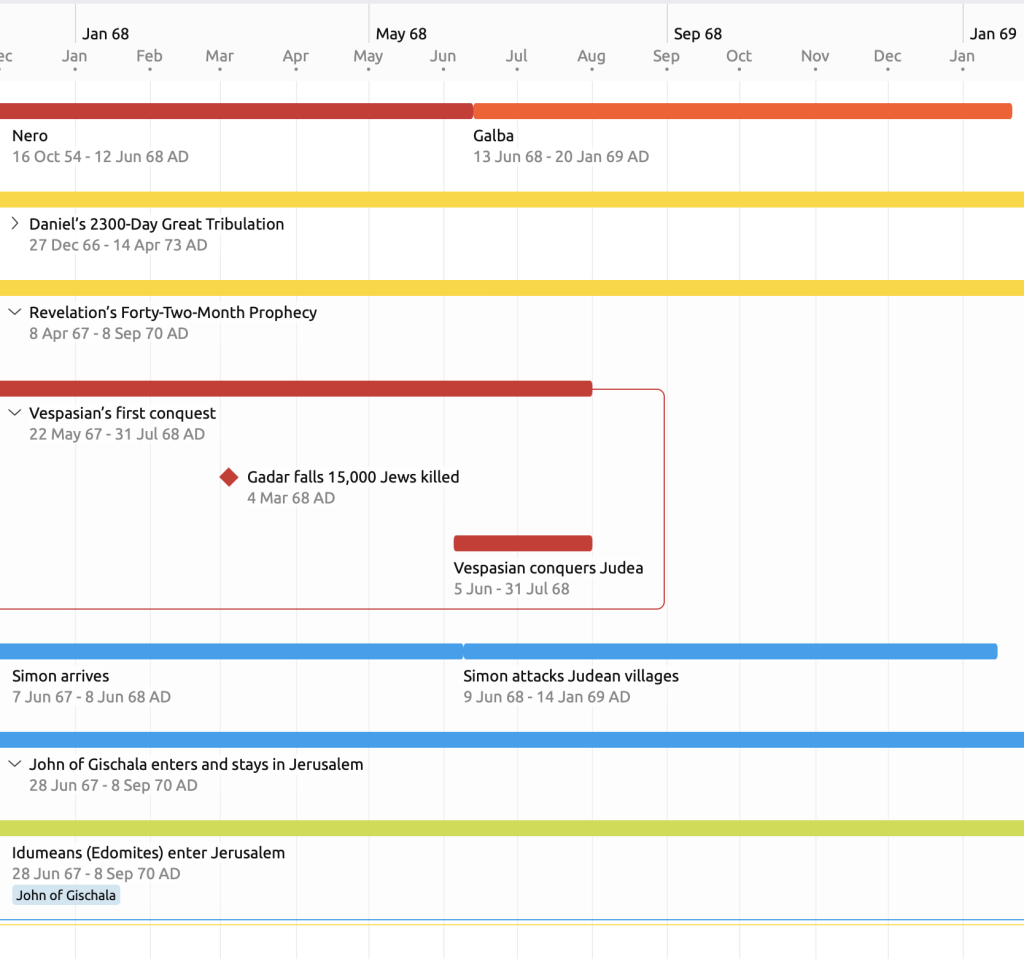
As the Romans seize control of Galilee and Samaria, more Jews flee to Jerusalem. John the Zealot, now ruling the city, welcomes newcomers to build an army against the Romans. Among them are both the innocent and the seditious. Robbers also enter Jerusalem mixed in with the innocent. Most of these robbers side with John because it gives them an opportunity to attack and murder anyone who considers surrendering to the Romans. The innocent are caught in the middle. If they refuse to join John against the Romans, they must sell their possessions to buy food and water. If they are seen trying to escape the city, they are slaughtered by their fellow Jews.
B. Simon the Zealot Prepares for Battle
Simon ben Giora, whose defeat of the Roman Twelfth Legion Fulminata was later seen as the spark of the Great Tribulation, came to believe that he was the Messiah.
He stays ahead of the Romans by raiding villages for food and recruits to bolster his army. He also targets Jerusalem to overthrow John of Gischala and lead the resistance against the Romans. In 68 CE, Simon is attacked by the Zealots and the Idumeans, then finally strikes back against the Idumeans and captures Hebron. Simon then assembles an army of 40,000.
C. The Romans Shift Their Focus to Judea
Having conquered Samaria and Galilee, Vespasian now advances through the towns and villages of Judea, looting and destroying everything in his path.
D. Death of the Antichrist
In 68 CE, Nero’s death and Galba’s rise to emperor mark the end of the Antichrist, yet the spiritual Beast described in the books of Revelation and Daniel remains very active. Vespasian is in Jericho when he learns of Nero’s death, just as he is preparing to carry out Nero’s command to destroy Jerusalem. Upon receiving the news, he decides to delay the attack.
E. Famine and Pestilence
With both the Romans slaughtering thousands of working farmers and Simon plundering all the Judean storehouses, famine and pestilence grew increasingly severe.
| Josephus’ Reference | Macedonian Date | Roman Calendar | Hebrew Calendar | Historic Event by the Romans | Historic Events by the Jews |
| 68 CE | |||||
| 4.413-435 | Dystros 4 | March 4 | Adar 10 | Gadara falls and 15,000 Jews are killed | People of Gadara first attack the Romans |
| 4.8.1 | Daiseus 5 | June 5 | Sivan 17 | Vespasian starts Nero’s campaign against Judea destroying every village including kills 10,000 Idumeans | |
| 4.498 | Daiseus 8 | June 8 | Sivan 20 | Galba becomes Emperor | |
| 4.497 | Daiseus | June 9 | Sivan 21 | Nero dies | Simon the Zealot arrives in Masada, gathers a band of robbers and builds Nain into a fortress |
| 4.9.2 to 4.9.7 | July | Vespasian hears of Nero’s death in Jericho late in July. Vespasian suspends his attack on Jerusalem. | Simon went throughout Judea, killing, stealing grain and massing an army of 20,000. John and the Idumeans attack him, but neither fails to gain the victory. Simon attacks the Idumeans and conquers Hebron. |
F. Antichrist’s Death
Only fourteen months into the forty-two-month prophecy and eighteen months (nineteen in the Hebrew Calendar), Nero, the Antichrist, dies.
With Nero’s death, Vespasian delays the attack on Jerusalem while he waits to see what happens with Emperor Galba, Otho and Vitellius.
This delay, caused by the Roman civil war, also postponed Jerusalem’s destruction, so it was exactly 40 years after Jesus’ 40-year prophecy.
5. A Year of Politics: 69 CE
We now enter the penultimate year of the forty-two-month prophecy.
A. Year of First Roman Empire Civil War
In 69 CE, the Roman Empire experienced a civil war known as the Year of the Four Emperors. During this time, Galba, Otho, and Vitellius were all killed by supporters of their respective successors.
B. Simon ben Giora
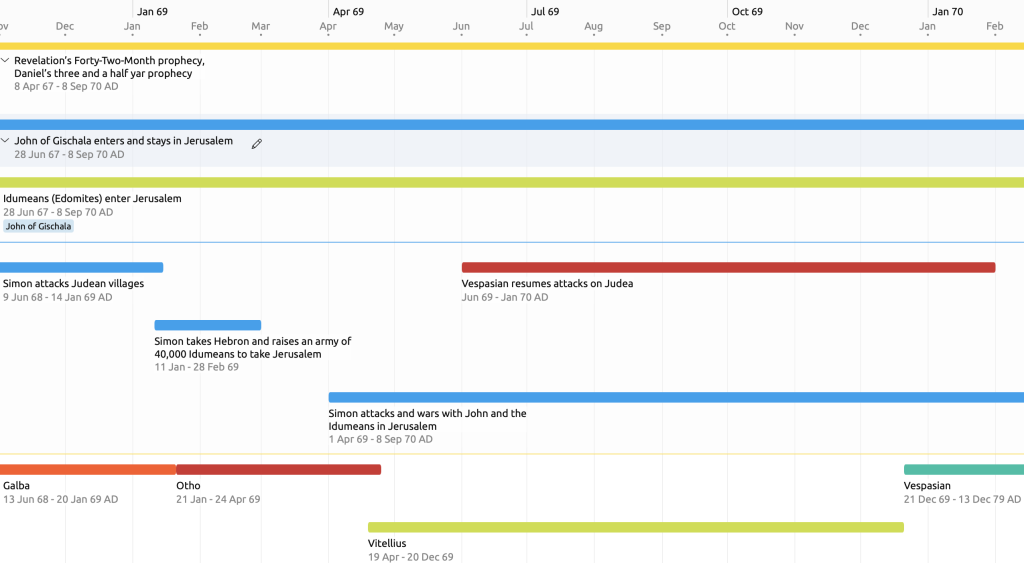
Simon ben Giora is rapidly gaining power. He has just captured Hebron from the Idumeans and forced their army to join him. Simon publicly proclaimed himself to be the Messiah. He now commands an army of 40,000 men and is preparing to attack Jerusalem. The priesthood, disheartened by the bloodshed caused by John of Gischala and the Idumeans under his command, secretly opened the city gates to allow Simon and his Idumean forces into Jerusalem.
C. Vespasian
As the civil war rages, Vespasian sends his men to Rome, who proclaim him Emperor on July 3, 69 CE. Twenty-four months into the forty-two-month prophecy, Vespasian restarts the campaign against Judea. Vitellius continues to reign until his murder on December 20, 69 CE.
Vespasian then returns to Rome for his inauguration and sends his son, Titus, to complete the conquest of Judea.
| Josephus’ Reference | Macedonian Date | Roman Calendar | Hebrew Calendar | Historic Event by the Romans | Historic Events by the Jews |
| 69 CE | |||||
| 4.529 | Titus hears of Galba’s murder | Simon forces the Idumean army to join him. | |||
| 4.546 | January 15 | Shevat 4 | Galba killed and Otho proclaimed Emperor | ||
| 4.557 | Simon conquers Idumea and compels their men to join his army | ||||
| 4.566 | |||||
| 4.577 | Xanthicus | April | Nisan | Simon and the Idumeans take Jerusalem with 40,000 men | |
| 4.545-8, 580 | Xanthicus 16 | April 16 | Iyyar 6 | Otho commits suicide | |
| Xanthicus 19 | April 19 | Iyyar 9 | Vitellius becomes Emperor. | ||
| 4.550 | Daiseus 5 | June 5 | Sivan 27 | Vespasian restarts his campaign against Judea. | |
| 4.605 Tacitus 2.79 | Panamos 3 | July 3 | Tammuz 26 | Vespasian was proclaimed Emperor by his men. | |
| 4.654 | Dec 20 | Tevet 18 | Vitellius is killed. | ||
| 4.658 Tacitus, 4.372 | Dec 21 | Tevet 19 | Vespasian becomes Emperor. |
6. Summary of Forty-Two-Month Prophecy
- The forty-two-month prophecy of Revelation began in April 67 and concluded in September 70 CE with the capture of the city.
- Forty-two months, in fulfilment of the prophecy, must be calculated using the Hebrew calendar, because in the Gregorian or Julian calendar it amounts to only forty-one months.
- The Gentiles trampled the city and the temple court throughout the entire forty-two-month prophetic period.
- The Antichrist initiated the Great Tribulation but died only 14 months into the prophesied 42-month period.
- His death delayed the capture of the city, ensuring that all the prophecies (forty-two-month, three and a half years, 1290, and 1335-day prophecies) could be fulfilled to the day and month.
In the next lesson, we will look at the culmination of the forty-two-month prophecy, 70 CE.
April 70 CE will also be the start of the five-month prophecy of Revelation.
© Use by Permission Awakening Impact Ministries / Dr Neville Westerbeek van Eerten D.Miss, 2026