


1. What Are Daniel’s 1,335 Days?
Daniel’s 1335-day prophecy concludes with a promise: “Blessed is he who waits, and comes to the one thousand three hundred and thirty-five days” (Daniel 12:12, NKJV).
What was this promised blessing? This lesson examines the relationship between Daniel’s 1,290 and 1,335 days and the events following Jerusalem’s destruction in 70 CE. We trace the captives’ journey towards Antioch and consider the blessing in relation to deliverance and faith in Jesus Christ. We distinguish the calculated dates and their prophetic interpretation from events Josephus explicitly records.
Blessed is he who waits, and comes to the one thousand three hundred and thirty-five days.
Daniel 12:12
The angel identifies 1,290 days in Daniel 12:11 before extending the period by another 45 days. Although Daniel receives the precise duration, the angel does not explicitly identify the blessing awaiting those who reach its conclusion.
The promise follows Daniel’s description of a time of unparalleled distress, during which the power of the holy people would be completely shattered (Daniel 12:1,7). Jesus subsequently connects Daniel’s prophecy with the Great Tribulation that would overtake Jerusalem and Judea (Matthew 24:15-22).
In this first-century interpretation, Jerusalem’s destruction in 70 CE marks the culmination of this unprecedented judgment. However, Daniel’s prophecy continues for another 50 days before reaching the 1,290th day. A further 45 days lead to the promised blessing on the 1,335th day.
The central question therefore concerns the nature of this blessing. Did Daniel anticipate merely the preservation of physical life, or did the prophecy point toward a greater spiritual blessing associated with the continuing reign of Christ?
This lesson examines the historical events following Jerusalem’s destruction and considers whether the promised blessing marks the beginning of the Millennium in December 70 CE.
A. The Prophetic Context
This is the eleventh lesson in our study of the Great Tribulation, which unfolded between 66 and 73 CE. Our preceding lessons examined the historical fulfilment of Daniel’s prophecies and their relationship to the Book of Revelation.
We examined Daniel’s Seventy Weeks, the 2,300 days, the forty-two months of Jerusalem’s trampling, and the five-month prophecy culminating in Jerusalem’s destruction on 8 September 70 CE. We also investigated the signs recorded by Josephus, the Roman armies as the abomination of desolation, and the remarkable correspondence between biblical prophecy and first-century history.
However, Daniel’s final prophecy extends beyond Jerusalem’s destruction. He identifies 1,290 days, then announces a blessing for those who endure until the 1,335th day.
What happened during those additional 45 days, and what blessing did God promise to those who survived?
2. Understanding Daniel’s 1,290 and 1,335 Days
Daniel’s final prophecy extends beyond the three-and-a-half years associated with Jerusalem’s destruction. In Daniel 12:11-12, the angel declares that these events will conclude when the power of the holy people has been completely shattered.
Then I heard the man clothed in linen, who was above the waters of the river, when he held up his right hand and his left hand to heaven, and swore by Him who lives forever, that it shall be for a time, times, and half a time; and when the power of the holy people has been completely shattered, all these things shall be finished.
Daniel 12:7 (NKJV)
The forty-two months of Revelation correspond to this three-and-a-half-year period. However, Daniel introduces two additional periods: 1,290 days and 1,335 days.
In our established chronology, the prophetic period begins on 15 Nisan 67 CE (18 April), during Passover. Daniel’s 1,290 days extend 30 days beyond the conventional 1,260-day period. He then adds another 45 days, bringing the total to 1,335 days.
Those additional 45 days introduce an extraordinary promise of blessing to those who endure.
A. The Hebrew Wording
And from the time that the daily sacrifice is taken away, and the abomination of desolation is set up, there shall be one thousand two hundred and ninety days. Blessed is he who waits, and comes to the one thousand three hundred and thirty-five days.
Daniel 12:11 (NKJV)
The original Hebrew provides important details for interpreting this prophecy. The opening expression, u-me’et, means “and from the time.” The Hebrew text therefore establishes a temporal relationship between the removal of the daily sacrifice, the abomination of desolation, and the 1,290 days.1
The NKJV supplies the words “there shall be” to render the Hebrew sentence in natural English. These words do not appear as a separate verb in the original text, but they accurately convey its grammatical construction.
The prophecy identifies a 1,290-day period associated with the removal of the daily sacrifice and the establishment of the abomination of desolation. We understand these events as belonging to the period described, rather than being separated by exactly 1,290 days. This interpretation must account for the Hebrew expression “and from the time”, which anchors the count to the events described. Verse 12 then promises a blessing to those who wait and reach the 1,335 days.
B. The Army of God
In our lesson Introduction to the Great Tribulation, we established that Jesus identified the Roman armies as the fulfilment of Daniel’s abomination of desolation. Luke provides the clearest explanation of Jesus’ warning.
But when you see Jerusalem surrounded by armies, then know that its desolation is near.
Luke 21:20 (NKJV)
The Roman army, comprising four legions during the final siege, advanced against Jerusalem, devastating the land like a swarm of locusts. Joel provides a striking illustration of an army acting as God’s instrument of judgment.
”So I will restore to you the years that the swarming locust has eaten,
Joel 2:25 (NKJV)
The crawling locust,
The consuming locust,
And the chewing locust,
My great army, which I sent among you.
Although Joel originally describes the devastation caused by locusts, his imagery illustrates how God can employ destructive forces to accomplish His purposes.
In our interpretation, God appointed the Roman armies to execute His judgment upon Jerusalem. Their campaign ended daily Temple sacrifices and culminated in the city’s destruction in 70 CE.
Daniel’s 1,290-day prophecy places these events within an appointed period extending beyond Jerusalem’s fall, preparing us for the promised blessing at the conclusion of 1,335 days.
C. Ordained Desolation
The time for the daily sacrifice to be taken away, and the abomination of desolation is set up, shall be one thousand two hundred and ninety days.
Daniel 12:11 (NKJV)
In our interpretation, God appointed a period of 1,290 days during which the Roman armies would bring about the cessation of the daily sacrifices and Jerusalem’s desolation. Verse 12 then promises a blessing to those who endure until the 1,335th day, another 45 days beyond the 1,290. The destruction of Jerusalem was therefore not an unforeseen catastrophe but the fulfilment of God’s prophetic judgment.
D. Start of the 1290-Day Prophecy
To establish the chronology of Daniel’s 1,290-day and 1,335-day prophecies, we begin on 15 Nisan 67 CE (18 April, Julian calendar), the same date used in our Forty-Two-Month Prophecy lesson. Using our established Hebrew calendar reconstruction, the first three years total 1,092 days. The variation in their lengths reflects the Hebrew lunisolar calendar, which incorporates additional months in leap years.
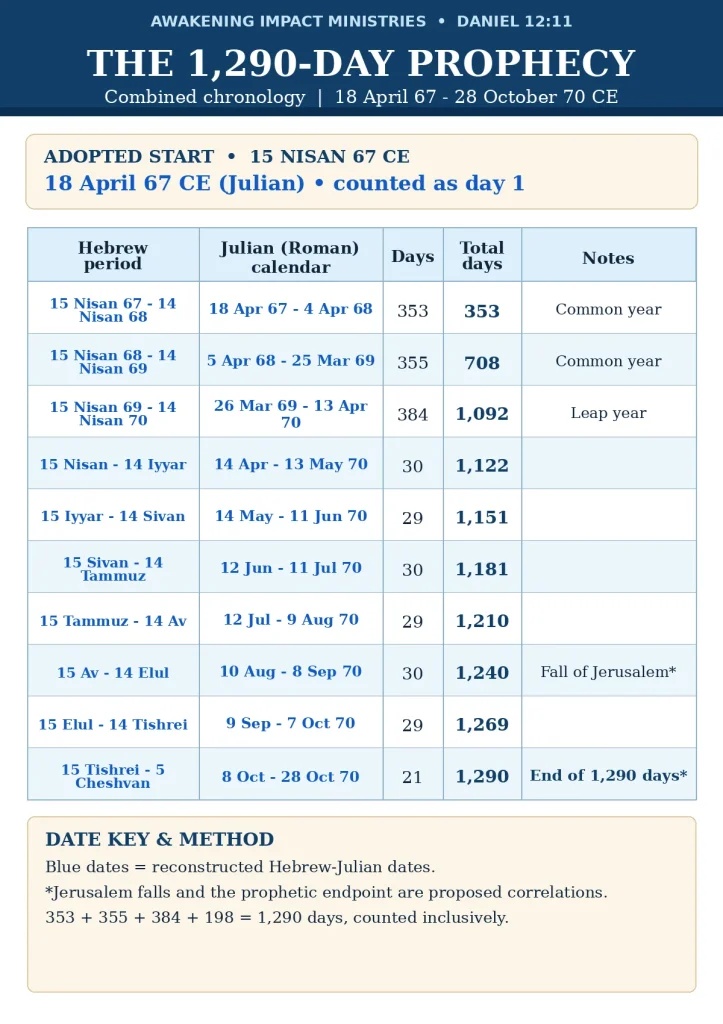
This brings us to 14 Nisan 70 CE, immediately before Passover, when Titus was preparing his final siege of Jerusalem.
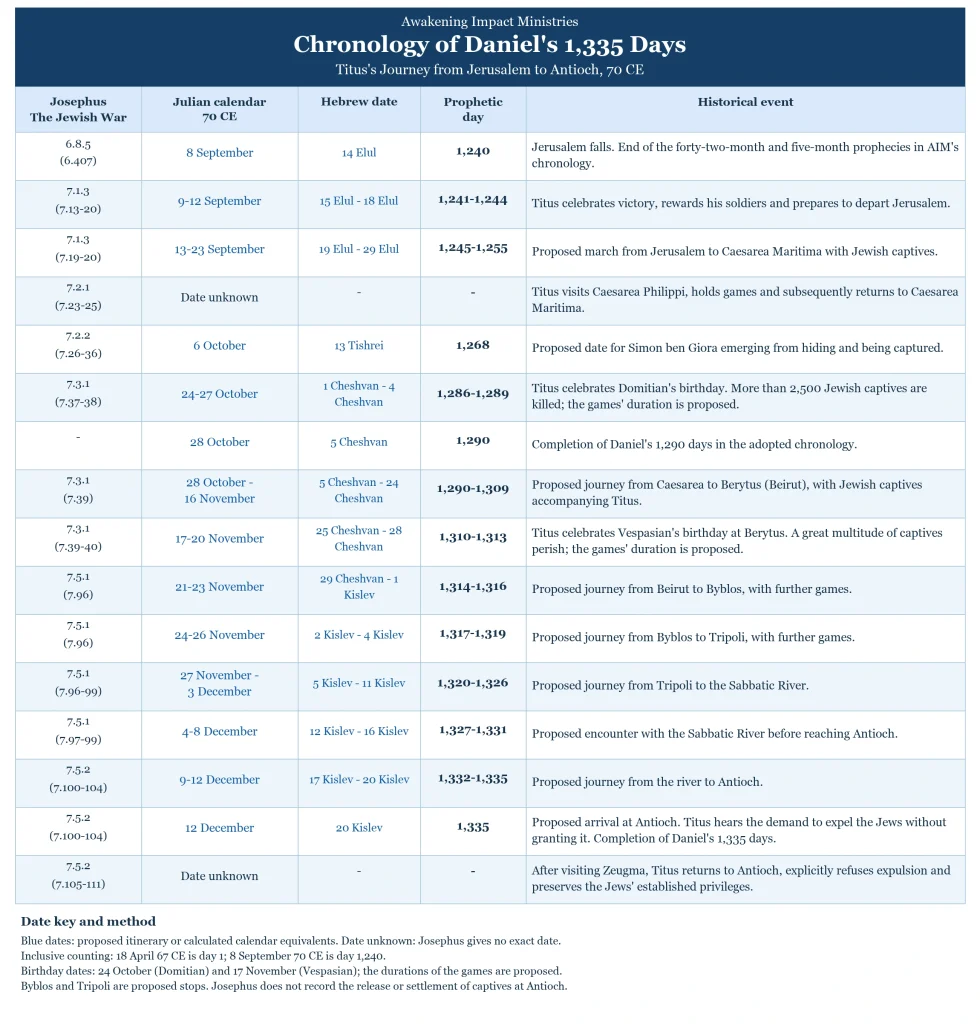
The next table continues the calculation through the destruction of Jerusalem and beyond, identifying the conclusion of Daniel’s 1,290-day and 1,335-day periods.
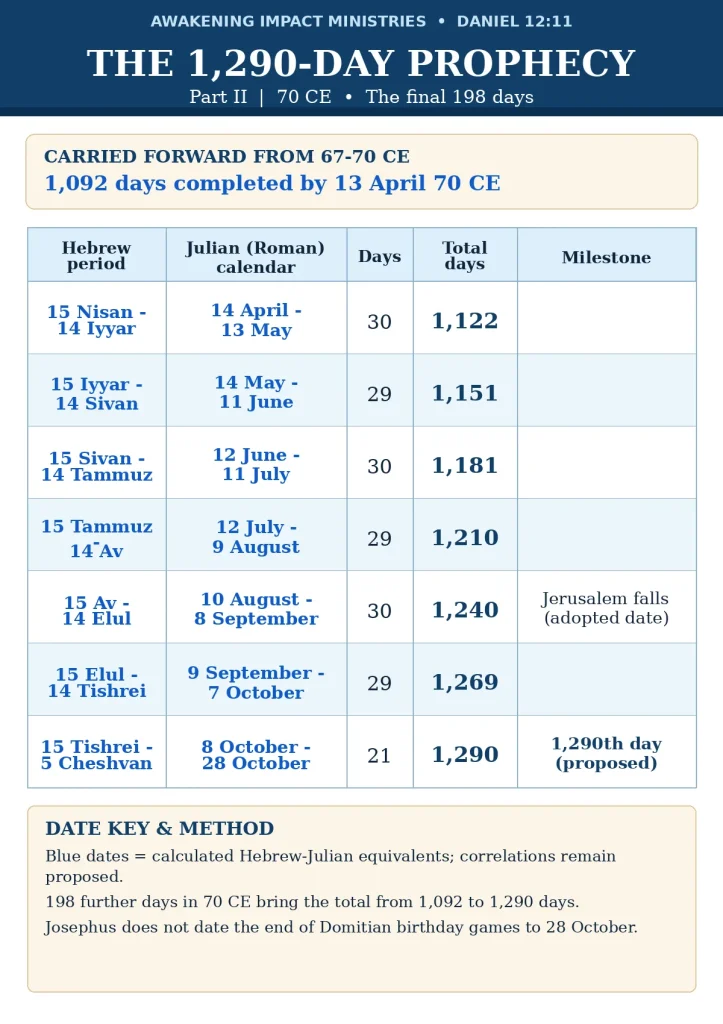
Within this chronology, Jerusalem fell on 8 September 70 CE, the 1,240th day. Jerusalem’s fall on day 1,240 left another 50 days until the 1,290th day on 28 October.
A further 45 days brought the prophecy to its conclusion on 12 December 70 CE.
These dates use inclusive counting, with 18 April 67 CE designated as the first day. Why did Daniel extend his prophecy beyond Jerusalem’s destruction? What occurred during those additional 95 days, and why did God promise a blessing specifically to those who endured until the 1,335th day? To answer these questions, we must follow Titus and the surviving Jewish captives after Jerusalem’s fall.
3. After Jerusalem’s Fall: Titus and the Captives at Caesarea
Following Jerusalem’s destruction on 8 September 70 CE, Titus began the next stage of his campaign. Although the city lay in ruins, the suffering of the surviving Jewish captives continued. Their journey through Caesarea and the cities of Syria provides the historical setting for the final 95 days of Daniel’s 1,335-day prophecy.
We will follow Josephus’s account of these events and examine their relationship to Daniel’s promised blessing.
A. Roman Celebrations
Following Jerusalem’s fall, Titus rewarded his soldiers with promotions, gold ornaments, silver, and other spoils of war. He celebrated the Roman victory with sacrifices and feasting, spending three days with his senior commanders.
Titus left Legio X Fretensis to garrison Jerusalem. He transferred Legio XII Fulminata, which had suffered a humiliating defeat under Cestius Gallus in 66 CE, from its Syrian station to Melitene near the Euphrates. Two other legions accompanied him to Caesarea Maritima.
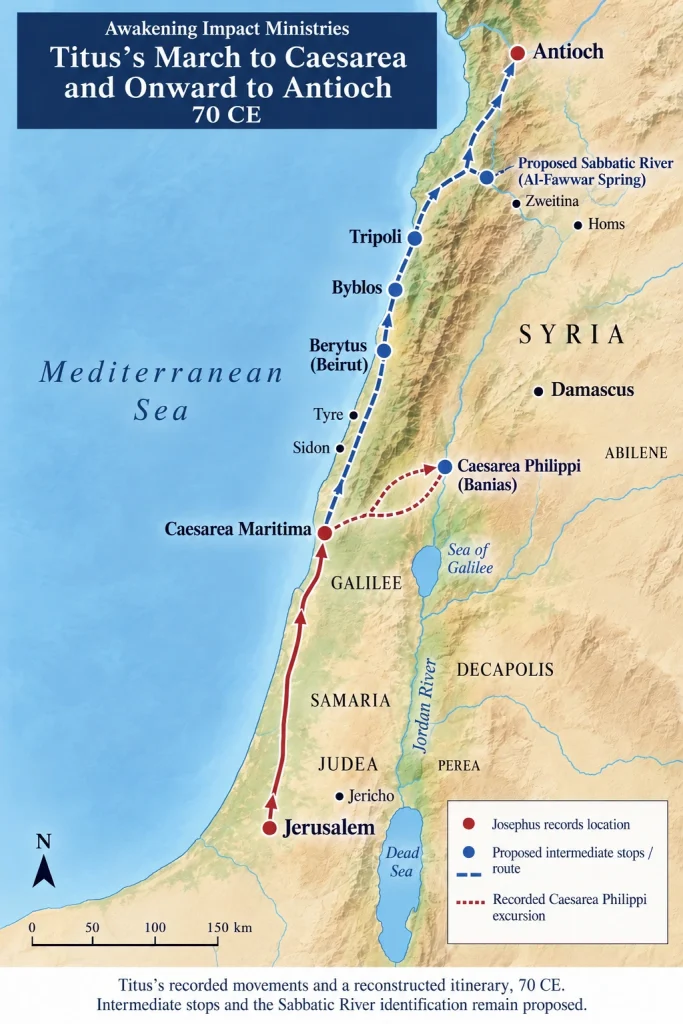
Titus then departed Jerusalem for Caesarea, taking the surviving Jewish captives and the spoils of war. Unable to sail to Rome because winter was approaching, he ordered the captives detained at Caesarea, where they suffered further.2
B. March to Caesarea
Josephus records that 1.1 million Jews perished during the siege of Jerusalem, while 97,000 were taken captive throughout the entire Jewish-Roman War. After Jerusalem’s fall, Titus ordered the captives separated by fate. Those under seventeen were sold into slavery, while many older prisoners were sent to the Egyptian mines or condemned to die in Roman games. Josephus records that another 11,000 died from starvation while awaiting their fate.3
Titus then marched approximately 120 km from Jerusalem to Caesarea Maritima, taking Jewish captives with him. We estimate that the journey took around twelve days, considering the prisoners’ severe malnutrition, disease, and exhaustion. A further 1,000 deaths during the march is our estimate; Josephus supplies neither a death toll nor a journey duration.4
The Romans had good reason to keep the surviving captives alive. They could sell them into slavery or use them in the spectacles celebrating Rome’s victory. Upon reaching Caesarea, Titus ordered the captives detained while he prepared for the next stage of his journey.
C. Domitian Birthday Games
On 24 October 70 CE, Titus celebrated his younger brother Domitian’s birthday with elaborate public games at Caesarea. Josephus records that more than 2,500 Jewish captives were killed. Some were thrown to wild beasts, others were burned alive, while still others were forced to fight one another to the death. The Romans considered even these horrific executions insufficient punishment for the Jewish rebellion.
These celebrations occurred near the conclusion of Daniel’s 1,290-day prophecy, which our chronology places on 28 October 70 CE. Although Josephus does not specify when the games ended, their timing provides a possible historical connection with Daniel’s prophecy. From 28 October, the surviving captives faced another 45 days before the promised blessing on the 1,335th day.5
D. Simon ben Giora
Following Jerusalem’s fall, Simon ben Giora and his closest followers retreated into underground passages beneath the city. Accompanied by stonemasons carrying excavation tools, they attempted to tunnel beyond the Roman defences and escape. However, their progress was slow, and their provisions ran out.
Realising that escape was impossible, Simon dressed in a white tunic and purple cloak, symbolising royal authority, and dramatically emerged from beneath the ruins of the Temple. He hoped to astonish the Roman soldiers, but Terentius Rufus, the Roman commander, arrested him and reported his capture to Titus. Simon was subsequently taken in chains to Caesarea, where Titus ordered him held for his triumphal procession in Rome.6
Simon and John of Gischala, together with 700 specially selected Jewish captives, were eventually transported to Italy. During the Roman triumph in 71 CE, Simon was publicly humiliated and executed, while John received life imprisonment. Thus ended the ambitions of Jerusalem’s two principal rival leaders.7
E. Inside the Minds of the Jewish Captives
IImagine the surviving Jewish captives reflecting upon the destruction of Jerusalem. On 8 September 70 CE (14 Elul), they had witnessed the devastation of their city, the destruction of the Temple, and the collapse of the Jewish nation’s religious and political authority.
Within our prophetic interpretation, these events marked the fulfilment of three interconnected prophecies: the forty-two months of Revelation, the three-and-a-half years of Daniel, and the five-month prophecy of Revelation, which began on 15 Nisan 70 CE.
Those familiar with Daniel’s prophecies may have recalled his warning that the power of the holy people would be completely shattered (Daniel 12:7). Jewish believers in Jesus could also have recognised the fulfilment of His warnings concerning Jerusalem’s destruction.
Yet Daniel’s prophecy did not end with Jerusalem’s fall. The 1,290 days extended another 50 days beyond 8 September, while the promised blessing awaited those who endured until the 1,335th day.
For any captives who understood this prophetic chronology, the question was no longer whether Jerusalem would fall, but whether they would survive long enough to receive Daniel’s promised blessing.
F. Syncretist Jewish Captives
After Legio XII Fulminata’s defeat in November 66 CE, most Christians had a chance to flee Jerusalem, as Jesus had warned. However, some Jewish Christians may have remained, particularly those who continued to observe the Mosaic Law and Jewish festivals.
These believers had accepted Jesus as the Messiah but may not have fully understood that His death and resurrection had established the New Covenant, replacing the obligations of the Mosaic Law. Paul had already addressed this confusion.
Having wiped out the handwriting of requirements that were against us, which were contrary to us. And He has taken it out of the way, having nailed it to the cross.
Colossians 2:14 (NKJV)
For Jewish Christians who survived Jerusalem’s destruction, the loss of the Temple and its sacrificial system would have confronted them with the reality that Christ had fulfilled the requirements of the Old Covenant.
They may also have recalled the three extraordinary signs Josephus recorded around Passover, which our chronology places in 67 CE:
- A heifer being brought for sacrifice gave birth to a lamb inside the Temple.
- The massive eastern gate of the inner Temple opened by itself at midnight.
- A brilliant light illuminated the altar and Temple for about thirty minutes, starting around 3 am.
Josephus records that the religious authorities interpreted these signs as warnings of the Temple’s approaching destruction.8
G. End of the Last Days
Jesus foretold that Jerusalem’s destruction would occur within the generation that heard His warning (Matthew 24:34). In our chronology, its fall on 8 September 70 CE marked the conclusion of the Last Days associated with the Old Covenant, approximately forty years after Jesus’ prophecy.
Jewish Christians among the surviving captives may have recalled Peter’s sermon at Pentecost, when he declared that Joel’s prophecy marked the beginning of the Last Days.
But this is what was spoken by the prophet Joel:
Acts 2:16-20 (NKJV)
‘And it shall come to pass in the last days, says God,
That I will pour out of My Spirit on all flesh;
Your sons and your daughters shall prophesy,
Your young men shall see visions,
Your old men shall dream dreams.
And on My menservants and on My maidservants
I will pour out My Spirit in those days;
And they shall prophesy.
I will show wonders in heaven above
And signs in the earth beneath:
Blood and fire and vapour of smoke.
The sun shall be turned into darkness,
And the moon into blood,
Before the coming of the great and awesome day of the LORD.
H. Blood, Fire, and the Heavenly Signs of 70 CE
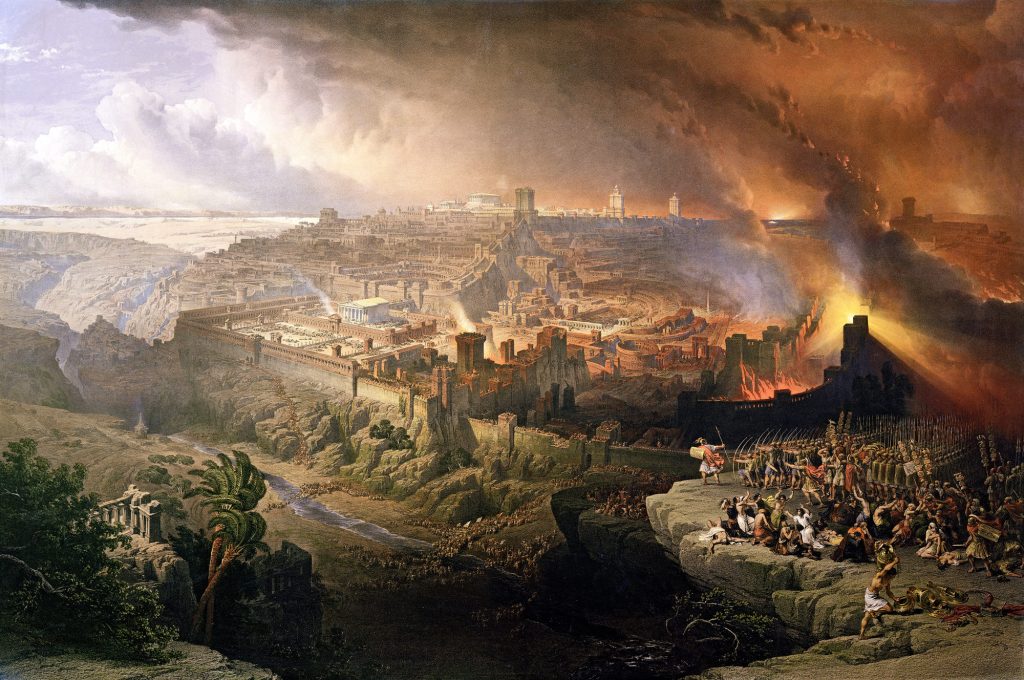
Josephus describes the Temple engulfed in flames amid extraordinary bloodshed, with fire appearing to consume the entire city. The resulting smoke could have darkened the sunlight and made the moon appear reddish.9
Remarkably, NASA confirms that penumbral lunar eclipses occurred on 14 April and 9 September 70 CE (Julian calendar), corresponding closely with the beginning of Titus’s final siege and Jerusalem’s fall. Although genuine astronomical events, neither produced a visible blood moon over Jerusalem. The April eclipse reached maximum after moonset, while the September eclipse was too weak to be perceptible. Nevertheless, these eclipses occurred at significant moments in our prophetic chronology.10
Jerusalem’s destruction fulfilled Joel’s warning concerning the great and awesome day of the Lord. These first-century events remain relevant to Christians today. Rather than searching for modern blood moons as pointers to future prophetic fulfilment, we should recognise how the events surrounding Jerusalem’s destruction illuminate the fulfilment of Jesus’ warnings and the certainty of God’s prophetic Word.
The Last Days of the Old Covenant had ended, although the Gentile era continued. These historical events remind us that God faithfully fulfils His promises, including His promise of blessing to those who endure. Daniel’s 1,335-day prophecy therefore directs our attention beyond Jerusalem’s destruction to the salvation and blessing awaiting those who remained faithful.
I. Salvation
In our lesson on salvation, we established that the biblical meaning of salvation extends beyond being born again. Depending on the context, it can also describe physical deliverance from danger, persecution, or death.
Peter concluded his quotation from Joel with a promise that offered hope amid the coming judgment upon Jerusalem.
And it shall come to pass
Acts 2:21 (NKJV)
That whoever calls on the name of the LORD
Shall be saved.
Peter’s sermon called the Jews to recognise Jesus as their Messiah and receive forgiveness of sins. He also warned them to save themselves from that perverse generation (Acts 2:40). His warning anticipated the judgment that would overtake Jerusalem in 70 CE.
Those Christians who obeyed Jesus’ warning to flee Jerusalem escaped its destruction. However, any Jewish Christians who remained among the captives still faced persecution, enslavement, and possible execution.
For these survivors, Daniel’s promise of blessing after 1,335 days offered extraordinary hope. We understand this blessing to encompass both physical deliverance and the opportunity to receive salvation through Jesus Christ. For Jewish Christians, survival offered an opportunity to embrace the freedom of the New Covenant. For other captives, it offered an opportunity to hear the gospel and believe in Christ.
The promise of salvation therefore leads directly to the necessity of repentance.
J. Repentance
In the topic on repentance, we established that the Greek word metanoia means a change of mind that leads to a change in direction. Peter called the Jews to reconsider their understanding of the Messiah, abandon their rejection of Jesus Christ, and embrace the New Covenant.
Then Peter said to them, “Repent, and let every one of you be baptized in the name of Jesus Christ for the remission of sins; and you shall receive the gift of the Holy Spirit.
Acts 2:38 (NKJV)
Jewish Christians among the captives may also have recalled the extraordinary sign Josephus recorded at Pentecost, which our chronology places in 67 CE. The priests experienced an earthquake, heard a great noise, and then heard what sounded like a multitude declaring, “Let us remove hence.”11
This remarkable event parallels John’s description of heavenly judgment in Revelation.
Then the angel took the censer, filled it with fire from the altar, and threw it to the earth. And there were noises (Gk: Voices), thunderings, lightnings, and an earthquake.
Revelation 8:5 (NKJV)
The Greek word phōnai, translated “noises” in the NKJV, can also mean “voices.” Within our interpretation, the events Josephus recorded at Pentecost signalled God’s impending departure from the Temple and the judgment that would follow.
For the surviving Jewish captives, repentance meant more than acknowledging Jerusalem’s destruction. They needed to recognise Jesus as their Messiah and place their faith in Him rather than in the religious system that had rejected Him.
K. Repentance From Syncretism
Syncretism was already established among Jewish Christians during the apostolic era. Many accepted Jesus as their Messiah while continuing to observe the Mosaic Law, including circumcision, Temple rituals, and Jewish festivals. Luke confirms that thousands of Jewish believers remained committed to the Law.
And when they heard it, they glorified the Lord. And they said to him, ‘You see, brother, how many myriads of Jews there are who have believed, and they are all zealous for the law.’
Act 21:20 (NKJV)
The controversy extended beyond Jewish Christians. Some believers insisted that Gentile converts also had to observe the Mosaic Law (Acts 15:1, 5). Paul vigorously opposed any attempt to combine justification through Christ with obedience to the Law.
You have become estranged from Christ, you who attempt to be justified by law; you have fallen from grace.
Galatians 5:4 (NKJV)
This blending of Old Covenant obligations with faith in Jesus Christ constituted syncretism within our New Covenant understanding. Although Christ had fulfilled the Law through His death and resurrection, many Jewish Christians continued practising its requirements.
Some of these believers may have remained in Jerusalem and subsequently endured captivity following its destruction. The loss of the Temple and sacrificial system forced them to abandon dependence on the Old Covenant and embrace the sufficiency of Christ’s sacrifice.
Their repentance required more than acknowledging Jesus as Messiah. They needed to recognise that the New Covenant had replaced the Old and that Jesus Christ alone brought righteousness and salvation.
L. Temple Sacrifices
The destruction of Jerusalem brought an end to the official Temple sacrificial system. Josephus records that the daily sacrifice ceased on 17 Tammuz 70 CE because there were insufficient men to offer it.12 The Temple’s subsequent destruction removed the centre of Jewish sacrificial worship.
Nevertheless, some Jews sought to preserve the sacrificial system. The Mishnah records that sacrifices could be offered even without a Temple building, suggesting that Jewish authorities still regarded the sacred site as suitable for sacrifice. 13 Whether sacrifices actually resumed among Jerusalem’s ruins immediately after 70 CE remains uncertain.14
For Jewish Christians who survived Jerusalem’s destruction, the loss of the Temple presented a profound theological challenge. They needed to recognise that Jesus Christ had fulfilled the sacrificial requirements of the Old Covenant through His death on the cross.
For by one offering He has perfected forever those who are being sanctified.”
Hebrews 10:14 (NKJV)
The promised blessing of Daniel’s 1,335 days therefore involved more than physical survival. Within our interpretation, those who endured could experience deliverance and embrace the salvation available through Christ alone, leaving behind their dependence upon the Mosaic sacrificial system.
4. The Final 45 Days: From Caesarea towards Antioch
Following the birthday celebrations for Domitian at Caesarea, Titus continued northwards towards Syria, taking Jewish captives with him. Josephus records that Titus stopped at Berytus (Beirut), where further captives perished during celebrations honouring Emperor Vespasian. He subsequently travelled through other Syrian cities, displaying the surviving prisoners as evidence of Rome’s victory over the Jewish nation.15
A. Inside the Minds of the Christian Captives
Imagine the Jewish Christians who may have survived the destruction of Jerusalem and the deadly games at Caesarea. They had witnessed the fulfilment of Jesus’ warning concerning the Temple and the devastation of their nation. Yet their suffering continued, and their survival remained uncertain.
Within our prophetic chronology, they had reached the 1,290th day on 28 October 70 CE. Only another 45 days remained before Daniel’s promised blessing on the 1,335th day.
Those familiar with Daniel’s prophecy may have encouraged one another to endure, praying for deliverance and reflecting upon God’s promise. Some may have shared their faith in Jesus Christ with fellow Jewish captives, explaining how His prophecies concerning Jerusalem had been fulfilled.
Although we cannot establish what these prisoners knew or discussed, their circumstances provide a compelling setting for Daniel’s promise:
Blessed is he who waits, and comes to the one thousand three hundred and thirty-five days.”
Daniel 12:12 (NKJV)
The question remained whether they would survive the remaining 45 days and experience the promised blessing.
B. Northwards March
After Domitian’s birthday games at Caesarea, Titus continued north along the Mediterranean coast toward Berytus (Beirut), taking the surviving Jewish captives with him. Josephus records that Titus subsequently held further games at Berytus, where many more prisoners were killed.16
For the captives, the journey offered little assurance of survival. They had survived Jerusalem’s destruction and the executions at Caesarea, but further suffering awaited them.
Within our chronology, the 1,290-day prophecy had concluded on 28 October 70 CE, leaving another 45 days until Daniel’s promised blessing. Any Jewish Christians familiar with this prophecy may have counted the remaining days, encouraging one another to endure despite the uncertainty surrounding their fate.
Their journey towards Antioch would become central to our understanding of the 1,335-day blessing.
C. Beirut (Berytus)
Upon reaching Berytus (modern Beirut), an important Roman colony in Phoenicia, Titus stayed longer to celebrate Emperor Vespasian’s birthday on 17 November 70 CE.
A great multitude of the captives were here destroyed after the same manner as before.
Josephus, The Jewish War 7.3.1 (7.39-40).
The prisoners faced the same horrific executions that had claimed more than 2,500 lives during Domitian’s birthday celebrations. Josephus does not specify how many died at Berytus, but his description confirms that the slaughter continued as Titus travelled northwards.
Within our chronology, Vespasian’s birthday fell on the 1,310th day of Daniel’s prophecy17, leaving only 25 days until the promised blessing on 12 December 70 CE. However, Josephus does not establish the games’ precise dates.
Winter prevented Titus from sailing to Italy, so he continued his journey through Syria. For the surviving Jewish captives, the additional 45 days beyond Daniel’s 1,290-day prophecy remained a period of extraordinary suffering and uncertainty.
D. Cities of Syria
After leaving Berytus, Titus continued northwards through Syria, holding further public games in the cities along his route. Josephus records that he used Jewish captives in these spectacles to demonstrate Rome’s victory and the destruction of the Jewish nation.
Now Titus Caesar tarried some time at Berytus, as we told you before. He thence removed, and exhibited magnificent shows in all those cities of Syria through which he went, and made use of the captive Jews as public instances of the destruction of that nation. He then saw a river as he went along, of such a nature as deserves to be recorded in history;
Josephus, The Wars of the Jews 7.96
The coastal cities of Byblos and Tripoli lay along the probable route towards the Sabbatic River and Antioch. Although Josephus does not identify these cities individually, they are reasonable candidates for the additional games he describes.
For the surviving Jewish captives, each stop brought the possibility of further executions. Within our reconstructed chronology, these events occurred during the final 45 days of Daniel’s 1,335-day prophecy, as the prisoners continued their journey towards Antioch.
Josephus next records that Titus encountered an extraordinary river between Arcea and Raphanea. This remarkable event introduces the next stage of our investigation into the promised blessing.
5. The Sabbatic River and Titus’s Response to the Jews
after which days it runs on the seventh day as it did before,
Josephus, The Jewish War 7.5.1 (7.97-99)
Josephus explains that the river’s remarkable seven-day cycle gave it the name Sabbatic River, reflecting the sacred seventh day of the Jewish week. The river is commonly identified with the intermittent Al-Fawwar spring near Zweitina in Syria. The nineteenth-century explorer Claude Reignier Conder identified this spring with Josephus’s Sabbatic River, while the Syrian tourism organisation ComeSyria continues to recognise this historical association. Today, the spring erupts at irregular intervals rather than following the seven-day cycle Josephus described.18
Frequent earthquakes plausibly explain this change. In 115 CE, just 45 years after Jerusalem’s destruction, a devastating earthquake struck Antioch and surrounding areas. Cassius Dio specifically records that the earthquake caused new springs to emerge while existing streams disappeared.19 The region experienced further destructive earthquakes, including the great earthquake of 1822. Conder reported that this earthquake interrupted the spring’s flow for an entire year. By the nineteenth century, its eruptions occurred at irregular intervals, generally between four and seven days. 20 These historical accounts suggest that successive earthquakes may have altered the underground limestone channels supplying the spring, potentially explaining why its flow no longer follows the seven-day cycle Josephus described.
Titus’s encounter becomes particularly compelling when we examine what Josephus records immediately afterwards. Until then, Titus had celebrated Rome’s victory by executing thousands of Jewish captives in public games. Yet following his encounter with this remarkable river, Josephus describes a striking contrast in Titus’s treatment of the Jews.
When the inhabitants of Antioch approached Titus and demanded that he expel their Jewish population, he listened but did not grant their request. After travelling to Zeugma and returning to Antioch, he explicitly rejected their demands. He also refused to revoke the Jews’ established privileges, allowing them to remain in the city.21
Could the Sabbatic River have influenced Titus’s attitude towards the Jews? Having witnessed an extraordinary natural phenomenon tied to their sacred Sabbath, Titus may have reflected on the people whose nation he had just destroyed. Josephus does not explicitly identify the river as the cause of his decision, but the sequence of events makes this a compelling possibility.
Within our prophetic interpretation, God may have used this remarkable encounter to influence Titus towards mercy rather than further persecution. The same Roman commander who had brought judgment upon Jerusalem now became the instrument through which Antioch’s established Jewish community received protection.
This extraordinary contrast links the Sabbatic River to Daniel’s promised blessing at the conclusion of 1,335 days.
A. Population of Antioch Visits Titus
As Titus approached Antioch, news of his arrival spread throughout the city. Josephus records that large crowds of men, women, and children travelled more than thirty furlongs beyond the city walls to welcome the victorious Roman commander. They lined both sides of the road, stretched out their hands, and greeted him with enthusiastic acclamations.
However, their welcome concealed a disturbing demand. The inhabitants repeatedly urged Titus to expel the Jewish population from Antioch. Josephus records:
They also, among all the acclamations they made to him, besought him all the way they went to eject the Jews out of their city;
Josephus, The Wars of the Jews 7:101-103
Antioch’s Jewish community had already suffered considerable persecution during the Jewish-Roman War. False accusations, violence, and attempts to suppress their religious practices had placed them in constant danger. Now the city’s inhabitants sought to exploit Rome’s victory over Jerusalem to remove them permanently.
Remarkably, Titus did not agree to their demands. Instead, he listened without granting their request. His response contrasts sharply with the treatment of Jewish captives during the preceding months.
Having recently encountered the extraordinary Sabbatic River, Titus now faced a decision concerning the survival of Antioch’s Jewish community. In our interpretation, the timing suggests that God had already begun influencing the Roman commander toward the mercy associated with Daniel’s promised blessing.
B. The 1,335-Day Blessing
Titus’s response to the inhabitants of Antioch was extraordinary. Despite having destroyed Jerusalem and executed thousands of Jewish captives, he refused to expel the Jews from Antioch. When the citizens renewed their demands following his return from Zeugma, Titus reminded them that the Jews’ homeland had been destroyed and that no other country would receive them. Josephus records Titus’s refusal:
“How can this be done, since that country of theirs, whither the Jews must be obliged then to retire, is destroyed.”
Josephus, The Jewish War 7.5.2 (7.100-111).
The Antiochians then demanded the removal of the bronze tablets recording the Jews’ established privileges. Titus again refused, allowing the Jewish community to retain its rights and remain in the city.
These events occurred around 12 December 70 CE, the 1,335th day of Daniel’s prophecy. The timing suggests a remarkable connection between Daniel’s promised blessing and Titus’s unexpected protection of the Jews.
The surviving Jewish captives travelling with Titus may also have benefited from his decision, potentially finding refuge among Antioch’s established Jewish population. Josephus does not establish how many captives accompanied Titus to Antioch, nor does he record their release or settlement there.
This possibility becomes even more significant when we consider Antioch’s established Christian community. Those who survived could have encountered the gospel in the very city where believers were first called Christians (Acts 11:26).
Daniel’s blessing involved both deliverance from death and the opportunity to receive salvation through Jesus Christ. After 1,335 days of suffering and judgment, God may have provided a remarkable opportunity for the surviving Jews to embrace the New Covenant.
6. Antioch and the Promised 1,335-Day Blessing
Antioch, the capital of Roman Syria, was one of the most important cities in the eastern Roman Empire. It had a substantial Jewish community and had already become a major centre of Christianity through the apostles’ ministry.
Antioch’s significance to Daniel’s 1,335-day prophecy becomes clear when we consider Titus’s extraordinary response to its inhabitants. Having celebrated Rome’s victory through the execution of thousands of Jewish captives, Titus refused the demands of Antioch’s citizens to expel their Jewish population. He subsequently reaffirmed his decision and preserved their established privileges.
Within our proposed chronology, these events occurred around the completion of Daniel’s 1,335 days in December 70 CE. Josephus confirms Titus’s protection of Antioch’s existing Jewish community, though he does not give a precise date or record the settlement of Jerusalem’s surviving captives there.
Antioch’s significance, however, extended beyond physical preservation. The city already possessed a flourishing Christian community where Jews and Gentiles heard the gospel of Jesus Christ. This provides the foundation for understanding how Daniel’s promised blessing could encompass both deliverance from destruction and the opportunity for salvation through faith in Christ.
The following sections examine Antioch’s apostolic foundations, Ignatius’s subsequent ministry, and the historical developments following Jerusalem’s destruction.
A. Antioch and Daniel’s Seventy-Weeks Prophecy
In our lesson on Daniel’s Seventy-Weeks Prophecy, we identified the persecution following Stephen’s martyrdom as beginning around 17 September 33 CE (Julian), 4 Tishri. This persecution scattered believers from Jerusalem, spreading the gospel into Phoenicia, Cyprus and Antioch (Acts 11:19). What began as persecution became an opportunity for the expansion of Christ’s Church.
But some of them were men from Cyprus and Cyrene, who, when they had come to Antioch, spoke to the Hellenists, preaching the Lord Jesus. And the hand of the Lord was with them, and a great number believed and turned to the Lord.
Acts 11:20-21 (NKJV)
Antioch subsequently became a major centre of Christian teaching and missionary activity. Barnabas brought Saul from Tarsus, and together they taught the growing congregation.
Then Barnabas departed for Tarsus to seek Saul. And when he had found him, he brought him to Antioch. Thus, for a whole year, they assembled with the church and taught a great many people. And the disciples were first called Christians in Antioch.
Acts 11:25-26 (NKJV)
By approximately 36 CE, Antioch was emerging as an important centre for spreading the gospel beyond Jerusalem. God was preparing a city that would influence Christian theology and missionary activity for centuries.
This development becomes particularly significant when we return to December 70 CE. Josephus records that Titus refused to expel Antioch’s established Jewish community, preserving their existing privileges.
We propose that Jewish survivors from Jerusalem may also have found refuge in Antioch, where they could encounter the gospel and receive salvation through Jesus Christ. Josephus does not document their settlement or conversion, but Antioch’s established Christian community makes this a reasonable possibility to examine.
Within our interpretation, Daniel’s promised blessing at 1,335 days therefore extends beyond physical preservation. Those who endured Jerusalem’s destruction could find something greater than deliverance from Rome: eternal life through faith in Jesus Christ.
“How can this be done, since that country of theirs, whither the Jews must be obliged then to retire, is destroyed, and no place will receive them besides?”
Titus: Josephus, The Wars of the Jews 7:103-110
The blessing of being welcomed and receiving salvation by believing in Jesus Christ is the 1335-day blessing as Daniel had prophesied.
B. Ignatius
Ignatius of Antioch was an influential early Church leader, traditionally associated with the Apostle John. Eusebius identifies him as the second bishop of Antioch, succeeding Evodius, although church tradition also places Peter before them. During the reign of Emperor Trajan (98-117 CE), Roman authorities sent Ignatius to Rome, where he suffered martyrdom.22
While travelling to Rome, Ignatius wrote letters to several Christian congregations. These provide valuable evidence of the theological challenges confronting the early Church, particularly the continued influence of Jewish religious practices among believers.
In his letter to the Magnesians, Ignatius strongly opposed combining faith in Jesus Christ with dependence upon the Mosaic Law:
It is absurd to profess Christ Jesus, and to Judaize. For Christianity did not embrace Judaism, but Judaism Christianity, that so every tongue which believes might be gathered together to God.
The Epistle of Ignatius to the Magnesians 10
Ignatius argued that Christianity fulfilled what Judaism anticipated rather than remaining subject to its former covenantal requirements. His warning reflects the same concern Paul expressed about believers returning to the Law as the basis of their righteousness (Galatians 5:4).23
This evidence is significant for our proposed interpretation of Daniel’s 1,335-day blessing. Antioch had become a major Christian centre where Jewish believers could learn to distinguish the New Covenant from the Old.
Ignatius’s letters show that the Church continued to confront this issue in the next generation. They do not establish that Jerusalem’s captives settled in Antioch after 70 CE, but they provide historical context for the spiritual transformation we propose accompanied Daniel’s promised blessing.
C. Return to Jerusalem
Although Antioch became an important centre of Christianity, Jerusalem retained its significance for Jews who continued to observe the Mosaic Law. Some may have returned to Jerusalem after its destruction in 70 CE, although no surviving historical account shows that Jewish captives taken to Antioch later returned there.
The destruction of the Temple did not necessarily end Jewish belief in the legitimacy of sacrifices. The Mishnah records Rabbi Joshua’s teaching that “sacrifices may be offered even though there is no Temple.” 24
This demonstrates that Jewish religious authorities recognised the possibility of offering sacrifices without a standing Temple. However, it does not establish that regular sacrifices resumed in Jerusalem after 70 CE.
Approximately a century after Jesus prophesied Jerusalem’s destruction, another Jewish rebellion challenged Roman authority. Under Simon bar Kokhba, the Jews revolted against Rome between 132 and 135 CE.
Cassius Dio records that Emperor Hadrian established the Roman city of Aelia Capitolina on the site of Jerusalem and introduced the worship of Jupiter at the former Temple site.25 Following the rebellion’s defeat, Hadrian prohibited Jews from entering Jerusalem, as Eusebius records.26
Thus, Jerusalem experienced another devastating judgement, while Antioch continued to provide an important centre for proclaiming the New Covenant.
In our interpretation of Daniel’s 1,335-day prophecy, this contrast matters. The promised blessing was not ultimately found in returning to Jerusalem, restoring Temple sacrifices or preserving the Old Covenant. It was found in Jesus Christ, through whom Jews and Gentiles alike could receive eternal life.
Daniel’s promised blessing points beyond Jerusalem’s destruction to deliverance and life in Christ. Our separate lesson on the Millennium examines its relationship to the Millennium and illustrates it in the timeline accompanying Jesus’ Last Days Prophecy. Christ’s reign began at His ascension; the Millennium represents a subsequent phase of that reign, while the Final Consummation remains future.
Historical and Scholarly References
- Hebrew verification: Daniel 12:11, Westminster Leningrad Codex. ↩︎
- Josephus, The Jewish War 7.1.3 (7.13-20). ↩︎
- Josephus, The Jewish War 6.9.2-3 (6.414-420). ↩︎
- Josephus, The Jewish War 7.1.3 (7.19-20). ↩︎
- Josephus, The Jewish War 7.3.1 (7.37-38). ↩︎
- Josephus, The Jewish War 7.2.2 (7.26-36). ↩︎
- Josephus, The Jewish War 7.5.3, 7.5.6 (7.118-119, 7.153-155), 6.9.4 (6.434). ↩︎
- Josephus, The Jewish War 6.5.3 (6.290-295). ↩︎
- Josephus, The Jewish War 6.5.1 (6.271-276). ↩︎
- Espenak, Fred, and Jean Meeus, Five Millennium Catalogue of Lunar Eclipses: -1999 to +3000 (2000 BCE to 3000 CE), NASA/TP-2009-214173, NASA Goddard Space Flight Centre, 2009. ↩︎
- Josephus, The Jewish War 6.5.3 (6.299-300). ↩︎
- Josephus, The Jewish War 6.2.1 (6.93-94). ↩︎
- Mishnah, Eduyot 8.6. ↩︎
- Clark, Kenneth W., “Worship in the Jerusalem Temple after A.D. 70,” New Testament Studies 6, no. 4 (1960): 269-280. ↩︎
- Josephus, The Jewish War 7.3.1 (7.37-40); 7.5.1 (7.96). ↩︎
- Josephus, The Jewish War 7.3.1 (7.39). ↩︎
- Suetonius, The Twelve Caesars, Vespasian 2.1. ↩︎
- Josephus, The Jewish War 7.5.1 (7.97-99); Claude Reignier Conder, Heth and Moab: Explorations in Syria in 1881 and 1882 (London: Richard Bentley and Son, 1883), 54-55; ComeSyria, “Al-Fawwar Spring, Valley of the Christians.” ↩︎
- Cassius Dio, Roman History 68.24-25, particularly 68.25.6. ↩︎
- Claude Reignier Conder, Heth and Moab: Explorations in Syria in 1881 and 1882 (London: Richard Bentley and Son, 1883), 54-55; ComeSyria, “Al-Fawwar Spring, Valley of the Christians.” ↩︎
- Josephus, The Jewish War 7.5.2 (7.100-111). ↩︎
- Eusebius, Ecclesiastical History 3.22; 3.36. ↩︎
- Ignatius of Antioch, Epistle to the Magnesians 8-10, particularly 10.3. ↩︎
- Mishnah, Eduyot 8.6. ↩︎
- Cassius Dio, Roman History 69.12.1-2. ↩︎
- Eusebius, Ecclesiastical History 4.6.3-4. ↩︎
© Use by Permission Awakening Impact Ministries/ Dr Neville Westerbeek van Eerten D. Miss. BVSc. 2027